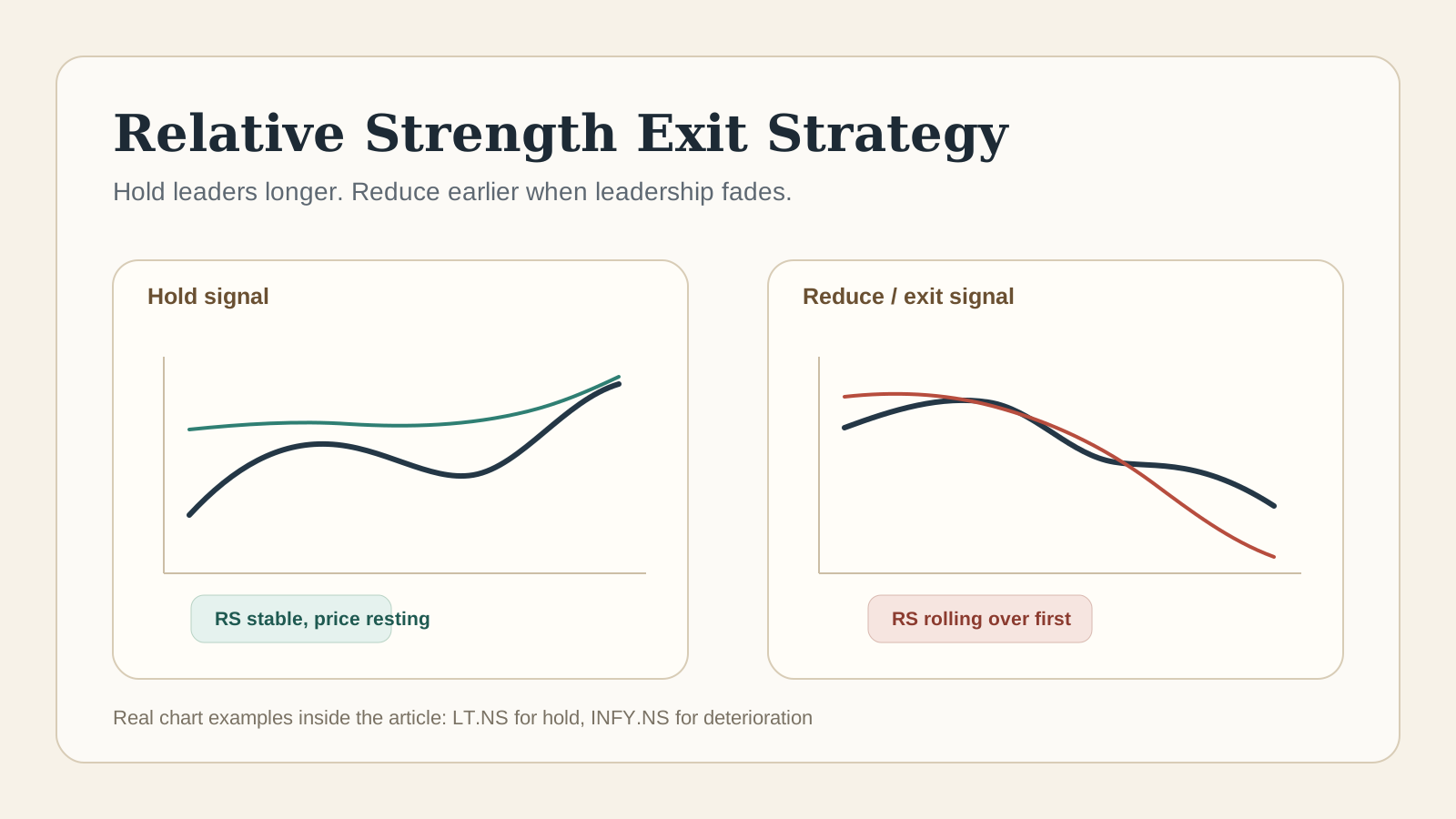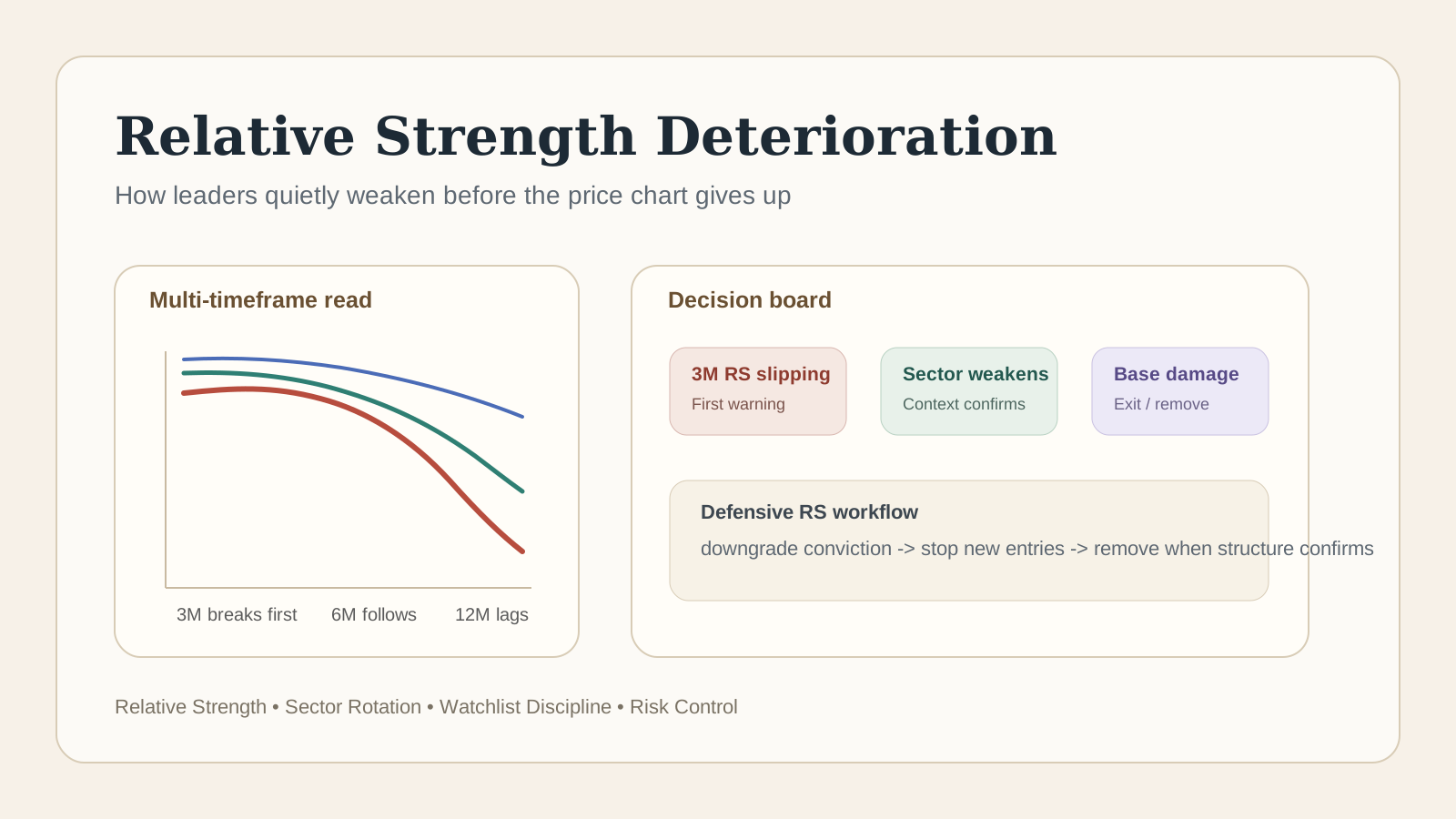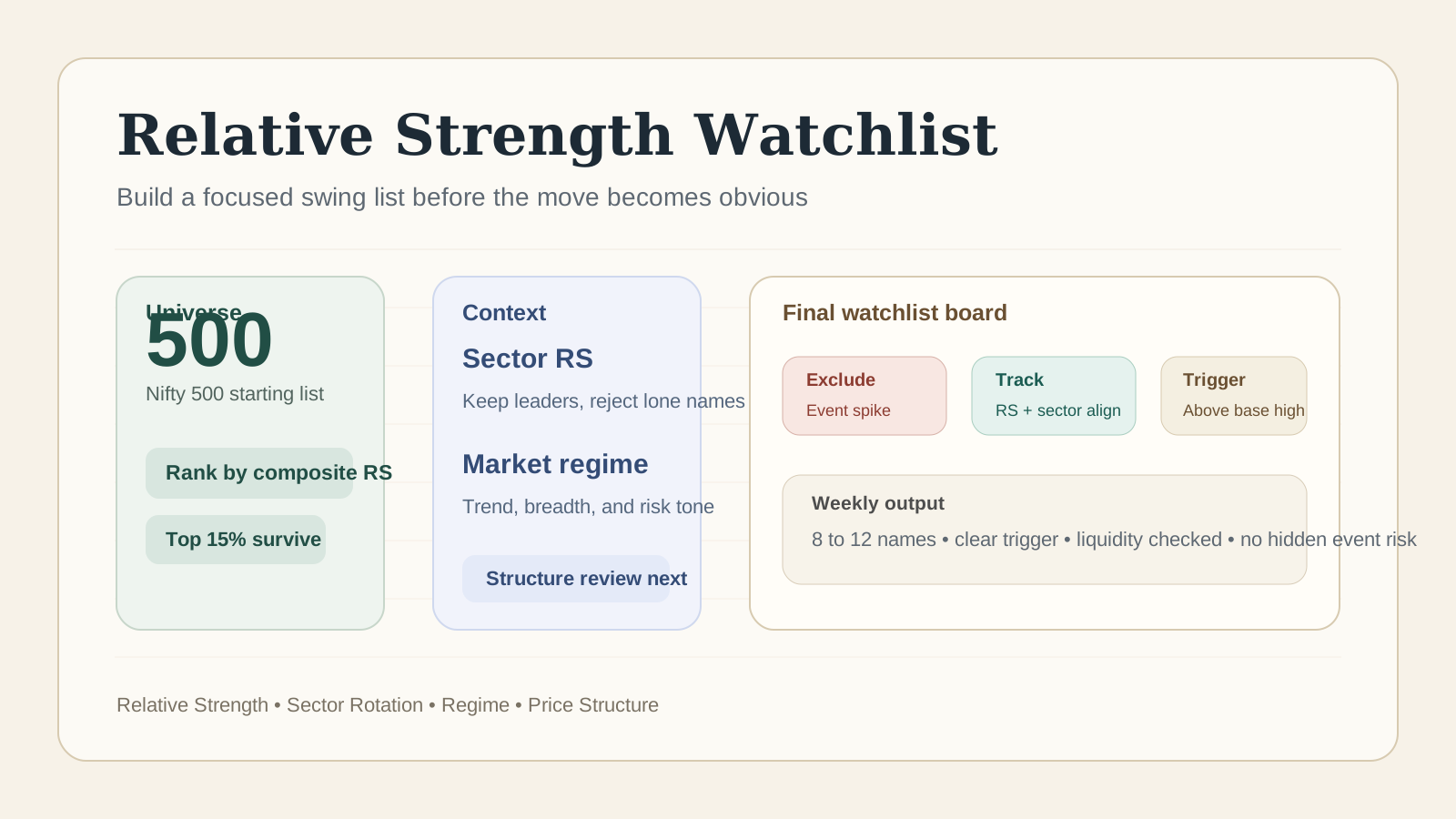
Most traders have a watchlist. Very few have a good one.
The typical watchlist is a collection of stocks accumulated over time -- names from a tip someone shared, companies from a sector that moved recently, stocks that appeared on a scanner last week and were never removed. It grows without a pruning mechanism. By the time a trader sits down to prepare for the week, they are looking at 60 to 80 names with no clear logic for why most of them are there.
The result is decision paralysis during the session, or worse, reactive decision-making -- the trader picks from the list based on what is moving that day rather than what was already identified as structurally strong. Both outcomes undermine the preparation that a watchlist is supposed to provide.
A relative strength watchlist solves this differently. Instead of accumulating names reactively, it uses RS data to narrow a large universe to a small, high-quality shortlist of names where sector context, stock-level strength, and price structure are already aligned. The entries are chosen before the move, not after it is obvious.
In practical terms, a relative strength watchlist is a weekly shortlist of stocks that have already proven their leadership versus the market and their sector, but have not yet become overcrowded breakout candidates.
This article explains how to build that kind of watchlist, step by step, from universe selection through to the final focused list you actually use each week.
Why Most Watchlists Fail Before the Week Starts
The problem is not effort. Most traders who build a watchlist do put in work over the weekend. The problem is the basis on which names are selected.
Three patterns produce bad watchlists:
Recency bias. Names that moved last week get added to next week's list. The logic is that what moved recently might move again. Sometimes it does. More often, the move has played out and the stock is now extended, consolidating with overhead resistance, or in the hands of traders who want to exit at break-even. Last week's leaders are not automatically next week's leaders.
Interest-driven selection. Traders add stocks they find interesting -- well-known companies, stocks they own personally, sectors they follow in the news. Interest and edge are unrelated. A stock can be a great company and a poor swing trading candidate simultaneously, because the price structure is poor, the RS is declining, or the sector is out of favour with institutional capital.
Scanner-driven addition without exit criteria. Stocks that appear on a scanner get added. But there is no rule for when they should be removed. The watchlist grows monotonically until it is too large to use effectively.
The fix is not adding fewer stocks randomly. It is building the list from a top-down process where each name has to earn its place by meeting defined criteria across multiple dimensions -- and where names that stop meeting those criteria are removed automatically.
What Relative Strength Adds to Watchlist Building
The foundational RS guide explains why RS is a leading indicator of institutional interest. When a stock holds up better than its benchmark during market weakness, or outperforms during market strength, the RS percentile rank climbs -- often before the price chart shows anything obvious to a pattern-recognition scanner.
For watchlist building, this property is exactly what is needed. A stock entering the top quartile of RS rankings while still in a price consolidation is a candidate worth monitoring. It has demonstrated that demand is building without the breakout yet having occurred. The setup is forming, not formed. There is still time to prepare, size correctly, and identify a specific entry trigger.
A stock that is already at 52-week highs with a 90th percentile RS and a price breakout on a high-volume session is a potential entry -- but it is also fully visible to every scanner-driven trader simultaneously. The edge, if any, is thin. The watchlist built on RS captures names one step earlier.
The stock ranking system provides the framework for scoring stocks across multiple RS timeframes. The multi-timeframe RS article explains which timeframes serve which purpose. What follows is how to apply these tools specifically to weekly watchlist construction.
Building the Watchlist: A Step-by-Step Narrowing Process
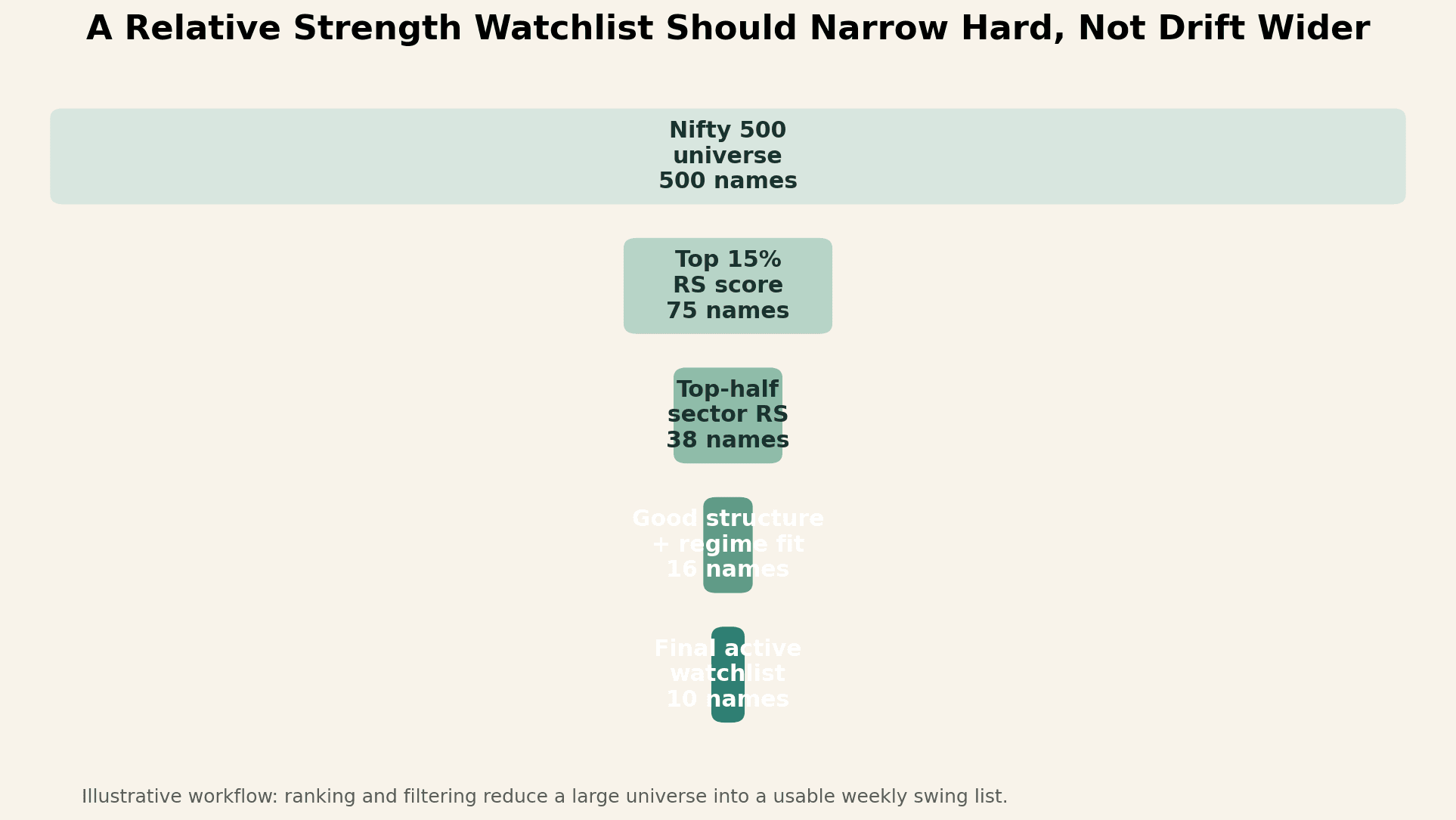
The goal is to move from several hundred potential candidates down to ten to fifteen names that deserve close attention in the coming week. Each step eliminates candidates that do not meet the criteria.
Step 1: Define the universe
Start with a defined, consistent universe rather than an open-ended one. For Indian swing traders, the Nifty 500 is a practical starting point. It covers the top 500 companies by market capitalisation on NSE, has sufficient liquidity across most constituents, and is large enough to find genuine leaders in any given week.
Avoid building a watchlist from a custom universe that shifts week to week. Consistent universe selection is what makes RS percentile rankings comparable over time.
Step 2: Rank by composite RS score
Using the weighted scoring model (40% weight on 12-month RS, 30% on 6-month RS, 30% on 3-month RS), rank every stock in the universe. Extract the top 15% by composite score. From a Nifty 500 universe, this gives approximately 75 names.
These are stocks with demonstrated, multi-timeframe outperformance. They have the institutional fingerprint described in the RS and sector rotation framework: capital has been flowing into them consistently, not sporadically.
Step 3: Filter by sector RS
Check which sectors these 75 names belong to. Rank the sectors by their own composite RS score.
Keep only stocks from sectors in the top half of sector RS rankings. This eliminates names that are holding up at the stock level but belong to sectors with net outflows at the institutional level. A stock can have strong recent RS but deteriorating sector context -- the two should point in the same direction for a swing watchlist candidate.
After this filter, the list typically narrows to 30 to 40 names.
Step 4: Check market regime
Before going further, assess the current market regime. Is the Nifty 500 in a trending phase, range-bound, or deteriorating?
If the regime is strongly trending, standard breakout and continuation setups from high-RS stocks work at historically higher rates. If the regime is choppy or range-bound, trend-following setups fail more frequently. The market regime identification framework provides the tools for this assessment.
In a choppy regime, apply tighter criteria to the remaining candidates: only the top 10% of composite RS, only the sector with the single highest RS rank, only names showing explicit consolidation or range compression rather than any trending pattern.
In a trending regime, the 30 to 40 names from Step 3 are a reasonable working list to review for price structure.
Step 5: Review price structure
This is the first time individual charts are opened. At this stage, you are not looking for interesting charts. You are looking for one specific pattern: a stock in the top RS percentiles that is currently consolidating -- building a base, compressing its trading range, showing declining volume during the rest period.
The pre-breakout structure guide covers exactly what to look for. Tight range, volume contraction, clear breakout level defined. Names that meet this structural criteria move to the shortlist. Names that are extended (already well past a base), chopping without direction, or showing poor base quality are removed.
After the structure filter, the list is typically 10 to 20 names.
Step 6: Apply liquidity and event-risk filters
Before finalising the watchlist, apply two practical filters that determine whether a name is actually tradeable in the coming week.
Liquidity check: Does the stock have sufficient average daily volume that an entry and exit can be executed at the intended prices without significant slippage? For mid-cap names in particular, a stock that looks great on RS and price structure may have average daily value traded of Rs. 2 to 5 crore -- thin enough that a meaningful position size would move the price on entry. As a working rule for NSE mid-caps, a minimum average daily value traded of Rs. 15 to 20 crore reduces this risk.
Event risk check: Are there any scheduled events in the coming week -- quarterly results, index rebalancing announcements, sector-specific policy events -- that create non-directional volatility for specific names? A stock with a perfect RS and price structure that reports results on Thursday is not a clean swing candidate if the results are a coin flip. Remove event-heavy names from the actionable list or move them to a separate "post-event" watch category.
After these filters, the final watchlist is typically 8 to 12 names. Each one has earned its place through multiple filters rather than being added reactively.
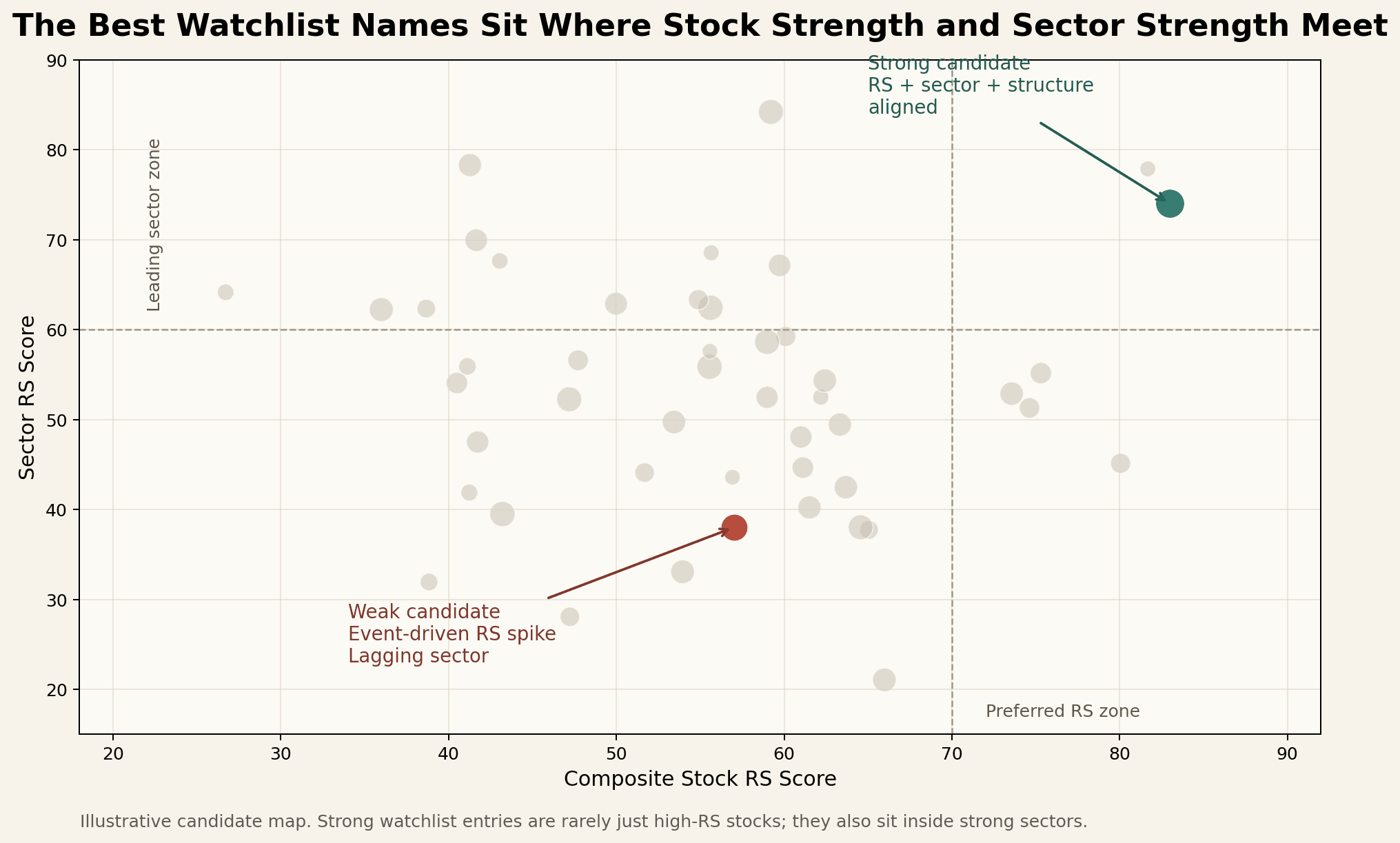
Worked Example 1: The Name That Looks Good But Should Not Be on the List
A mid-cap FMCG stock has generated news coverage after a strong quarterly result. The stock is up 14% over three months and is approaching a prior swing high.
The surface case for including it: The 3-month RS percentile is 82nd. The price is near a breakout level. Volume was strong on the initial result day. The company is well-known and the result commentary was positive.
The RS and sector reality:
- 6-month RS percentile: 54th. The stock was mediocre over the broader period; only the recent earnings spike produced the strong 3-month number.
- 12-month RS percentile: 41st. Over the full year, the stock was a below-average performer in its universe.
- Composite RS score: (0.40 × 41) + (0.30 × 54) + (0.30 × 82) = 16.4 + 16.2 + 24.6 = 57.2 -- solidly mid-table, not top-quartile.
- Sector RS: FMCG as a sector is at the 38th percentile on 6-month RS. It has been losing ground to capital goods, industrials, and banking for several months.
The structure reality: The price is extended after a 14% move in three weeks, trading above the prior resistance level that would have been the entry point. Volume during the recent move was concentrated on the result day; subsequent sessions have been lower-volume and choppy. There is no clean consolidation forming. The base has not developed.
Verdict: This name does not belong on the swing watchlist. It passes the 3-month RS filter on a single event. It fails the 6-month and 12-month filters. It fails sector RS. It fails price structure. The interest in it is recency-driven -- it moved and got coverage. A RS-based watchlist process filters it out before the chart is even opened.
Worked Example 2: The Name That Deserves to Be Watched
A mid-cap capital goods stock has been quiet for six weeks. No news, no earnings event scheduled, no unusual volume. It is not appearing on any scanner or in any coverage.
The RS data:
- 12-month RS percentile: 86th. Over the past year, the stock has been a consistent outperformer in its universe, maintaining top-quartile RS through a variety of market conditions.
- 6-month RS percentile: 79th. The strength is continuing and is not fading.
- 3-month RS percentile: 83rd. During the past three months -- including the six-week consolidation -- the stock has been quietly rising in the RS rankings. Despite price going nowhere, it has outperformed the Nifty 500 on most down days.
- Composite RS score: (0.40 × 86) + (0.30 × 79) + (0.30 × 83) = 34.4 + 23.7 + 24.9 = 83.0 -- firmly top-quartile.
Sector RS: Capital goods sector is at the 74th percentile on 6-month RS and improving. The FADE signals described in the sector rotation article are broadly present: flow is positive, acceleration is building on 3-month RS, and divergence from lagging sectors is widening.
Price structure: The stock has been in a 7% range for six weeks after a prior trending move. Volume has been declining for three consecutive weeks. The prior swing high defines a clear breakout level. The candles are narrowing in range.
Liquidity: Average daily value traded is approximately Rs. 35 crore. Sufficient for meaningful position sizes without slippage concern.
Event risk: No results due for eleven weeks. No sector-specific policy announcements flagged.
Verdict: This name belongs at the top of the watchlist. Every filter has been passed: composite RS in top-quartile, sector RS positive and accelerating, price structure coiling with volume contraction, liquidity adequate, event risk minimal. A breakout trigger is identified (above the prior swing high) and the trade can be planned specifically before the entry occurs.
The contrast with Example 1 is the point. Example 1 was interesting. Example 2 is actionable.
How Market Regime and Sector Rotation Change the Watchlist Week to Week
A watchlist is not a static document. The names on it should change as RS rankings update, sector leadership shifts, and price structures resolve or deteriorate.
In a trending market regime, the watchlist should be weighted toward breakout candidates -- names in coiling bases where the trigger is imminent. These setups have the highest probability of follow-through when the macro environment is supportive.
In a choppy or range-bound regime, the same RS-ranked names may not be appropriate for breakout entries because the broad environment is not providing the directional tailwind. In this context, either the watchlist is narrowed further to only the highest-RS, tightest-base setups, or the watchlist shifts toward range-bound strategies -- buying at support within defined ranges in high-RS names, not waiting for breakouts that are unlikely to hold.
Sector rotation is the other variable that changes the composition week to week. When a new sector begins climbing the RS rankings -- the early stages of the FADE signal described in the sector rotation piece -- it may not yet produce names with strong 12-month RS. But it will produce names with rapidly improving 3-month RS and visible institutional volume. These emerging-sector candidates can be a secondary watchlist category: lower weight, smaller initial size, with the expectation that the RS confirmation will build over the coming weeks if the rotation is genuine.
The market regime article covers how to assess regime at the start of each week. Reading regime before finalising the watchlist prevents the mistake of loading up on breakout candidates in an environment that will punish every breakout.
For Indian Traders: Practical Watchlist Considerations
The Nifty 500 mid-cap liquidity trap. The mid-cap and small-cap segments of the Nifty 500 contain many stocks that look strong on RS and price structure but trade thinly in practice. A stock with average daily value traded of Rs. 4 to 6 crore cannot support a Rs. 2,50,000 swing position without meaningful slippage on both entry and exit. Sorting candidates by average daily value traded before finalising the list, and applying a minimum threshold appropriate to the account size, prevents a technically strong setup from producing a poor actual trade.
Event-heavy weeks in India. India's market calendar has specific recurring event risks: RBI monetary policy meetings, Union Budget week, quarterly results season, and index rebalancing announcements. During heavy results seasons, every stock has a potential binary event risk within days. During these periods, the watchlist should either be built from stocks with results already behind them (and whose RS has held post-announcement) or from names whose results are at least four weeks away. Trading into a results announcement on the basis of a clean setup is speculation on the outcome, not swing trading the structure.
Sector leadership shifts and PSU names. In the Indian market, PSU sector moves can be sharp and driven by policy announcements that are difficult to anticipate. A PSU infrastructure or energy stock with strong RS can produce excellent swing trading setups -- but the regime-change risk is higher than for private sector names. During periods of active government policy action (budget cycle, election periods), PSU names may require smaller initial sizing and wider awareness of event risk.
Why some strong-looking names are not practical swing candidates. A stock at the 90th RS percentile in the Nifty 500 might have most of its trading volume in the futures segment rather than the equity cash segment. The cash equity may be relatively thinly traded, making the price structure less reliable as a trading signal and the execution more challenging. Checking the split between cash and futures volume for derivatives-heavy names prevents the mistake of entering a position that is structurally illiquid in the segment being traded.
Side-by-Side: Weak Watchlist Candidate vs Strong Watchlist Candidate
| Dimension | Weak Candidate (Example 1) | Strong Candidate (Example 2) |
|---|---|---|
| 12-month RS | 41st percentile | 86th percentile |
| 6-month RS | 54th percentile | 79th percentile |
| 3-month RS | 82nd (event-driven spike) | 83rd (sustained, improving) |
| Composite RS score | 57 -- mid-table | 83 -- top-quartile |
| Sector RS | 38th percentile (FMCG lagging) | 74th percentile (capital goods leading) |
| Price structure | Extended post-result, no base | 6-week coiling base, volume contraction |
| Liquidity | Adequate | Adequate |
| Event risk | None (but recency-driven interest) | None (clean event calendar) |
| Watchlist verdict | Exclude | Include at top of list |
Common Watchlist-Building Mistakes
Adding without removing. The watchlist grows but never shrinks. Names that had a good RS setup three weeks ago but have since broken down, extended, or shown RS deterioration should be removed. A weekly pruning step is as important as the weekly addition step.
Ignoring the sector layer. A stock with strong composite RS in a lagging sector is a lower-quality candidate than the same RS score in a leading sector. Skipping sector RS screening produces a watchlist contaminated with names that look strong individually but have no capital flow tailwind behind them.
Opening charts before screening. Looking at charts before running RS and sector filters allows confirmation bias to corrupt the process. If a chart looks interesting, the temptation is to find the RS and sector data that justifies it rather than letting the RS data determine which charts are worth looking at. The process runs filters first, charts second. Always.
Not adjusting for regime. The same watchlist process in a trending regime and a choppy regime produces setups with very different follow-through rates. The regime assessment should happen before finalising the list, not after.
Including event-risk names without flagging them. A stock can be on the watchlist during a results season as long as the event risk is explicitly noted and sizing is adjusted accordingly. What is problematic is carrying an event-risk name as a standard entry candidate without recognising that the results outcome will dominate any technical setup.
Tracking too many names. A watchlist with 40 names is not a watchlist -- it is a universe. The purpose of the filtering process is to produce a short list that can be monitored intraday without cognitive overload. Eight to twelve names is the practical maximum for most active swing traders who also have other obligations during market hours.
Weekly Watchlist-Building Checklist
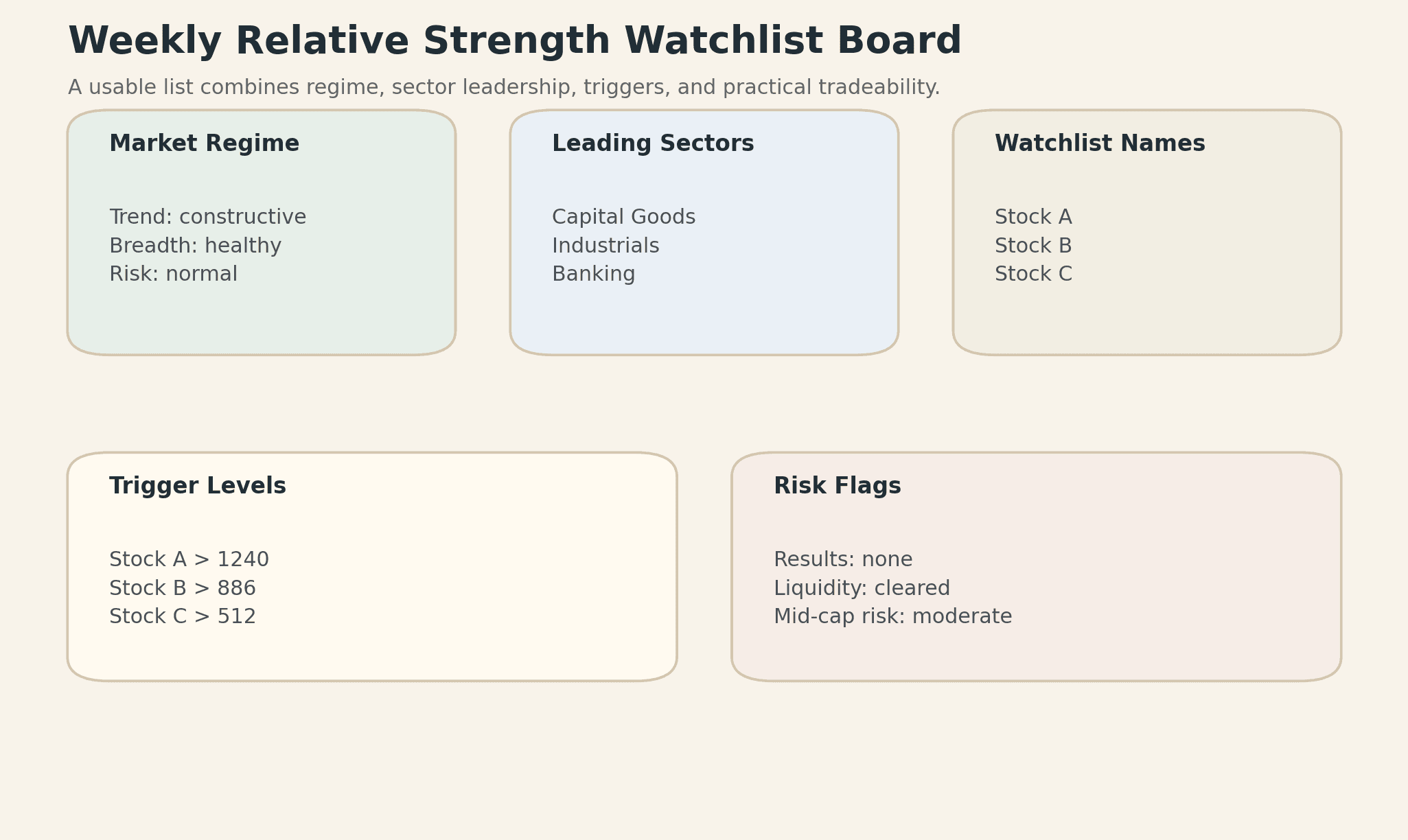
Run through this process over the weekend before each trading week. It should take 60 to 90 minutes once the workflow is established.
Universe and RS screening
- Run composite RS scoring across Nifty 500
- Extract top 15% by composite score (approximately 75 names)
- Filter to names in sectors with top-half sector RS (approximately 30 to 40 names remain)
Regime assessment
- Identify current market regime (trending, range-bound, or deteriorating)
- Adjust filtering criteria accordingly (tighter in choppy regime, standard in trending)
Price structure review
- Open charts only for the filtered 30 to 40 names
- Identify names in recognisable consolidation bases with volume contraction
- Note the specific breakout trigger level for each candidate
- Remove extended names, choppy consolidations, and poor-structure names (10 to 20 remain)
Liquidity and event-risk check
- Confirm average daily value traded meets minimum threshold for each name
- Check results calendar and sector event calendar for the coming week
- Flag or remove event-risk names
- Remove liquidity-constrained names
Final list
- Maximum 12 names on the active watchlist
- Each name has a defined trigger level, entry plan, stop level, and target
- Names that no longer meet RS or structure criteria from prior weeks are removed
Carry-forward review
- For names carried from last week: has RS held or improved during the past week?
- Has the price structure remained intact?
- Has any news or event changed the context?
- Remove anything that has deteriorated; add newly qualifying names
Key Takeaway
A watchlist built on relative strength is not a list of interesting stocks. It is a pre-screened universe of names where institutional demand, sector leadership, price structure, and market context are already aligned.
The process runs top-down: define a consistent universe, rank by composite RS, filter by sector RS, assess market regime, review price structure within the filtered set, and apply liquidity and event-risk checks. Each step eliminates candidates that do not meet the criteria. The result is a focused list of eight to twelve names where each entry has earned its place through multiple independent filters.
This process takes longer than adding names reactively. But it produces a materially different watchlist -- one where the names being watched were identified before the move, not after it became obvious. That timing difference is where the edge in swing trading preparation actually lives.
The TradInvest RS content series -- foundational RS guide, ranking system, timeframe selection, sector rotation, pre-breakout selection, price structure and context, and market regime -- provides the analytical tools this watchlist process draws on. This article is where those tools combine into a single repeatable weekly workflow.
If you want to operationalise the screening faster, the most relevant next stops are the features, Edge, and pricing pages. They show how TradInvest packages the RS ranking, sector context, and workflow pieces used in this article without changing the underlying judgment process.
Spread the good words
Give your view.
Give your view
Comments
0Use this insight inside the product
TradInvest is built to connect market context, strategy quality, and post-trade learning. Read the market with Pulse, narrow your watchlist with rotation and momentum, then review what actually worked.
Related posts
More insight tied to the same trading workflow.