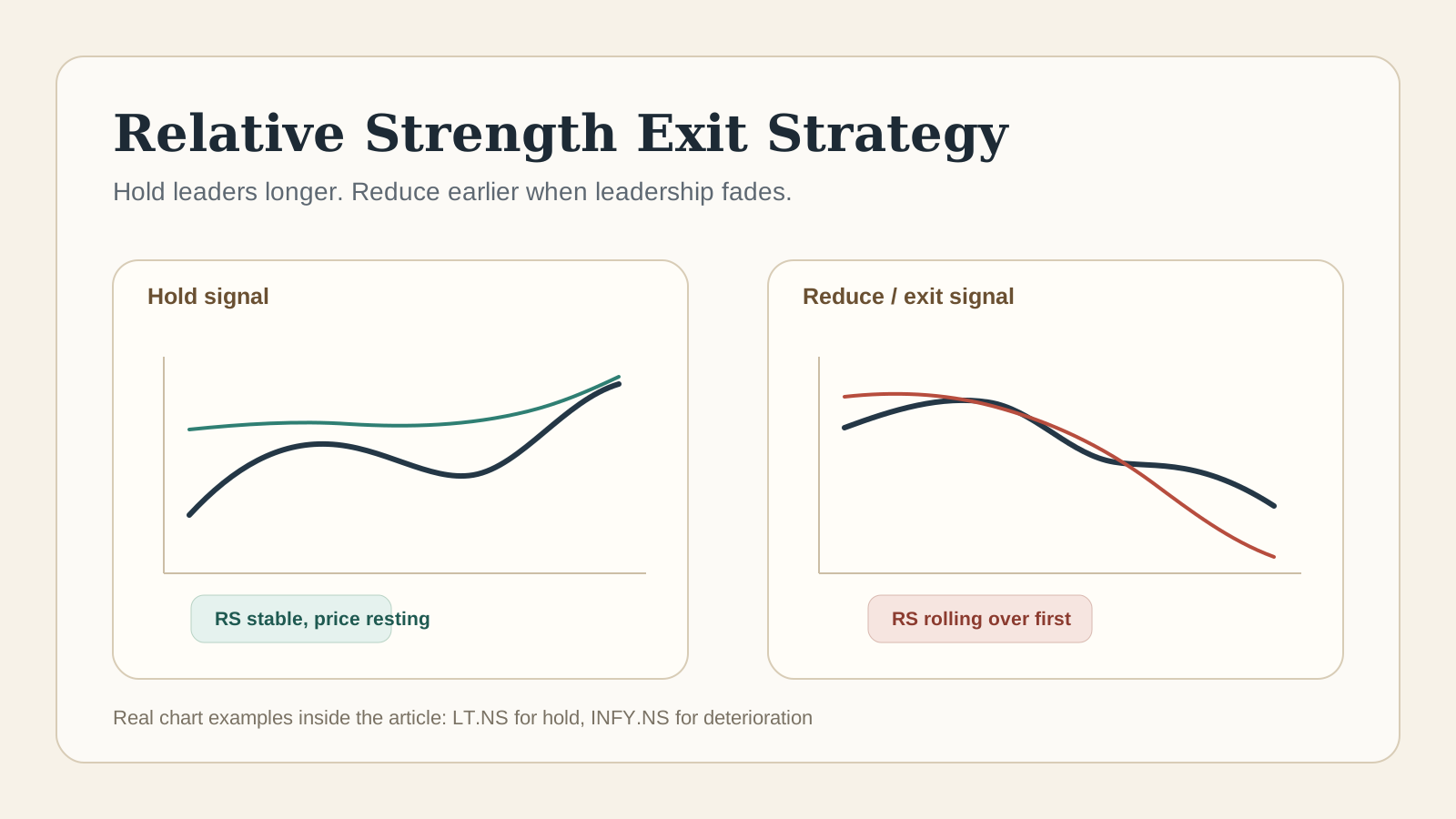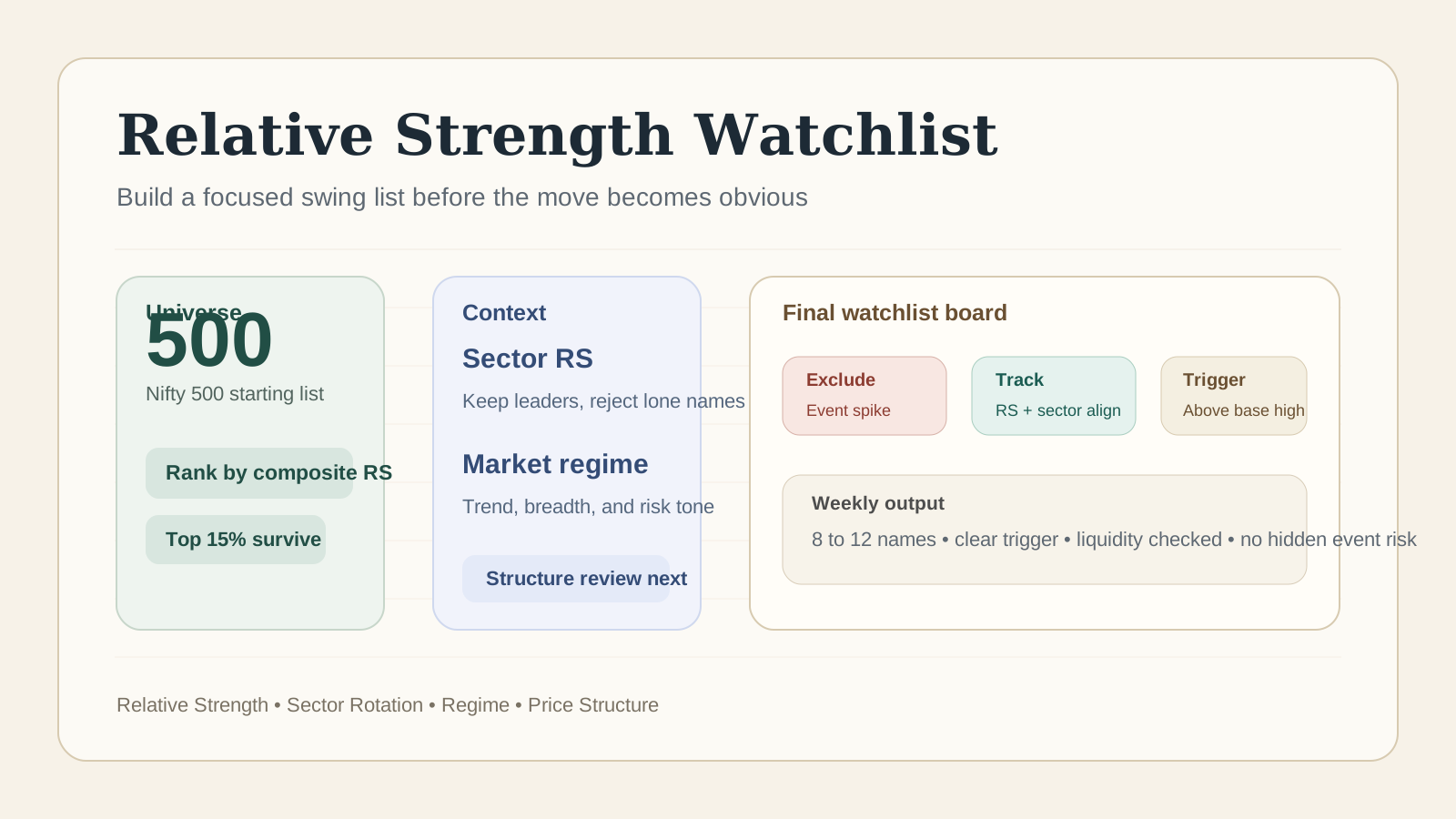
Most traders who use relative strength understand how to use it to find stocks worth buying. Fewer understand how to use it as a warning system.
The assumption underneath most RS-based selection is that a high-ranking stock stays high-ranking. Leaders persist. Strong stocks stay strong. This is true statistically, over long periods. But it is not true unconditionally. Sector leadership shifts. Market regimes change. Institutional positioning rotates. And when it does, the first signal is almost never a visible price breakdown. It is relative strength deterioration -- a quiet, multi-week process by which a stock's ranking starts slipping while its price chart still looks acceptable.
Traders who do not watch for this pattern find themselves in one of two situations. Either they are still holding a position or carrying a watchlist candidate when the price finally breaks, taking more loss than they needed to. Or they are entering a setup that looks textbook-clean but is actually late-cycle, just before the institutional distribution completes and the price falls away.
This article explains what RS deterioration looks like, how to detect it across multiple timeframes before price damage is obvious, and how it should change what you do with a stock: hold it, reduce it, remove it from the watchlist, or avoid it as a new entry.
In practical terms, relative strength deterioration is the process by which a stock stops leading its peers and benchmark weeks before the price chart shows an obvious breakdown.
Why Traders Notice Weakness Too Late
The problem is structural. Most traders evaluate stocks through their charts, and price charts have a natural lag relative to the institutional order flow that drives them.
When a fund begins reducing a large position, they do not dump it in one session. They distribute over weeks -- selling into strength, absorbing rallies, gradually reducing exposure. During this distribution phase, the price chart may look fine. The stock may still be above its moving averages, still inside a range that a technical analyst would read as a consolidation, still making the occasional higher close.
What is already changing is the relative performance. While the stock holds its range, the rest of the market keeps moving. The index makes new highs. The sector recovers from a dip and keeps climbing. The stock participates less and less. Week by week, it falls in the RS rankings -- not dramatically, but consistently.
By the time the price breakdown arrives, a trader watching only the chart sees a sudden, unexpected sell-off. A trader watching RS has seen the evidence building for weeks.
This is the practical value of multi-timeframe RS tracking as an exit and avoidance signal. Not every RS decline is a warning of a coming breakdown. But most significant breakdowns in prior market leaders are preceded by a visible pattern of RS decay.
What Relative Strength Deterioration Actually Looks Like
RS deterioration is not a single data point. It is a pattern that develops across timeframes and reveals itself in specific sequences. Four signals, appearing together or in sequence, define the deterioration pattern.
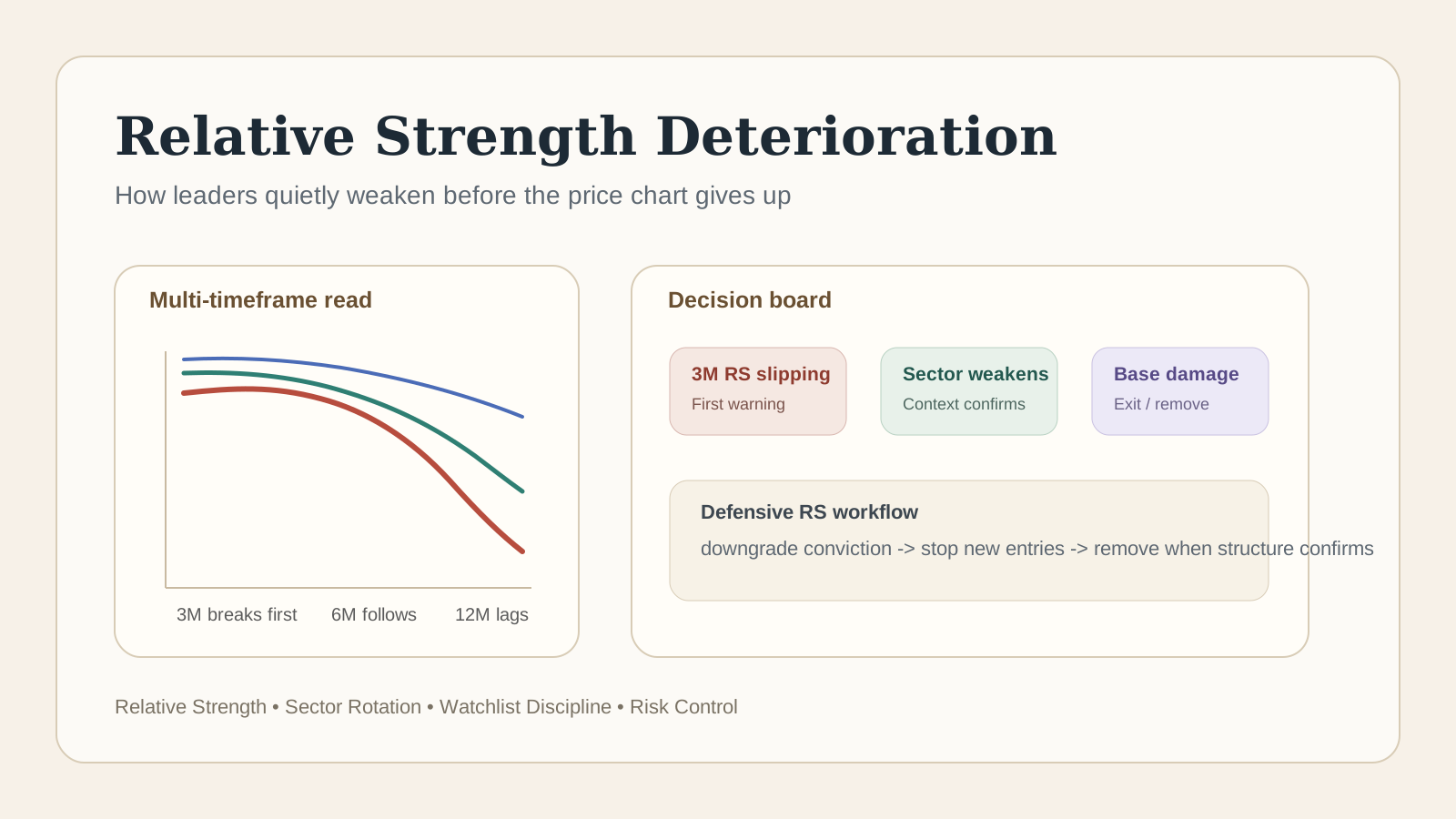
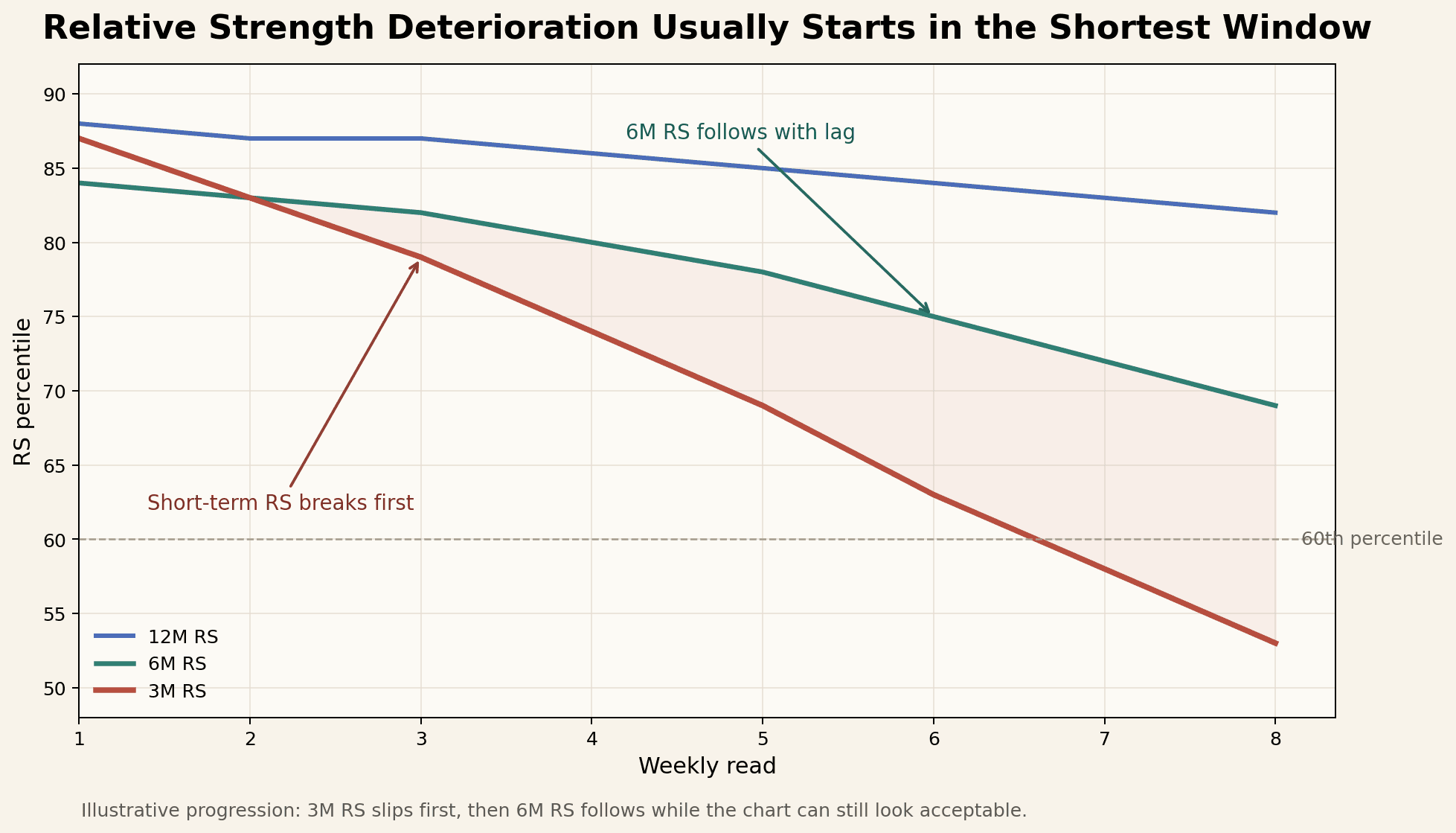
The short-term RS rank falls first. The 3-month RS percentile is the most sensitive window. It captures the most recent twelve weeks of relative performance. When institutional distribution begins, this window picks it up earliest -- the stock starts underperforming on up-market days, recovering less strongly than its peers during bounces. The 3-month rank slips from the 85th percentile to the 78th to the 71st over three to four consecutive weekly reads.
The 6-month RS follows with a lag. If the 3-month deterioration persists, the 6-month RS begins to decline a few weeks later. At this point, the deterioration has been sustained long enough to be reflected in the medium-term data. A 3-month RS decline that does not spread to 6-month RS over several weeks may be temporary -- noise from a short consolidation or a sector-specific event. Deterioration that spreads to 6-month RS is more likely to be structural.
The composite RS score crosses below a threshold. Using the weighted composite model (40% on 12-month, 30% on 6-month, 30% on 3-month), a stock that has been in the top quartile will begin its descent to mid-table. The composite score does not move dramatically in one week. It erodes. A stock that was at the 83rd composite percentile four weeks ago and is now at the 71st has dropped 12 points. That is RS deterioration worth acting on. For details on the composite scoring approach, see the RS ranking article.
The stock underperforms on both up days and down days. This is the behavioural confirmation. In a healthy leader, the stock holds up better than the market on bad days and participates fully on good days. In a deteriorating name, it starts losing ground on both types of sessions. Up days produce modest gains while peers run harder. Down days produce losses in line with or worse than the index. The stock stops leading and starts matching or lagging the market in both directions.
How Sector Context and Regime Accelerate Deterioration
A stock's RS deterioration does not happen in isolation. It is almost always accompanied by or preceded by sector-level changes that the sector rotation article covers in detail. When institutional capital begins rotating out of a sector -- when the FADE signals run in reverse, with sector RS decelerating and a new sector gaining in its place -- the individual stocks within the leaving sector face headwinds that make their own RS deterioration more likely and more durable.
Sector deterioration is the context layer. Individual stock RS deterioration is the stock-level confirmation. When both are happening simultaneously, the signal is significantly more reliable than either in isolation.
Market regime shifts provide the third layer. In a deteriorating or choppy market regime, even stocks with historically strong RS can see their rankings slip simply because the environment is hostile to trend continuation. This is a context-dependent deterioration, not necessarily a structural one. The market regime framework is essential for distinguishing between: a stock deteriorating because the regime has changed broadly (lower signal), and a stock deteriorating while its sector is still healthy and the regime is still supportive (higher signal).
The most meaningful deterioration -- the kind most worth acting on -- is when individual stock RS is declining, sector RS is weakening, and the regime remains broadly neutral or positive. In that combination, the stock is failing on its own terms, not being dragged down by macro conditions. That is where genuine distribution is most likely.
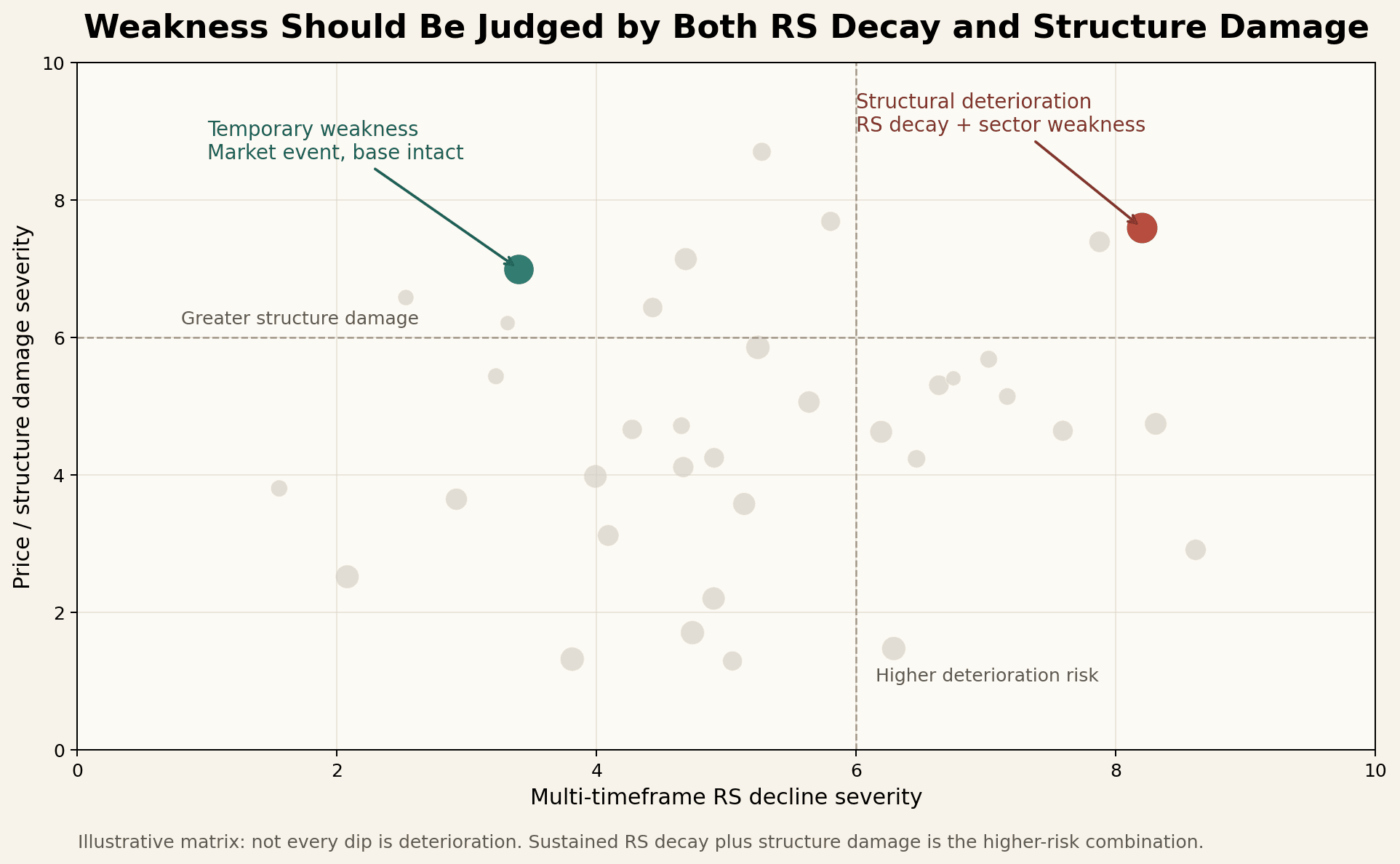
Worked Example 1: RS Weakens While Price Still Looks Acceptable
A large-cap IT stock has been a consistent RS leader for eighteen months. It built a long base in the first half of that period, broke out cleanly, trended for several months, and is now approximately 35% above its breakout level. The chart shows the stock consolidating just below a prior swing high, with the 50-day moving average well below current price. A technical trader would characterise it as "healthy consolidation."
The RS data, tracked over eight consecutive weekly reads:
| Week | 12M RS | 6M RS | 3M RS | Composite |
|---|---|---|---|---|
| Week 1 | 88 | 84 | 87 | 86.9 |
| Week 2 | 87 | 83 | 83 | 85.0 |
| Week 3 | 87 | 82 | 79 | 83.5 |
| Week 4 | 86 | 80 | 74 | 81.4 |
| Week 5 | 85 | 78 | 69 | 79.3 |
| Week 6 | 84 | 75 | 63 | 76.5 |
| Week 7 | 83 | 72 | 58 | 73.7 |
| Week 8 | 82 | 69 | 53 | 71.1 |
The 12-month RS has barely moved -- still at 82nd percentile, which reflects the strong trailing year. Looking only at this number, the stock appears to be a consistent leader.
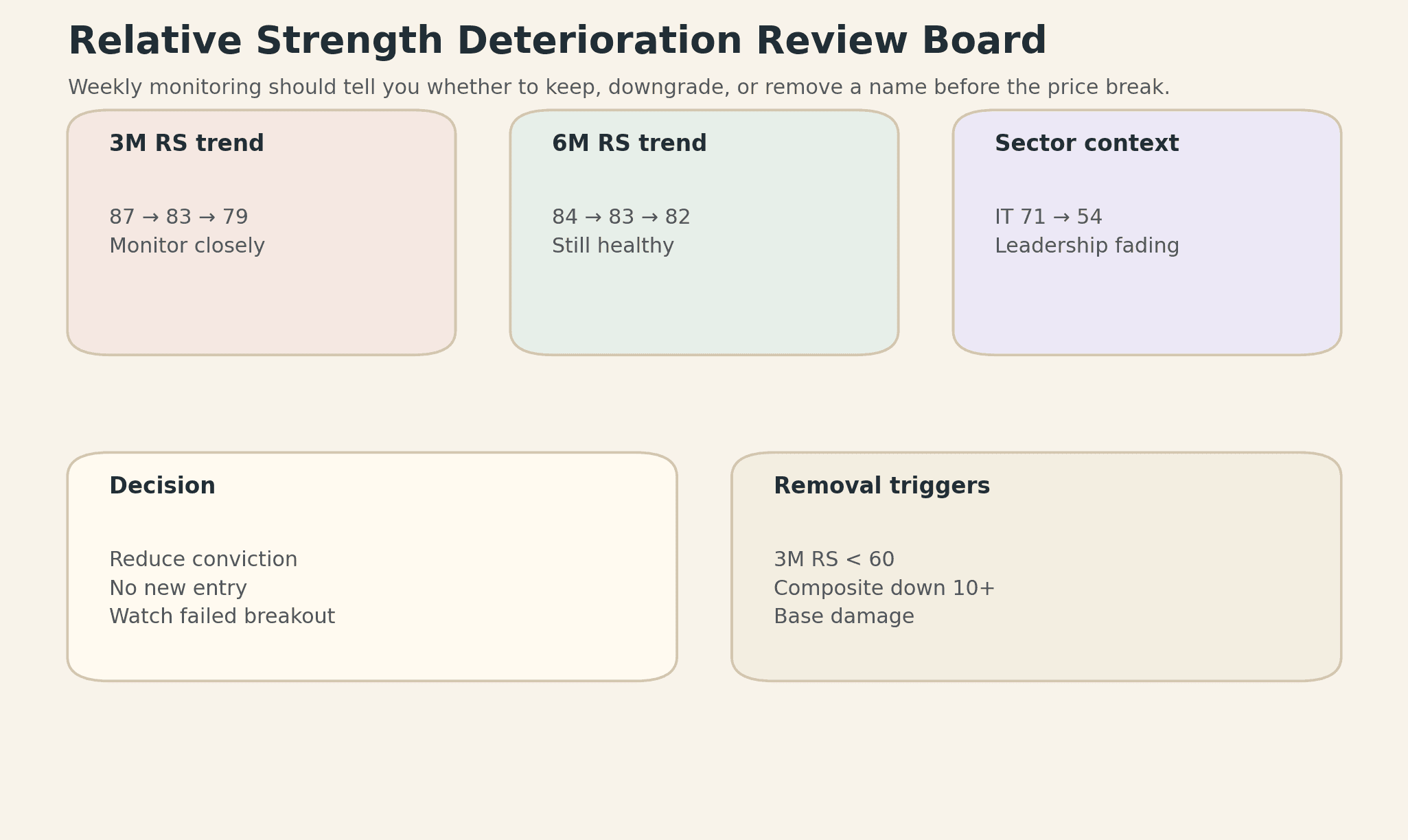
But the 3-month RS has dropped from the 87th to the 53rd percentile over eight weeks. The 6-month RS has slipped from 84th to 69th. The composite has moved from 86.9 to 71.1 -- a 16-point decline that crosses from "top-quartile leader" to "upper-middle."
The sector context: Nifty IT's 6-month sector RS has moved from the 71st to the 54th percentile over the same period. The sector is losing ground to capital goods and energy, which are climbing the rankings.
The price chart: Still inside a consolidation range. No visible breakdown. The stock has not made new highs recently, but it has not broken below any obvious support level either.
What the RS data is saying: The stock is quietly becoming a laggard within a sector that is itself quietly becoming a laggard. The price has not broken because distributions take time. But the data signals that institutional interest is waning. This name should move from the active watchlist to observation status, not be added as a new entry, and not be bought on any attempted breakout from the current consolidation without fresh RS improvement. If it is held as a position, conviction should be lowered and partial reduction is reasonable.
Two weeks later: The stock attempts to break out from the consolidation on average volume, stalls, and reverses to close back inside the range. That failed breakout, combined with the RS deterioration already in evidence, is the exit signal for any existing position and the definitive removal from the watchlist.
Worked Example 2: Temporary Weakness That Should Not Trigger Removal
A mid-cap capital goods stock has been on the watchlist for three weeks as a pre-breakout candidate. Strong composite RS (83rd percentile), leading sector context, tight consolidation base.
In week three, the Nifty 500 has a sharp three-session selloff driven by global macro concerns. The stock drops with the market. Its 3-month RS percentile slips from 83rd to 74th in a single weekly read.
The question: Does this weekly slip represent deterioration, or is it noise from a broad market move?
The assessment:
The 6-month RS has not changed -- still at 78th percentile. The 12-month RS is unchanged at 85th. The composite score has moved from 83 to 80.5, a 2.5-point reduction.
The sector -- capital goods -- has held its own during the selloff. Its 6-month RS is still at the 72nd percentile, unchanged from the prior week. Other stocks in the sector also showed similar 3-month slippage during the same sessions.
The price structure during the selloff showed the stock declining in line with the market but not undercutting the base. Volume during the down sessions was below the volume during the prior up sessions. The base is still intact.
What this represents: A broad market event affecting the short-term RS window. The stock declined with the market but did not weaken relative to the sector or on a sustained basis. The base is intact. The 3-month RS slip is shared with the entire sector, suggesting it is macro-driven rather than stock-specific distribution.
Decision: This stock stays on the watchlist. The 3-month RS slip is noted and monitored, but the 6-month and 12-month RS confirm the structural strength is unchanged. If the market recovers and the stock's 3-month RS recovers with it or faster -- which would confirm the stock is resuming leadership -- the pre-breakout candidate status is maintained.
The contrast with Example 1: In Example 1, the 3-month RS was declining persistently over eight weeks while the broader market was not in a prolonged selloff. The deterioration was sustained and stock-specific. In Example 2, the 3-month RS slip is sharp but coincident with a broad market event and not accompanied by 6-month or sector-level deterioration. Duration and context distinguish the two.
When to Remove a Stock From the Watchlist
Removal should be triggered by specific data conditions, not by how a stock feels or by a single bad week. The following conditions, individually or in combination, represent the appropriate removal criteria.
Composite RS has dropped more than 10 to 12 points from the peak observed while the stock was on the watchlist. A small drift is normal. A sustained 10-point decline in composite score, maintained across two or more weekly reads, indicates that the relative performance is genuinely deteriorating rather than fluctuating.
3-month RS has fallen below the 60th percentile. This means the stock is now performing below the top 40% of the universe on the most sensitive RS window. At this level, the stock has lost its short-term momentum and is no longer behaving like a pre-breakout leader.
Sector RS has crossed below the 50th percentile or is declining for three or more consecutive weeks. A stock cannot maintain strong RS indefinitely while its sector flows reverse. When sector RS crosses to the underperforming half of the market, the context for the individual stock entry has changed materially.
A failed breakout attempt occurs on declining RS. As shown in Example 1, a stock attempting to break out while RS is already in decline has a fundamentally different probability of follow-through than one breaking out with accelerating RS. A failed breakout on weakening RS is a double-negative signal. Remove immediately.
Price structure damage. A stock that breaks below the base low, undercuts a prior swing low on elevated volume, or produces a wide-range distribution candle on the highest volume in several weeks has given a price-level confirmation of what the RS was already suggesting. At this point, removal is not a decision -- it is the natural conclusion of a process that the RS data initiated several weeks earlier.
The stock fails to recover RS after a market-wide selloff. When the broad market recovers from a dip and most leaders bounce back strongly in RS, a stock that does not recover with them is demonstrating relative weakness specifically. This is the clearest distinction between macro-driven temporary weakness (which resolves when the market recovers) and structural deterioration (which persists even as the environment improves).
For Indian Traders: Specific Deterioration Patterns to Know
PSU follow-through failure. Public sector stocks in India frequently run hard on policy announcements -- infrastructure spending, energy sector decisions, bank recapitalisation news. These policy-driven runs often produce excellent RS scores on 3-month windows. But the follow-through in subsequent months frequently fails because the underlying earnings reality does not match the policy optimism. A PSU name showing a strong 3-month RS spike driven by a single policy event, without 6-month or 12-month RS support, should be treated as a candidate for near-term deterioration rather than a structural leader. Require 6-month RS confirmation before treating a PSU policy-run as a durable watchlist entry.
Low-liquidity names masking deterioration. In thinly traded mid-cap and small-cap names on NSE, a stock can maintain its price level for weeks with minimal actual trading volume. The RS score may look stable simply because there are no sellers and no buyers -- the price is not being discovered, it is just sitting. When a potential catalyst arrives, the first real selling can produce a sharp price drop that looks sudden on the chart but should have been identifiable from the lack of volume confirmation on any RS-supportive sessions. For liquidity-constrained names, RS must be evaluated alongside volume confirmation. A stable RS rank in a stock trading at 10% of its average volume is not reliable RS signal.
Earnings-season distortions. The strong quarterly results that powered a stock's initial RS improvement may not repeat. In the weeks before a second results announcement, a stock may be quietly distributing -- institutional holders who bought on the prior result's optimism are reducing ahead of the next one, uncertain whether the performance can sustain. This pattern often shows up as 3-month RS beginning to slip four to six weeks before the results date. Tracking the RS trend in the six-week window before a results announcement is a practical way to anticipate whether a prior leader is about to give back its RS gains.
Sector leadership concentration. Indian market rallies often concentrate in two or three sectors simultaneously before rotating. When a sector has been leading for twelve or more months, the individual stocks within it frequently begin showing RS deterioration in waves -- first the weakest names in the sector, then the mid-tier ones, and finally the bellwethers. By the time the leading names in a mature sector show RS deterioration, the sector rotation may already be several months old and the new sector leaders may be well-established. Watching sector-level RS as described in the timeframe comparison article allows detection of this pattern before it reaches the top names.
Side-by-Side: Structural Deterioration vs Temporary Weakness
| Signal | Structural Deterioration | Temporary Weakness |
|---|---|---|
| 3-month RS trend | Declining for 4+ consecutive weeks | Declined sharply in 1-2 weeks |
| 6-month RS | Also declining | Unchanged or recovering |
| 12-month RS | Beginning to slip | Unchanged |
| Composite score change | Down 10+ points from peak | Down 2-5 points |
| Sector RS | Weakening alongside stock | Holding or recovering |
| Cause | Stock-specific distribution | Broad market event |
| Recovery on market bounce | Does not recover with peers | Recovers in line with or faster than peers |
| Price structure | Base integrity weakening | Base intact |
| Volume on weak sessions | Elevated on down days | Below average on down days |
| Action | Remove from watchlist, avoid entry | Monitor; maintain watchlist position |
Common Mistakes in Reading RS Deterioration
Reacting to a single week of RS decline. One week of slippage, particularly during a broad market event, is noise not signal. The pattern that matters is sustained, multi-week decline across at least the 3-month and 6-month windows. Single-point readings are input data, not conclusions.
Ignoring the sector context. A stock's RS decline in isolation has very different implications depending on whether the sector is also weakening or still strong. A stock underperforming within a strong sector may simply be rotating temporarily, with other names in the sector leading that week. A stock underperforming within a weakening sector is showing stock-specific deterioration on top of sector-level headwinds -- a materially more serious combination.
Conflating base formation with deterioration. A stock consolidating after a move will naturally show 3-month RS stabilisation or slight decline simply because it is holding range while other things are moving. This is not necessarily deterioration -- it may be the normal RS behaviour of a stock in accumulation. The distinction is whether the RS decline is sustained and spreading to longer timeframes (deterioration) or whether it is shallow and stable during the consolidation period (normal base formation).
Holding a position because the chart still looks acceptable. This is the trap that the article began with. RS deterioration appears before price damage. By the time the price chart signals obvious weakness, the RS data has typically been indicating the problem for several weeks. Using RS as the leading signal and price as the confirmation -- not the other way around -- is the habit that changes when deterioration is identified and acted upon. The price structure article covers how these two signals relate.
Not tracking RS for existing positions. Most traders apply RS screening when building a watchlist but stop tracking it once they enter a position. RS for open positions should be reviewed weekly with the same rigour as RS for watchlist candidates. A held position showing RS deterioration deserves the same removal consideration as a watchlist name showing the same signal. The weekly review process incorporates this as part of the carry-forward check.
Practical Deterioration Monitoring Checklist
Run this alongside the watchlist-building process each week, applied to both watchlist candidates and open positions.
For each name on the watchlist or in the portfolio:
- What was the composite RS score two weeks ago? What is it this week? Is it declining?
- Has the 3-month RS percentile fallen below 70? If yes, is the decline stock-specific or shared with the sector?
- Has the 6-month RS percentile declined for two or more consecutive weeks? If yes, this is a structural deterioration signal.
- Has the sector RS weakened alongside the stock? (If yes: stronger deterioration signal. If no: possible temporary noise.)
- During the most recent market up-sessions, did this stock keep pace with its sector peers? (If no: stock-specific underperformance confirmed.)
- Is the price base still intact, or has there been a low undercut or a distribution candle on elevated volume?
- For open positions: is the RS still at the level it was when the position was entered? (If meaningfully lower: reduce conviction, consider partial exit.)
Removal triggers:
- Composite RS down 10+ points from peak across two weekly reads
- 3-month RS below 60th percentile
- Sector RS crossing below 50th percentile
- Failed breakout attempt on declining RS
- Price structure damage confirming what RS had already indicated
Monitoring status (not yet removal):
- Single-week 3-month RS slip during a broad market event
- Composite RS down 3-5 points without 6-month confirmation
- Sector RS temporarily lower but recovering
Key Takeaway
Relative strength deterioration is the leading indicator for most significant breakdowns in prior market leaders. It appears before price damage because it measures institutional order flow -- the quiet, sustained reduction of exposure that precedes a visible selloff.
The pattern to watch for: 3-month RS beginning to slip persistently, 6-month RS following with a lag, composite score declining across two or more weekly reads, sector RS weakening alongside the stock, and the stock failing to recover in line with peers when the market bounces. Each additional signal that confirms the pattern raises the probability that the deterioration is structural rather than temporary.
The practical response scales with the severity of the signal. Watchlist candidates showing early-stage deterioration move to monitoring status with lower conviction. Names showing confirmed multi-timeframe deterioration in a weakening sector are removed entirely. Open positions showing the same pattern are reduced or closed rather than held on the basis of how the chart still looks.
RS deterioration monitoring is the defensive half of the RS-based trading workflow. The watchlist-building process is the offensive half -- finding names where RS is building before the move. Both require the same weekly tracking habit, the same multi-timeframe RS data, and the same discipline for acting on what the data shows rather than what the chart still appears to be suggesting.
The full RS content series on TradInvest -- from the foundational guide through ranking, timeframe analysis, sector rotation, pre-breakout selection, price structure and context, and watchlist building -- builds toward a complete framework for using RS both offensively and defensively. This article is the closing piece on the defensive side.
If you want to track these changes faster, the most relevant next pages are features, Edge, and pricing. They show how TradInvest packages the same weekly RS workflow without changing the judgment rules described here.
Spread the good words
Give your view.
Give your view
Comments
0Use this insight inside the product
TradInvest is built to connect market context, strategy quality, and post-trade learning. Read the market with Pulse, narrow your watchlist with rotation and momentum, then review what actually worked.
Related posts
More insight tied to the same trading workflow.