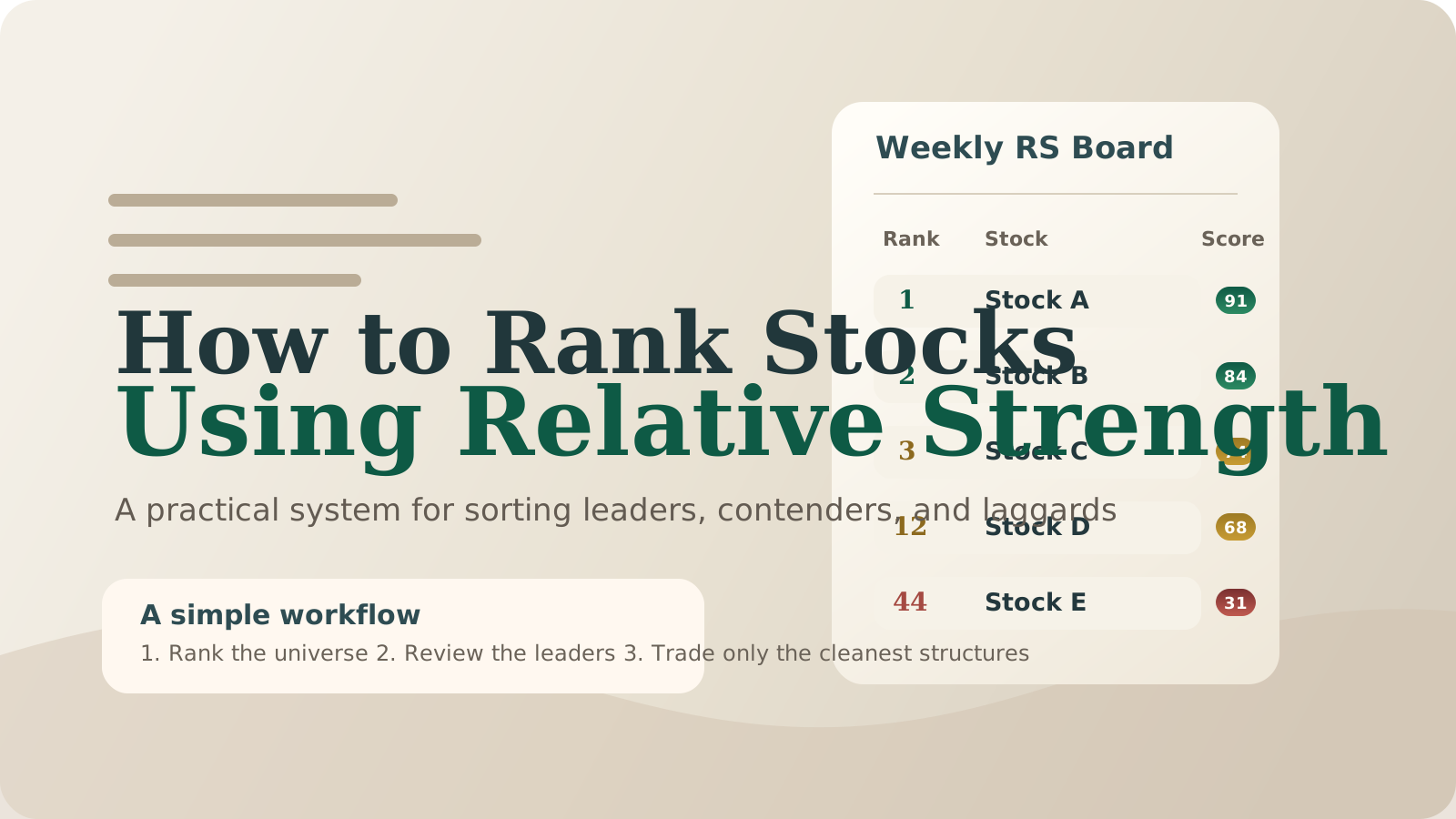
The stock that saved my account wasn't the one I picked. It was the one that refused to fall.
Table of Contents
- The Moment That Changed My Thinking
- What Relative Strength Actually Is (And What It's Not)
- Insight 1 — Strong Stocks Stay Strong for a Reason
- Insight 2 — Relative Weakness Is a Warning, Not a Discount
- Insight 3 — RS Tells You About the Whole Market, Not Just One Stock
- How to Actually Use Relative Strength in Your Trading
- The Mistakes Most Traders Make With RS
- The Real Shift: Stop Chasing, Start Reading
The Moment That Changed My Thinking
I spent the first few years of trading chasing momentum. Whatever was moving fast, I wanted in. Made sense in my head — fast movers make fast money, right?
Wrong. So deeply, expensively wrong.
What actually changed my trading wasn't some fancy indicator or a paid course. It was a random Tuesday in 2020. The market was selling off hard and I noticed something strange. Everything in my watchlist was bleeding — 5%, 8%, some names down 12% in a single session. But there was one stock that was down maybe 1.2%. That's it. The whole world was on fire and this thing was barely warm.
I ignored it. Moved on. Kept trying to catch falling knives elsewhere.
Three weeks later, when the market started recovering, that quiet stock was up 40% before anything I was watching had even gotten back to breakeven.
That's when I started paying serious attention to Relative Strength.
And I wish I had done it years earlier. Looking back, it was right there in front of me the whole time — in every market cycle, in every sector rotation, in every stock that quietly led the next rally. I just didn't know how to look for it.
This post is everything I've learned about RS since then. No textbook definitions. Just what I actually understand, how I use it, and the mistakes I made getting here.
What Relative Strength Actually Is
And what it's absolutely not.
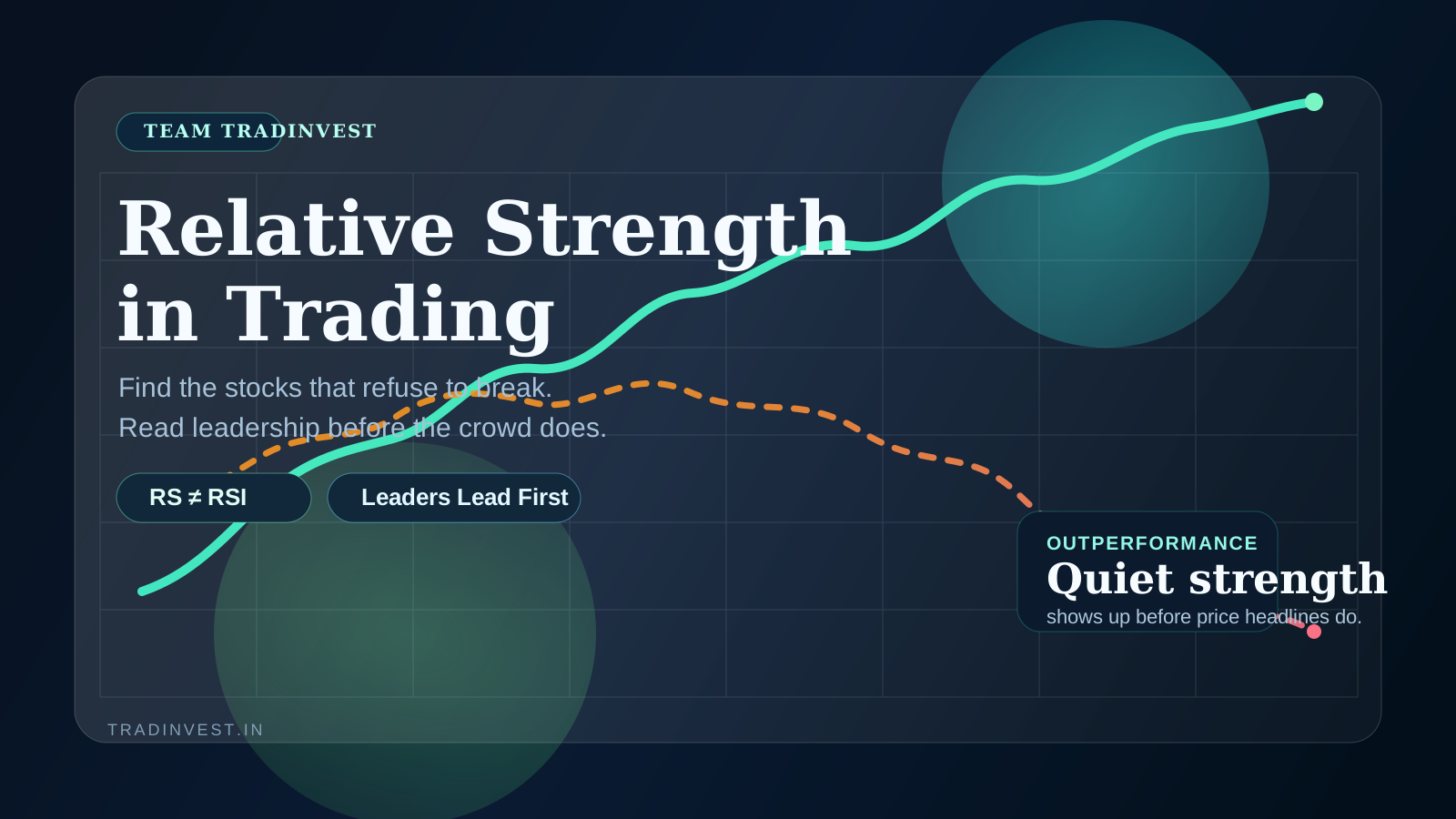
Let's get one thing out of the way immediately. Relative Strength is not RSI.
RSI — the Relative Strength Index — is a mathematical oscillator. It measures how fast and how much a stock has moved relative to its own historical price. It tells you if a stock is overbought or oversold based purely on its own past behaviour. That's a completely different animal.
Relative Strength (RS) is a comparison. It asks: how is this stock performing compared to everything else?
That's it. There's no complex formula to memorise. No oscillator to calibrate. You're simply asking whether a stock is outperforming or underperforming its benchmark — whether that's the broader market index, its sector ETF, or a group of peers.
A simple way to think about it:
- Nifty 50 drops 3%. A stock drops 0.5%. → High relative strength.
- Nifty 50 rises 2%. A stock barely moves. → Relative weakness.
- Market is flat for three weeks. A stock quietly makes new highs. → Very high relative strength.
Is this stock going up when the market is flat? Is it down 2% when everything else is down 8%? Is it breaking out to new highs while the index grinds sideways?
Every one of those observations is a Relative Strength read. You're not looking at the stock in isolation. You're placing it in context. And context, it turns out, is everything.
Insight 1 — Strong Stocks Stay Strong for a Reason
This sounds obvious. Most people still get it wrong.
"Strong stocks stay strong. Weak stocks stay weak."
Sounds painfully obvious until you really sit with it and understand why it's true.
When a stock holds up during a brutal market selloff, it's not luck. It's not random noise. It means someone — almost always someone with significant capital — is absorbing all the selling pressure. While retail traders are panic-selling, an institution is quietly buying everything that's being dumped. And they're not doing that randomly. They see something the market hasn't priced in yet.
Read that again.
Institutions don't quietly accumulate stocks they think are mediocre. When a stock refuses to fall in a falling market, that's smart money at work. And when buyers come back, there's nothing left to hold it down.
Why high-RS stocks lead every recovery
Think about what happens mechanically during a selloff in a high-RS stock. All the weak hands have already been shaken out. The supply that would otherwise suppress a price recovery has been absorbed. The institutional buyers have cleaned up the overhang. When the market stabilises and buyers return broadly, the high-RS stock has a compressed spring underneath it. Nothing in the way. It moves first. It moves hard.
This is why, if you study virtually every major market recovery — 2009, 2016, 2020 — the leaders of the next bull leg are almost always the stocks that barely participated in the prior decline. The stocks that looked "boring" during the worst of it are the ones that look like geniuses six months later.
The implication for your trading: You don't find the next leader by watching what's moving today. You find it by watching what held up when everything else didn't.
Start building your watchlist during corrections, not after recoveries. The stocks you want are the quiet ones. The ones where nothing dramatic is happening — but nothing bad is happening either.
Insight 2 — Relative Weakness Is a Warning, Not a Discount
This is where most retail traders get it exactly backwards.
People love buying beaten-down stocks. "It's down 60%, it has to bounce." There's an emotional pull to it — the feeling that you're getting a bargain, that patience will be rewarded, that the market has overreacted.
Sometimes that's true.
But if a stock is down 60% while the broader market is flat or up? That is not a bargain. That is a warning signal.
Relative weakness is information the market is broadcasting before the headline arrives. It could be institutional distribution — smart money quietly selling a position they know is deteriorating before the news goes public. It could be a structural problem with the business that analysts haven't downgraded yet. It could be a sector rotation away from that entire industry.
Whatever the reason: the price action is telling the story before the news does.
The slow bleed nobody talks about
The more dangerous version of this trap is a stock that shows persistent relative weakness without crashing outright. It doesn't fall apart spectacularly. It just quietly bleeds sideways while the market climbs. Month after month, it underperforms. It becomes dead capital.
That kind of underperformance is incredibly expensive because it doesn't hurt enough to trigger action. You're not panicking. You're just missing opportunity cost while your attention is stuck on a laggard.
And here's what most traders miss: money is not made by buying the stock that looks cheapest. It's made by buying the stock that institutions are most aggressively supporting.
Weak stocks are weak for reasons that often aren't visible yet. Treat relative weakness as a warning label, not a sale sign.
Insight 3 — RS Tells You About the Whole Market, Not Just One Stock
This is where Relative Strength becomes a market tool, not just a stock-picking tool.
Most traders use RS at the single-stock level and stop there. That's useful, but incomplete.
Because Relative Strength can also be applied across sectors, indices, and themes. And when you do that, you start seeing the market's internal structure much more clearly.
For example:
- If banks are showing RS while technology lags, that tells you something about where risk appetite is rotating.
- If defensive sectors are outperforming while the headline index is still rising, that's a warning that the rally may be weaker than it appears.
- If only a handful of mega-cap names are carrying the index while everything else shows relative weakness, the market is much less healthy than the index suggests.
This is why breadth matters. A healthy rally doesn't just mean the index is green. It means a wide base of sectors and stocks are outperforming together.
Broad RS vs narrow RS
When financials, industrials, and mid-caps all showing RS alongside the headline index — that's a genuinely healthy market. Money is flowing everywhere. That environment rewards aggressive positioning because the tide is lifting all boats.
Tracking RS across sectors and market cap bands gives you a real-time picture of where institutional capital is flowing and how confident it is. This is information you cannot get from a single index number.
It changes how you size positions, how aggressively you trade, and how much risk you take at any given time. Big picture thinking like this is what separates a trader from just a stock picker.
How to Actually Use Relative Strength in Your Trading
Enough theory. Here's the actual workflow.
Step 1 — Build a relative strength comparison
The most direct method: pull up your charting platform and overlay the stock you're analysing against its relevant benchmark.
- Large-cap stock → compare against Nifty 50 or S&P 500
- Mid-cap → compare against Nifty Midcap 150 or Russell 2000
- Sector-specific → compare against the relevant sector index or ETF
You want to see the stock line clearly above the benchmark line — not just for a few days, but over a sustained 3 to 6 month window. That duration matters. It tells you the outperformance isn't noise or a one-time event. It's a pattern. And sustained patterns reflect sustained intentions, which in institutional terms means consistent, deliberate buying.
Step 2 — Stress test it during a down day
Once you have a candidate, wait. Wait for the market to have a rough session — a genuine selloff, not just a flat day. Watch how your candidate behaves.
- Does it hold up better than the index?
- Does it drop meaningfully less than its sector peers?
- Does it actually tick up while everything else falls?
That behaviour under pressure is your confirmation. It tells you the demand is real — not just a result of the general market being in an uptrend. If it drops as hard as everything else, or worse, harder than the index — the RS you thought you saw may have been a mirage. The name comes off the list.
Step 3 — Buy into the recovery, not the panic
When the market stabilises or begins to recover, that's when you enter your high-RS positions. Not during the selloff. Not to "average down." You buy strength as it resumes.
These stocks will typically be among the first to make new highs, and they'll do it with conviction — because the supply overhang was already absorbed during the correction. There's nothing left to hold them down.
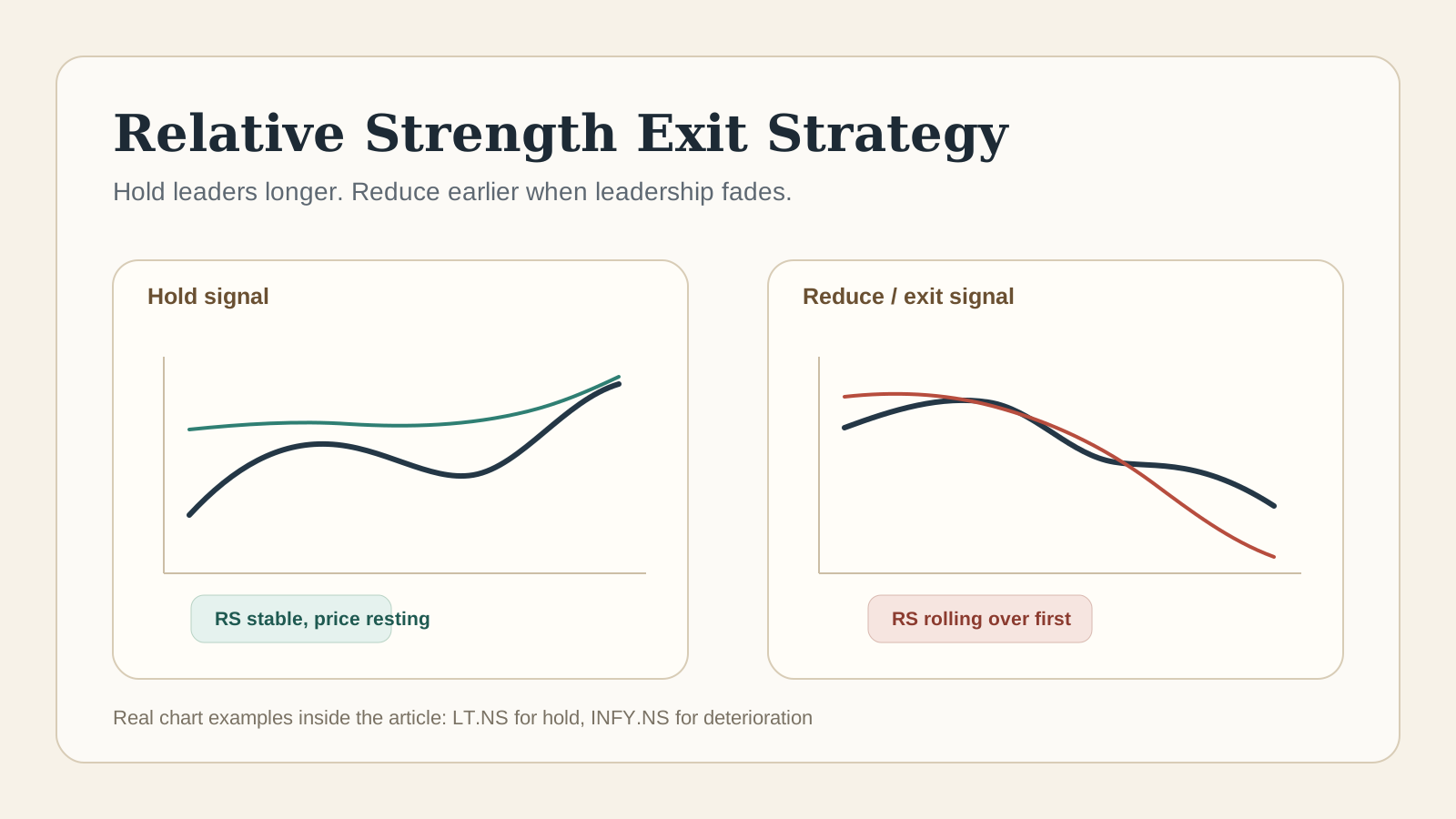
Step 4 — Use RS as an exit signal too
This is the part most people skip entirely. Relative Strength works as a sell indicator just as well as a buy indicator.
If a stock you're holding starts showing relative weakness — the market goes up, your stock goes sideways or quietly dips — start paying attention. You don't need to sell immediately. But trim. Watch. Because relative weakness before a major breakdown is almost always visible in the charts before the actual breakdown, if you're looking for it.
It's your early warning system. Use it.
Quick-reference RS checklist
Before adding any stock to your active watchlist, run through this:
- Is the stock outperforming its benchmark over the last 3–6 months?
- Does it hold up better than the index on down days?
- Is its sector showing broad strength alongside it?
- Is the RS improving week-over-week, not just day-to-day?
- Has it made new highs while the market was flat or declining?
If you're getting yes to most of these — it belongs on your list.
The Mistakes Most Traders Make With RS
I've made most of these. Here they are so you don't have to.
Mistake 1 — Buying the laggard because "it'll catch up"
You find a hot sector, identify the leader, then buy the weakest stock in the sector because it seems cheaper or less extended. The logic feels sound: same industry, maybe the laggard just hasn't moved yet.
Sometimes laggards catch up. More often they don't. And even when they do, the leader has already run 20% before the laggard moved 5%. Always be in the leader of the leading sector. The strongest RS name in the strongest RS sector is almost always the best trade in the room.
Mistake 2 — Mismatching timeframes
A stock can have short-term relative weakness but long-term relative strength, or the reverse. Comparing a 6-month RS chart when you're planning a 3-day swing trade is misleading. The timeframe of your RS analysis must match the timeframe of your trade.
- Intraday trades → use intraday relative performance against the index
- Swing trades (days to weeks) → use daily and weekly charts
- Positional trades (weeks to months) → use weekly and monthly charts
Mixing these up leads to acting on information that's irrelevant to your actual holding period.
Mistake 3 — Confusing a one-day spike with sustained RS
A stock rockets 8% on earnings while the market is flat. That looks like RS. But it's not — not unless that outperformance holds and builds over the following weeks.
One-day events are noise. An earnings pop that fades back to underperformance in two weeks tells you the market didn't believe the story. Sustained, consistent outperformance over months is signal. Don't chase single-day spikes and call it RS investing.
Mistake 4 — Only using RS to buy, never to filter or exit
Half the value of Relative Strength is in what it tells you to avoid and when to leave. The stocks showing persistent relative weakness are the ones that erode your account slowly — not through dramatic crashes but through quiet, grinding underperformance while everything else moves.
Screening them out proactively, and exiting existing positions that develop RS deterioration, is just as important as finding the leaders. Maybe more important, because the losses from laggards are invisible until they're undeniable.
Mistake 5 — Ignoring the broader market context
Even the highest-RS stock in the world struggles in a genuine, sustained bear market. RS tells you which stocks to own — but the broader macro context tells you how aggressively to own anything.
In confirmed bear phases, cash is a position. RS helps you stay in the best stocks relative to the market, but it doesn't override the need to respect macro conditions. If the entire market is in a downtrend, even the best RS stocks will correct. Know when to reduce exposure across the board.
The Real Shift: Stop Chasing, Start Reading
Markets are fundamentally about where serious money is moving. You and I don't have access to institutional order books. We don't sit in on board calls. We don't know what the funds know.
But price action doesn't lie.
When capital is flowing into a stock — quietly, consistently, even against the current of a broader selloff — the chart shows it. Relative Strength is simply a way of seeing that flow clearly and early. Before the crowd notices. Before the analyst upgrades. Before the financial media starts writing about it.
The best trades I've ever made weren't in flashy names with explosive news flow. They were in stocks that quietly refused to go down when they should have. That behaviour — that quiet defiance of gravity — was a tell. It meant someone knew something. And when the environment finally turned, those stocks didn't just recover. They led.
The shift this creates in how you approach trading is genuinely significant. You stop asking "what's moving today?" You start asking "what has been leading for months?" You stop reacting to news and start reading the money flow behind the news.
That's a different game entirely.
And it's a much better one to be playing.
Key Takeaways
- Relative Strength (RS) is not RSI. RS measures a stock's performance relative to a benchmark. RSI measures a stock relative to its own history. They are completely different tools.
- Strong stocks stay strong because institutions are behind them. High RS during market selloffs reveals sustained accumulation by smart money.
- Relative weakness is a warning, not a bargain. A stock underperforming the market is broadcasting a problem — often before the public headline arrives.
- RS across sectors reveals overall market health. Broad RS = healthy, sustainable rally. Narrow RS concentrated in a few large-caps = fragile move.
- Use RS for both entry and exit. Deteriorating RS in a holding is an early warning signal. Act on it before it becomes obvious.
- Always be in the leader, not the laggard. The strongest RS stock in the strongest RS sector is almost always the best trade available.
Frequently Asked Questions
What is the difference between Relative Strength and RSI? Relative Strength compares one stock's performance against an external benchmark (like an index or sector). RSI (Relative Strength Index) is an oscillator that compares a stock's recent gains against its own recent losses. They measure completely different things and should not be confused.
What timeframe should I use for Relative Strength analysis? Match your RS timeframe to your trading timeframe. Intraday traders should compare intraday performance. Swing traders should use daily and weekly charts. Positional traders should use weekly and monthly charts for meaningful RS comparisons.
How do I calculate Relative Strength manually? Divide the stock's price by the index price and plot that ratio over time. A rising ratio line means the stock is outperforming; a falling line means underperformance. Most charting platforms (TradingView, Chartink, Thinkorswim) have built-in relative performance overlays.
Can Relative Strength be used in the Indian stock market (Nifty, BSE)? Absolutely. Compare stocks against Nifty 50, Nifty 500, or sector-specific indices like Nifty Bank or Nifty IT. The principle is identical regardless of market.
Is high Relative Strength a guaranteed buy signal? No single indicator is a guaranteed signal. High RS improves the odds by confirming institutional interest and demand. Always combine RS with overall market context, sector conditions, and your own risk management before entering a position.
This post is for educational purposes only. Nothing here constitutes financial advice. Always do your own research and consult a qualified financial advisor before making investment decisions.
Tags: relative-strength stock-trading RS-strategy leading-stocks institutional-buying swing-trading market-analysis stock-selection technical-analysis Nifty Indian-stock-market
Spread the good words
Give your view.
Give your view
Comments
0Use this insight inside the product
TradInvest is built to connect market context, strategy quality, and post-trade learning. Read the market with Pulse, narrow your watchlist with rotation and momentum, then review what actually worked.
Related posts
More insight tied to the same trading workflow.