Entries are a solvable problem. There is a defined setup, a clear trigger, a logical stop. The decision is yes or no, and once made, the trade is on.
Exits are something else entirely.
A position in profit creates immediate psychological complexity that a pending entry never does. Hold and risk giving it back. Exit and risk leaving significant gains on the table. Reduce partly and manage the ambiguity of a half position that no longer has a clean thesis. Most traders make exit decisions reactively -- based on how the trade feels at any given moment, on recent price action, or on some arbitrary percentage target that was set before context was fully understood.
The result is a pattern that erodes expectancy consistently: winners cut too early, positions held too long into genuine deterioration, and no coherent logic for distinguishing between the two.
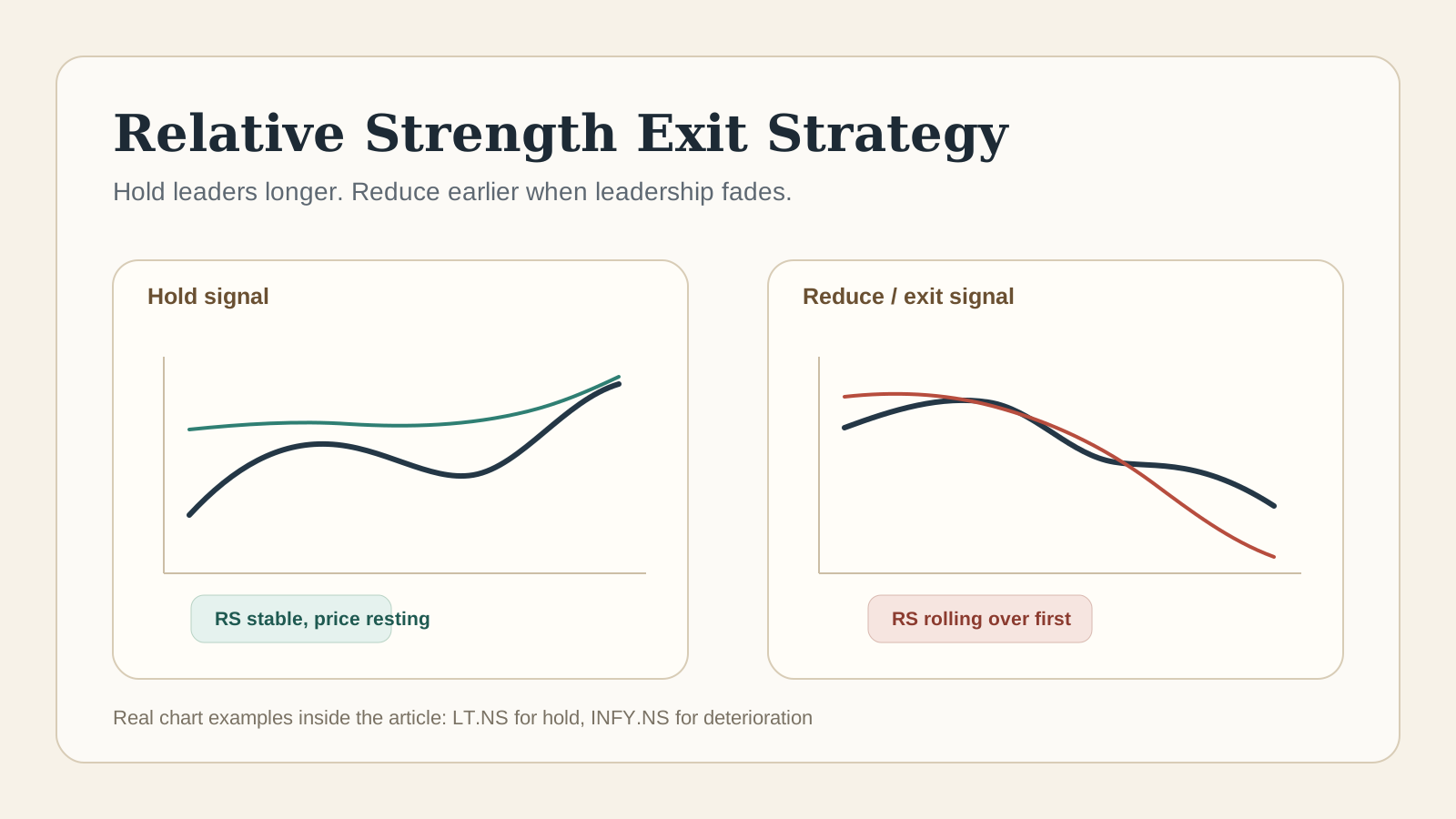
A relative strength exit strategy does not eliminate this difficulty, but it provides a structured basis for each decision. When RS is strong and improving, holding has data behind it. When RS is deteriorating, reducing or exiting has data behind it. The exit is no longer a judgment call made in the heat of a session -- it is the conclusion of a process that has been running since the position was entered.
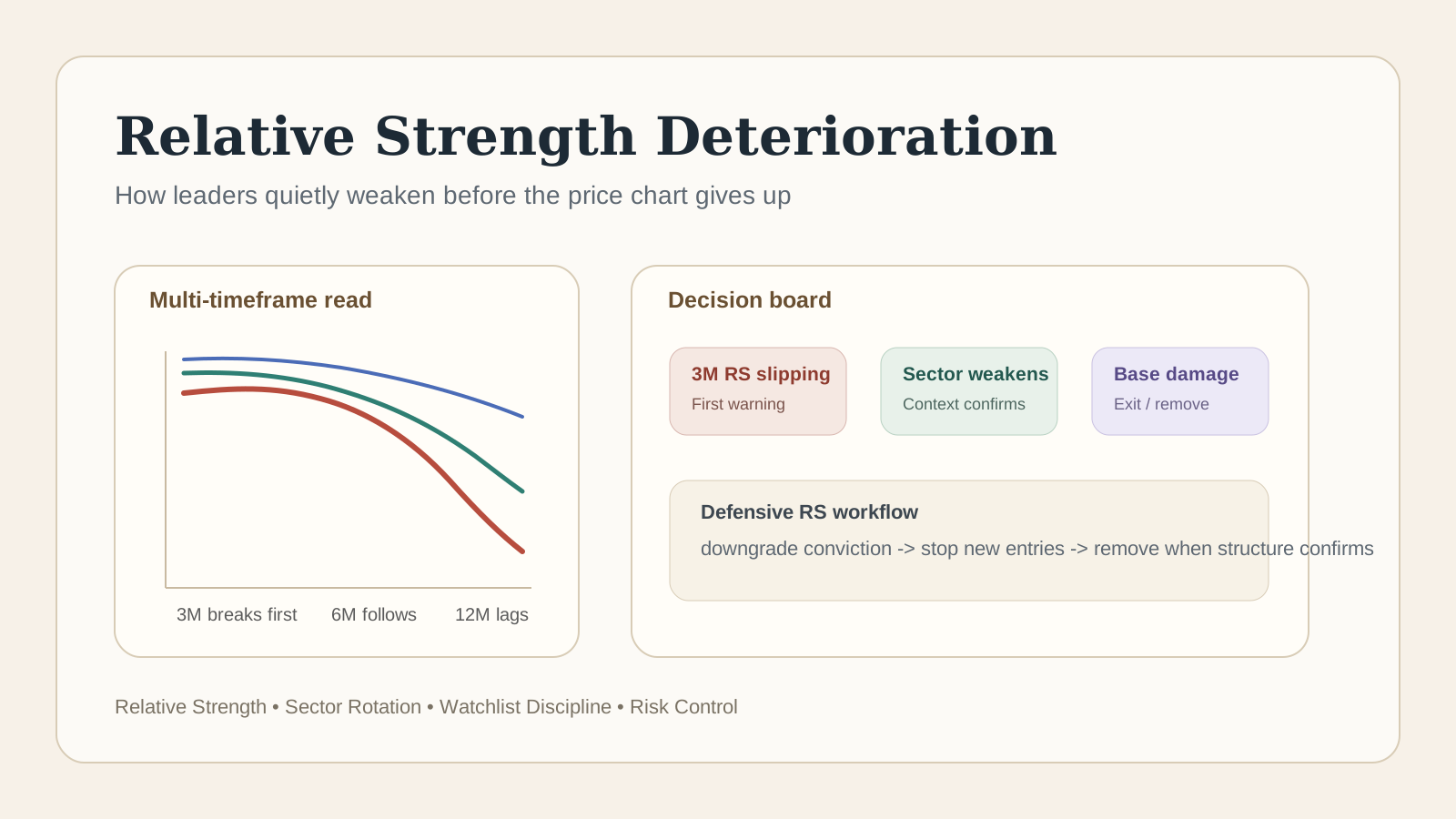
This article explains how to use RS for three distinct exit decisions: holding through normal consolidation, reducing on warning signs, and exiting fully before obvious price damage. If you are not yet familiar with how RS deterioration develops as a pattern, the deterioration article provides the detailed framework this article builds on.
Why Entries Are Easier Than Exits
An entry decision is made in a neutral state. The position does not exist yet. There is no unrealised gain to protect, no loss to fear, no emotional attachment to a thesis that has already been tested. The setup either meets the criteria or it does not.
An exit decision is made under load. The position exists, it has a P&L, and the trader has a history with it. Every price wiggle is interpreted through the lens of what has already happened. A consolidation that would be read as completely neutral in a name without a position becomes threatening in a name with an open trade and a visible gain.
This asymmetry creates two failure modes.
The first is premature exit. A stock consolidates for a week after a clean breakout. The gain shrinks from 8% to 5%. The trader feels the thesis slipping and closes for a smaller win than the setup merited. Two weeks later, the stock extends significantly from the same consolidation level. The trader identified the right stock, entered correctly, and managed the exit poorly.
The second is delayed exit. A stock that produced a 15% gain begins showing signs of deterioration. The trader holds, hoping to recover toward recent highs. The gain shrinks to 8%, then 3%, then the position breaks below the original stop level. What began as a well-structured winning trade is closed for a loss.
Both failures stem from the same underlying problem: the exit decision was emotional rather than evidential. RS changes the basis.
What Relative Strength Adds to Exit Decisions
RS-based exit management does not replace a stop loss. The stop loss is still the unconditional exit -- if the price breaks below it, the position is closed regardless of RS, regardless of conviction, regardless of recent gains.
What RS adds is a framework for the space between entry and stop -- the zone where most exit decisions actually live.
In that zone, RS answers three questions that price alone cannot:
Is the stock still a leader relative to its peers? A stock consolidating while maintaining top-quartile RS is behaving like a leader taking a breath. A stock consolidating while its RS percentile rank is declining week over week is behaving like a leader losing its sponsorship. These two situations look similar on a price chart. They look very different on an RS chart.
Is the sector still supportive? A stock holding its RS rank while the sector's own RS is weakening faces structural headwinds that are not yet visible in the stock's individual price action. Sector deterioration is often the context within which individual stock deterioration develops. Watching sector RS as a leading indicator for what may happen to a held position is the early warning layer.
Is the pattern consistent with prior leadership behaviour? Leaders consolidate. They do not move in straight lines. A stock that built a multi-week base before the initial breakout will often build shorter consolidations during the subsequent trend. Understanding what is normal for a specific stock's leadership pattern -- compared to what represents genuine deterioration -- prevents exits at the wrong moments. The pre-breakout framework describes the RS behaviour that precedes genuine moves. The same logic applies in reverse for exits.
Worked Example 1: RS Supports Holding Through a Normal Consolidation
A mid-cap capital goods stock was added to the watchlist at the 83rd composite RS percentile, entered on a clean breakout with volume confirmation, and has now gained 12% over five weeks. In week six, the stock pulls back 4% over three sessions without any particular catalyst. The gain is now 8%.
The trader is uncomfortable. The gain was 12%. It is shrinking. Every session that the stock falls feels like a mistake for not having taken profit earlier.
The RS data in week six:
| Timeframe | RS at entry | RS now | Change |
|---|---|---|---|
| 3-month | 83rd | 81st | -2 points |
| 6-month | 79th | 80th | +1 point |
| 12-month | 85th | 86th | +1 point |
| Composite | 83.0 | 82.9 | -0.1 points |
The 3-month RS has dipped marginally. The 6-month and 12-month RS have actually ticked higher. The composite is essentially unchanged.
Sector context: Capital goods sector RS is at the 76th percentile, up from the 72nd percentile the week before. The sector is gaining, not losing.
Volume behaviour: The three down sessions showed below-average volume. The stock is falling on low interest, not on active selling.
Price structure: The pullback has found support above the prior breakout level. The stock has not undercut the base.
What the RS data is saying: This is not deterioration. The short-term RS dip is immaterial -- less than the noise of a single week's performance differential. The 6-month and 12-month RS are improving. The sector is gaining. The price pullback is on low volume and has not damaged the structure.
Decision: Hold. Tighten the trailing stop to protect a floor of the gain, but do not exit based on a 4% pullback that the RS, sector, and volume data all confirm is normal. Exiting here is an emotional decision dressed as risk management.
The real chart below uses LT.NS as a current-market illustration of this pattern: price pauses, range compression appears, but the relative-performance line versus Nifty remains firm rather than rolling over.
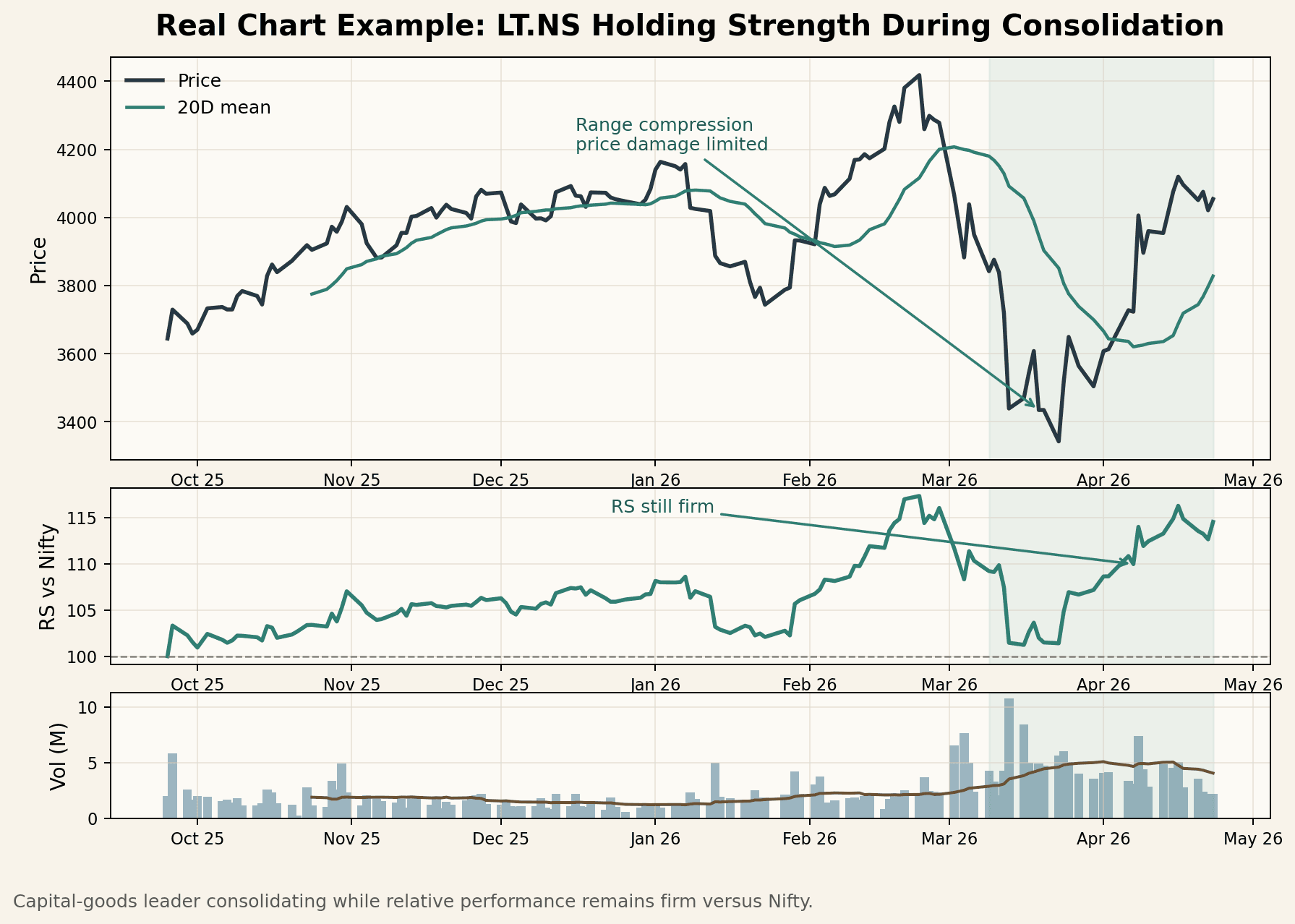
Three weeks later: the stock breaks to new highs from the consolidation, adding another 9% from the consolidation low. The total gain from entry is 21%. The trader who held based on RS confirmation rather than exiting on the pullback participates in that second leg. The trader who exited at 8% based on fear of giving back the 12% did not.
Worked Example 2: RS Deterioration Warns Before Price Breaks Down
A large-cap IT stock was entered six weeks earlier at the 87th composite RS percentile. It has gained 11%. The price is currently consolidating just below a prior all-time high, and on a chart basis looks like it may be preparing for a second breakout attempt.
The RS data tracked weekly:
| Week | 3M RS | 6M RS | 12M RS | Composite |
|---|---|---|---|---|
| Entry | 87 | 84 | 89 | 87.1 |
| +2 weeks | 86 | 83 | 89 | 86.3 |
| +4 weeks | 80 | 80 | 88 | 83.2 |
| +6 weeks (now) | 72 | 76 | 86 | 78.9 |
The 3-month RS has dropped from 87th to 72nd over six weeks -- a 15-point decline. The 6-month RS has declined from 84th to 76th. The composite has moved from 87.1 to 78.9, an 8.2-point decline, crossing from the top decile toward upper-middle.
Sector context: Nifty IT sector RS has moved from the 74th to the 61st percentile over the same six-week period. The sector is losing relative ground to capital goods and energy.
Volume behaviour: The most recent consolidation sessions have seen two higher-volume down days that close in the lower half of their range. Volume has been asymmetric -- heavier on down sessions than on up sessions.
Price structure: Price is holding above the prior high (which is now support), but the consolidation range is widening rather than contracting. The base is becoming messy.
What the RS data is saying: This is the pattern described in the deterioration article -- 3-month RS declining persistently, 6-month following, sector RS weakening alongside the stock. The composite score decline of 8 points over six weeks is above the noise threshold. Combined with asymmetric volume on the down sessions and a widening consolidation, this is structural deterioration, not a normal rest.
Decision: Reduce. Not necessarily close entirely in one session -- the price has not yet broken down, and the trailing stop may not have been hit. But with RS deteriorating at this rate, sector context weakening, and volume patterns asymmetric, holding the full position while waiting for confirmation from the price chart means the exit will come later -- after more of the gain has been given back.
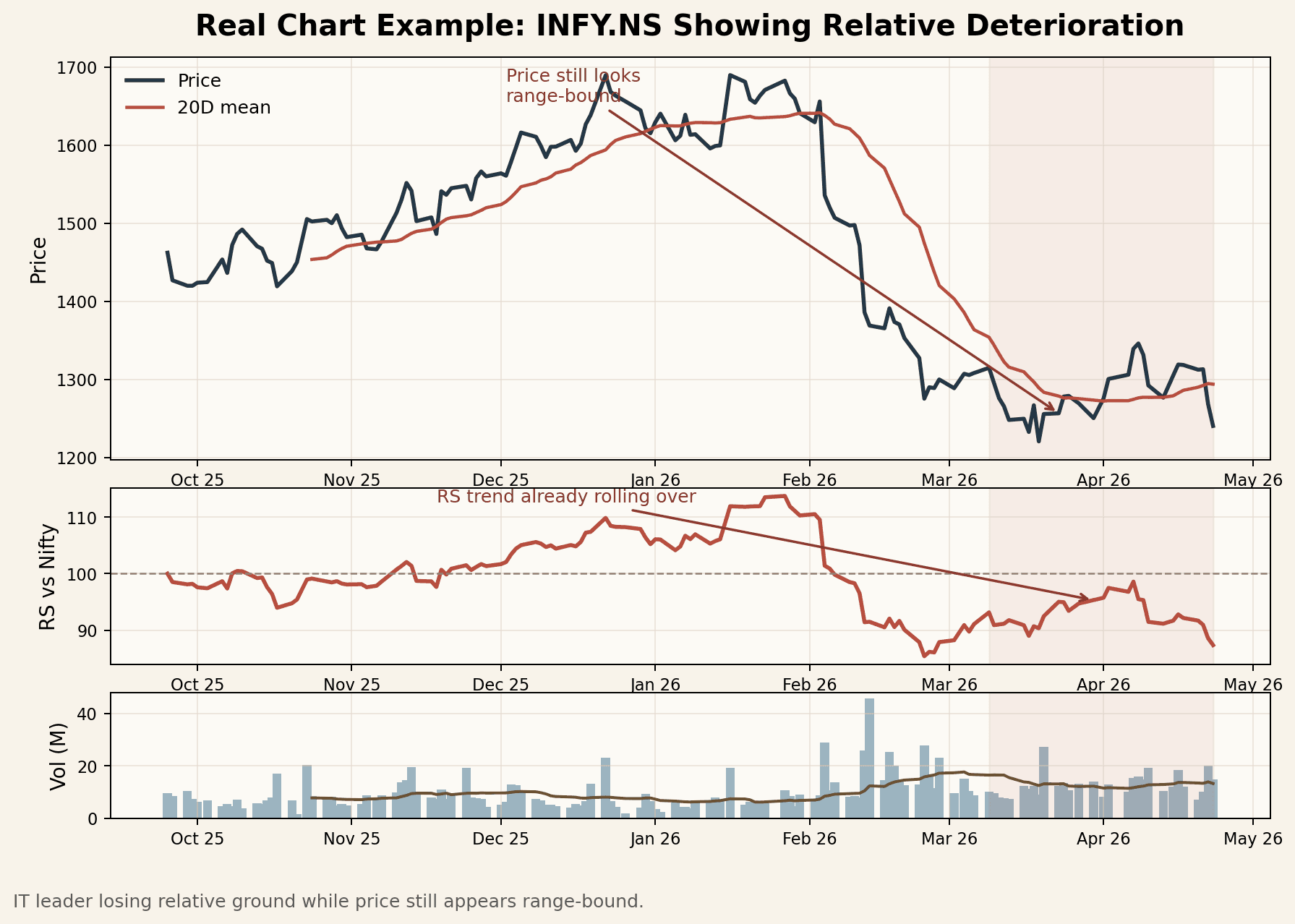
The real chart below uses INFY.NS as a current-market illustration of the same logic in reverse: price still looks range-bound for a while, but the relative-performance line is already rolling over against Nifty.
Reducing to half position now preserves flexibility: if the stock recovers its RS in the following two weeks and makes a new high on strong volume, the remaining half participates. If the deterioration continues and the price eventually breaks, the risk on the remaining position is half of what it was. The cost of waiting for price confirmation instead of acting on RS evidence is paid in reduced gain.
Two weeks later: The stock attempts the breakout on below-average volume, stalls, reverses, and breaks below the consolidation support on elevated volume. The trailing stop for the full position would have been hit here. The trader who reduced at the RS deterioration signal exits the remaining half for a modest gain. The trader who held the full position closed at approximately breakeven on the original entry after giving back most of the 11% gain.
The Central Distinction: Normal Consolidation vs Genuine Deterioration
This is the question that every holding decision comes down to.
Normal consolidation in a leading stock looks like this: RS percentile rank is stable or very slightly lower on the 3-month window, unchanged or improving on 6-month and 12-month, composite score essentially flat. Volume during the consolidation is below average -- the stock is quiet, not being actively sold. The price structure contracts toward a tighter range rather than widening. The sector RS is holding or improving.
Genuine deterioration looks like this: 3-month RS declining consistently across multiple weekly reads, 6-month RS beginning to follow, composite score declining by 8 to 12 points or more from peak. Volume asymmetric -- heavier on down days, lighter on up days. Price structure widening or producing failed rally attempts that close poorly. Sector RS weakening alongside the stock.
The difference is not always clean on any single week. It becomes clear across three to five consecutive weekly reads. This is why RS-based exit decisions require a data series, not a single snapshot. A trader who checks RS only on the day they are considering an exit is working with insufficient information. The weekly review process creates the data series that makes this distinction possible.
A useful rule of thumb: if the composite RS for a held position has declined by more than 8 to 10 points from the peak reading since entry, and the decline has persisted for three or more weekly reads, the deterioration is more likely structural than temporary. Begin reducing, not exiting entirely, but reducing.
How Sector Context and Regime Should Change Exit Decisions
Sector RS is the contextual layer that distinguishes stock-specific deterioration from market-wide pressure that may be temporary.
When a held position shows RS decline while its sector RS is also declining, the situation is more serious than when the stock's RS dips in isolation. The sector context tells you that capital is rotating away from the entire space, not just from this specific name. Exits from names in deteriorating sectors should be more aggressive -- reduce faster, require less additional confirmation before reducing further.
When a held position shows RS decline but the sector RS is holding or still improving, the deterioration may be temporary and stock-specific. In this case, monitoring more carefully before acting is reasonable. The stock may be going through a rotation within the sector itself, underperforming temporarily while peers lead, but with the sector tailwind still intact.
Market regime adds the macro layer. In a healthy trending regime, normal consolidations in high-RS names have a higher probability of resolving upward. RS dips are more likely to be temporary. Exit signals need a higher bar. In a deteriorating or choppy regime, the same RS dip in the same stock has a higher probability of being the beginning of a structural decline. Exit signals should be acted on more aggressively, and holding standards should be tighter. The market regime article covers how to assess regime as a context layer for all trading decisions.
The interaction is: for any exit decision, the RS data provides the primary signal, the sector context provides the amplification or dampening factor, and the regime provides the prior probability that the signal is correct. All three together produce a more calibrated decision than any one in isolation.
For Indian Traders: Exit Challenges Specific to NSE
Sharp sector rotation compresses exit windows. Indian markets can rotate sector leadership faster than most developed markets, particularly in response to policy events, RBI decisions, and global macro shocks. A sector that was gaining RS for three months can begin losing it in two or three weeks when a key policy narrative changes. For held positions in stocks with concentrated sector exposure -- PSU banks, capital goods, defence, IT export names -- the exit window following the first RS deterioration signal can be short. Acting promptly on early-stage RS deterioration in Indian sector plays is more important than in markets with slower rotation cycles.
PSU policy-move givebacks. Stocks that ran primarily on policy optimism -- infrastructure spending announcements, defence localisation orders, energy sector decisions -- frequently give back a large portion of the move when the market begins questioning whether the policy will translate into earnings. These givebacks are often preceded by exactly the RS pattern described in Example 2: 3-month RS begins declining while the price still looks acceptable, sector RS weakens, and then the price follows with a sharp reversal. For PSU names held after a policy-driven run, the RS deterioration signal deserves a faster response than for a name with strong fundamental earnings momentum behind it.
Earnings-season exit challenges. During quarterly results seasons, a stock may show RS deterioration in the weeks before results because institutional holders who bought on the prior quarter's optimism are reducing ahead of the next announcement. The RS exit signal and the results announcement can coincide or nearly coincide, creating a difficult decision: exit before results on the RS signal, or hold through results and risk a sharp reverse. In general, acting on the RS deterioration signal even without waiting for results confirmation is the lower-risk choice. The RS signal is data-driven; the results outcome is binary and unpredictable.
Overnight gap risk in held positions. Indian stocks can gap significantly at open following global overnight events. A position that has RS deterioration in progress -- signalling that institutional interest is fading -- faces higher gap-down risk than a position with stable, improving RS, because the institutional support that would otherwise absorb selling on an overnight shock is no longer as present. Reducing positions that show RS deterioration before an event-heavy night reduces exposure to gap risk that is already structurally higher. The position sizing article covers how to scale this consideration into sizing decisions.
Side-by-Side: Hold Signal vs Reduce/Exit Signal
| Signal | Hold: Normal Consolidation | Reduce/Exit: Genuine Deterioration |
|---|---|---|
| 3-month RS trend | Stable or marginally lower | Declining 3+ consecutive weeks |
| 6-month RS | Unchanged or improving | Beginning to decline |
| Composite score change | Flat to -3 points | Down 8-12+ points from peak |
| Sector RS | Holding or improving | Weakening alongside stock |
| Volume during consolidation | Below average on down days | Elevated on down days, light on up days |
| Price structure | Contracting range, base forming | Widening range, failed rally attempts |
| Market regime | Trending, supportive | Choppy or deteriorating |
| Breakout attempt behaviour | Not yet attempted, or attempted on good volume | Attempted on thin volume and reversed |
| Action | Hold with trailing stop | Begin reducing; full exit on price confirmation |
Common Exit Mistakes in RS-Based Swing Trading
Exiting on a feeling rather than data. "The trade feels tired" is not an exit signal. A tired feeling in the trader after a 10% gain is not the same as a tired leadership pattern in the stock. RS data distinguishes between the two. Using the data rather than the feeling prevents the premature exit failure mode.
Waiting for the price to break before acting on RS deterioration. The RS signal precedes price damage. By the time the price breaks a meaningful level, the RS deterioration has typically been visible for several weeks. A trader who uses RS for entry but waits for price confirmation to exit is choosing to act on a slower signal for exits than they do for entries. This asymmetry consistently produces exits that are too late.
Not differentiating between a one-week RS dip and a sustained decline. One week of 3-month RS weakness, particularly during a broad market event, is not an exit signal. It is data that needs context. The pattern that matters is sustained, multi-week decline across timeframes. Reacting to single-week RS fluctuations creates unnecessary churn and exits from positions at exactly the wrong moment.
Ignoring sector RS as a context layer. Stock-level RS alone does not tell the full story. A stock's RS declining while its sector is deteriorating is a more serious signal than the same RS decline in a stock whose sector is still strong. Most traders who use RS for exits track only the stock-level data and miss the amplification that sector context provides.
Failing to reduce gradually. Exits do not have to be binary -- full position or zero. In the grey zone between "clearly hold" and "clearly exit," reducing to half position captures the best of both options: protected exposure if the deterioration is real, maintained participation if the RS recovers. This proportional response is particularly useful in the Indian market where sector rotation can reverse quickly on a single policy event.
Practical Exit Decision Checklist
Review these questions for every open position alongside the weekly watchlist review. They take three to five minutes per position once the habit is established.
RS trend check
- What was the composite RS score two weeks ago? What is it today? Is it declining?
- Has the 3-month RS declined for two or more consecutive weekly reads?
- Has the 6-month RS begun to follow?
- Is the composite score more than 8 points below the peak reading since entry?
Sector and regime context
- Is the sector RS holding, improving, or declining?
- Is the current market regime trending or choppy?
- Are there any scheduled events in the next week (results, policy, expiry) that raise event risk?
Price and volume check
- Is volume heavier on down sessions than on up sessions?
- Has a breakout attempt failed on thin volume?
- Is the base structure contracting (positive) or widening (negative)?
- Has the price undercut any prior swing low within the current base?
Position decision
- If all RS and context signals are neutral to positive: hold, maintain trailing stop
- If 3-month RS is declining, 6-month is stable, sector is holding: monitor closely, do not add
- If 3-month RS is declining, 6-month is following, sector is weakening: reduce to half position
- If composite score is down 10+ points, sector is deteriorating, and volume asymmetry is present: reduce aggressively, move stop to protect near-breakeven
- If price structure damage occurs on top of RS deterioration: exit fully regardless of trailing stop level
Key Takeaway
The exit problem in swing trading is not primarily about target levels or stop distances. It is about having a consistent basis for distinguishing normal consolidation -- which should be held through -- from genuine deterioration -- which should trigger a response before the price chart confirms the damage.
Relative strength provides that basis. When RS is stable or improving across the 6-month and 12-month windows, when the sector is supportive, and when volume during pullbacks is below average, the data supports holding. When RS is declining persistently across multiple timeframes, sector RS is weakening, and volume asymmetry is negative, the data supports reducing -- not necessarily full exit immediately, but proportional reduction that preserves flexibility while managing risk.
The two examples in this article represent the two failure modes that RS exits are designed to prevent. Holding through the normal consolidation (Example 1) without exiting early requires trusting RS stability data over emotional discomfort. Reducing before the price breakdown (Example 2) requires acting on RS deterioration data before price confirmation arrives. Both decisions become executable when the weekly RS tracking is already in place rather than being performed reactively in the middle of a position under pressure.
The RS deterioration monitoring framework and the weekly review process are the infrastructure this article relies on. Without consistent weekly RS tracking, exit decisions default back to feeling. With it, they become the conclusion of a data process that has been running since the position was entered.
The full RS workflow on TradInvest -- from foundational understanding through pre-breakout identification, watchlist building, deterioration monitoring, and now exit management -- covers the complete lifecycle of an RS-based trade. Entries, holds, reductions, and exits each have a defined data basis rather than being made on intuition or arbitrary rules.
If you want to operationalise this review faster, the most relevant next pages are features, Edge, and pricing. They show how TradInvest packages the same RS-based monitoring workflow without changing the decision rules described here.
Spread the good words
Give your view.
Give your view
Comments
0Use this insight inside the product
TradInvest is built to connect market context, strategy quality, and post-trade learning. Read the market with Pulse, narrow your watchlist with rotation and momentum, then review what actually worked.
Related posts
More insight tied to the same trading workflow.