A setup that worked cleanly last week stops working. You tighten your entries, review your charts, question your indicators. The setup looks the same. The execution feels the same. The results are different.
Most traders assume this is a problem with their system. Often it is not. The system is the same. The market regime changed around it.
Market regime trading is the practice of classifying the current environment before making any decision about entries, sizing, or holding period. It is not a prediction tool. It does not tell you which stock will move. It tells you whether the conditions support the kind of trade you are planning, and how aggressively you should be pursuing it.
This article builds a practical regime-reading framework from first principles, explains the four core lenses every trader should be checking, and shows how to adapt your behavior when conditions shift.
Market regime, in one sentence: it is the current trading environment, defined by trend, breadth, volatility, and liquidity, and it determines how aggressively or cautiously you should trade.
Why Most Traders Skip Regime and Pay For It Later
The default mode for most retail traders is setup-first thinking. You scan for patterns, find a breakout or a pullback, assess the chart, and decide to enter or skip. The broader environment either gets a quick glance at the index or gets ignored entirely.
This creates a recurring problem: the same setup produces different outcomes in different conditions, and without a consistent way to classify those conditions, there is no way to learn from the variation.
A momentum breakout in a trending, high-breadth market with stable volatility is a fundamentally different trade from the same pattern in a choppy, low-breadth market with expanding volatility. The chart looks similar. The risk-adjusted outcome is not.
The traders who consistently outperform over time are rarely the ones who found better setups. They are the ones who learned to match their setups to the right environment, and to step back or resize when the environment does not support their edge.
Regime is not a macro concept reserved for fund managers. It is a decision filter. Every retail trader needs one.
What Market Regime Actually Means
Market regime is the current behavioral state of the market, defined by how it is trending, how broadly that movement is distributed, how much it is moving, and how easily positions can be entered and exited.
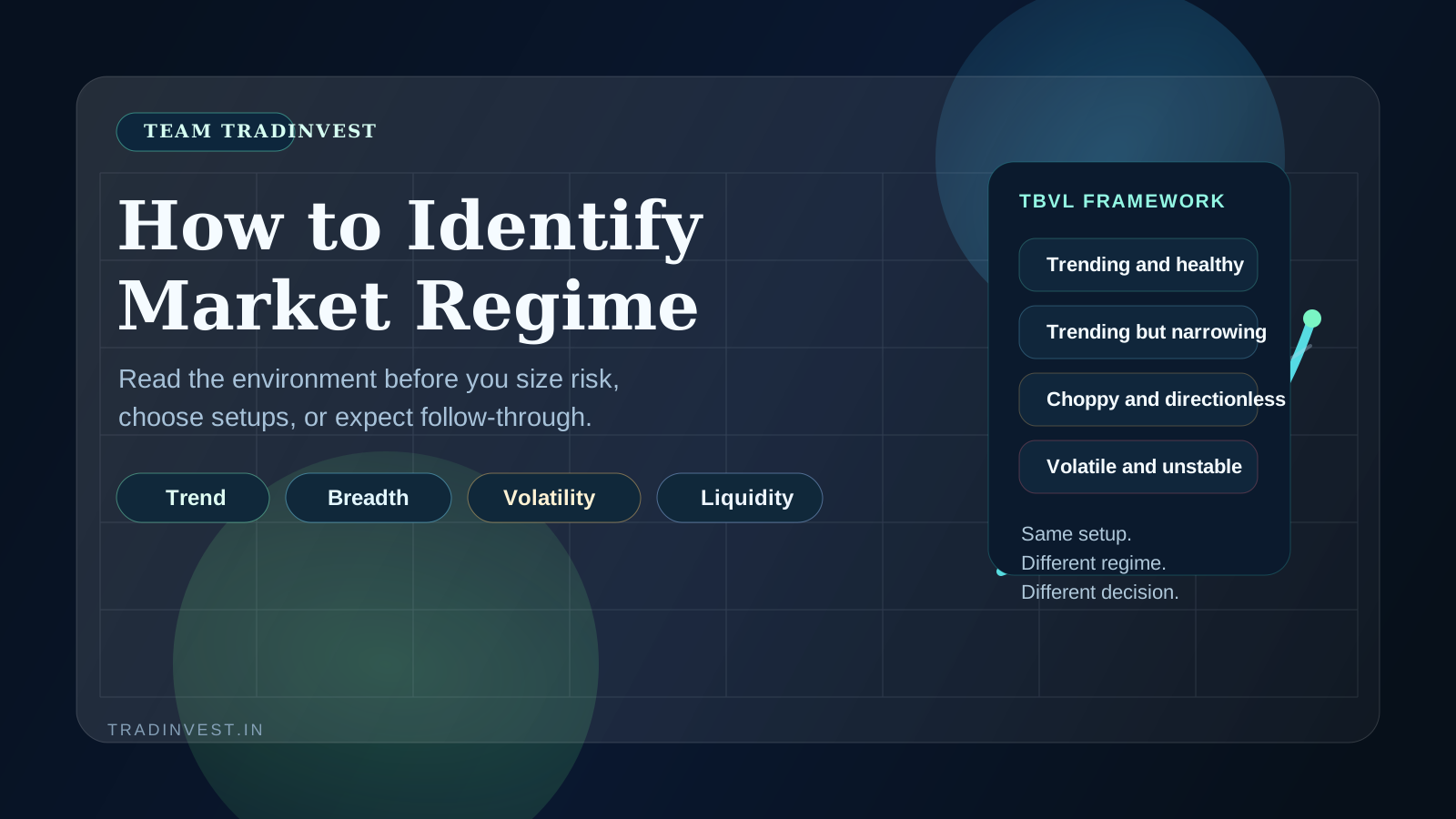
Four core dimensions determine regime:
- Trend: Is the market moving in a directional way or oscillating?
- Breadth: Is participation broad or narrow?
- Volatility: Is the range expanding or contracting?
- Liquidity: Are conditions orderly or is there spread, gap, and slippage risk?
These four inputs together define what kind of environment you are trading in. Different regimes favor different strategies, different sizing, and different expectations.
The TBVL Framework: A Practical Regime Classification System
To make regime reading consistent and repeatable, use what we call the TBVL Framework, named after its four inputs: Trend, Breadth, Volatility, Liquidity.
The goal is not to score the market perfectly. The goal is to answer four binary or scaled questions before each trading session, and use those answers to set your operating mode for the day or week.
T: Trend
What to ask: Is the market moving directionally, and over what timeframe?
Trend is the most basic regime input but the most misread. Most traders check whether the index is up or down on the day. That is not trend. Trend is the directional bias across a meaningful lookback period, 10 to 30 days for swing traders, 5 to 10 sessions for intraday traders.
Relevant questions:
- Is Nifty or the relevant index making higher highs and higher lows, or the opposite?
- Is price above or below a meaningful moving average on the primary timeframe?
- Has the trend been intact or is it showing signs of distribution or accumulation at extremes?
A clearly trending market supports directional bias, momentum entries, and wider targets. A range-bound market punishes breakout trades and rewards mean-reversion.
B: Breadth
What to ask: How many stocks are participating in the move?
Trend at the index level can be misleading. The index can make new highs while fewer and fewer stocks are participating. That divergence is a signal.
Market breadth captures participation. High breadth means the move is genuine and broadly supported. Low breadth means the index is being pulled by a handful of large-caps while the rest of the market sits still or falls.
Relevant signals:
- Advance-decline ratio: are more stocks rising than falling?
- Percentage of stocks above their 20-day or 50-day moving average
- New highs versus new lows across the broader market
- Whether mid-cap and small-cap indices are confirming the large-cap move
A bull phase with high breadth is the most favorable environment for trend-following and momentum strategies. A bull phase with deteriorating breadth is a warning that the environment is narrowing and risk is building.
V: Volatility
What to ask: Is the range expanding or contracting, and is it orderly or erratic?
Volatility is not inherently bad. Contracting volatility creates compression setups. Expanding volatility creates breakout opportunities. Erratic volatility, where ranges expand unpredictably and gaps become frequent, degrades almost every systematic strategy.
Relevant signals:
- India VIX: rising VIX signals expanding risk premium and uncertainty
- Average true range of the index over recent sessions compared to its 30-day norm
- Frequency of intraday reversals or gap-heavy opens
Low, stable volatility supports momentum and trend trades with tighter stops. High but directional volatility can still be traded but requires wider stops and smaller size. Erratic, news-driven volatility is the hardest environment: setups form and fail not because the logic was wrong but because the signal-to-noise ratio is low.
L: Liquidity
What to ask: Are conditions orderly, or is execution quality degraded?
Liquidity is the most underappreciated regime input. It shows up in bid-ask spreads, in how much slippage you get on fills, and in how often stocks gap through intended entries and stops.
This matters most for intraday traders and options traders in Indian markets, where liquidity can shift significantly around expiry weeks, post-result announcements, circuit-breaker events, or large institutional activity.
Relevant signals:
- Are spreads in your typical stocks wider than usual?
- Are you seeing frequent gap opens that are disconnecting price from the prior session?
- Is the options chain showing unusually high premiums or wide strikes?
Low liquidity environments require tighter position sizing, harder pass on marginal setups, and realistic expectations about fills.
Mapping TBVL to Four Regime Types
Once you run the four inputs, most market environments fall into one of these categories:
Regime 1: Trending and Healthy
Trend intact, breadth confirming, volatility moderate and stable, liquidity orderly. This is the most favorable environment. Momentum setups, breakouts, and trend continuation trades work well. Position sizing can be at normal levels. Holding periods can be extended.
Regime 2: Trending but Narrowing
Trend intact at the index level, but breadth is declining. Fewer stocks are participating. This is a warning environment. Index-level trend trades can still work, but individual stock selection becomes more important and mistakes are punished faster. Reduce size on setups that require broad confirmation.
Regime 3: Choppy and Directionless
No clear trend, breadth neutral or mixed, volatility low. Breakout trades fail repeatedly. Mean reversion setups have better odds. This is an environment to trade less, smaller, and with tighter expectations.
Regime 4: Volatile and Unstable
Sharp moves, expanding VIX, erratic intraday ranges, possible gap risk. Most setups are lower quality in this environment regardless of how clean the chart looks. Capital preservation mode. If you trade at all, size down significantly and focus only on your highest-conviction setups with clearly defined stops.
Worked Example: The Same Breakout in Two Regimes
Consider a standard volume-confirmed breakout setup on a mid-cap stock. Price has consolidated for several sessions just below a key resistance level. Volume contracts during the consolidation and expands on the breakout candle. The setup is textbook.
Scenario A: Regime 1 (Trending and Healthy)
Nifty is above its 50-day moving average and making higher highs. The advance-decline ratio has been positive for the past 10 sessions. India VIX is around 12. The mid-cap index is confirming the large-cap trend. Liquidity is normal.
In this environment, the breakout has a reasonable probability of following through. The broader market is providing a tailwind. Sector rotation is supportive. The trade is worth taking at full size with a target at the next meaningful resistance.
Scenario B: Regime 4 (Volatile and Unstable)
The same stock, the same chart pattern, two weeks later. Nifty has sold off sharply over three sessions. VIX has moved from 12 to 22. The advance-decline ratio is deeply negative. Mid and small caps are underperforming. There are frequent gap opens.
The breakout pattern still exists on the chart. But the environment has changed fundamentally. In this regime, breakouts fail at a much higher rate because sellers are active across the market and any upward move attracts distribution. The risk of a gap through your stop is elevated. Holding period expectations need to compress significantly.
The correct response is either to skip the trade entirely or to take it at a fraction of normal size with a tighter stop and a shorter target, acknowledging that the setup quality has not changed but the environment supporting it has deteriorated substantially.
This is the core principle of regime-aware trading: the setup does not exist in a vacuum. The environment either supports it or degrades it.
How Regime Should Change Your Trading Behavior
Position Sizing
Size is a regime variable, not a fixed percentage. In Regime 1, full size is justified on high-quality setups. In Regime 3 or 4, half-size or less is appropriate even on good setups. The expected value of each trade changes with the environment. Your risk per trade should reflect that.
Aggressiveness
In a healthy trending regime, being early on a pullback entry is acceptable because the trend provides a cushion. In a volatile or choppy regime, aggressive entries on early signals fail at much higher rates. Wait for more confirmation even if it costs some of the move.
Setup Selection
Momentum and breakout setups outperform in Regime 1. Mean reversion and range-bound setups are better suited for Regime 3. In Regime 4, the bias is toward avoidance rather than setup hunting. Forcing your preferred style into an unsupportive environment is one of the most common reasons traders run drawdown streaks.
Expectations and Targets
Healthy trending regimes support wider targets and longer holds. Choppy or volatile regimes require compressing expectations. A trade that you would normally hold for 3 to 5 days may only be worth holding for 1 day in a degraded environment. Adapt your target to what the environment can realistically deliver.
Holding Period
Regime affects how quickly the market changes its mind. In a volatile regime, thesis invalidation happens faster. Shorten your holding period unless you have a very clear and specific reason to stay in.
For Indian Traders: Regime Signals That Are Easy to Miss
Indian markets have structural features that affect regime in ways that generic frameworks do not account for.
Index Mood vs. Broad Participation
Nifty 50 is a large-cap index. It can look healthy while NSE 500 or the small-cap index is deteriorating. A common mistake is reading Nifty's trend as a proxy for overall market health. For traders who work in mid-caps or individual stocks outside the top 50, checking the broader index is essential.
F&O Expiry Effects
Weekly and monthly expiry create liquidity distortions that affect regime classification. In expiry week, IV compression, pin risk, and institutional positioning can produce range-bound behavior in stocks that normally trend. Breakout strategies tend to underperform around expiry, not because setups are bad but because the regime temporarily shifts toward noise. Factor this into your expectations each Thursday.
Sharp Open Gaps
Indian markets frequently gap at open in response to SGX Nifty, US market moves, or overnight news. A gap open does not automatically change the regime, but it changes the execution environment for that session. On gap-up opens in trending regimes, the first 30 minutes often see profit-booking before continuation. On gap-down opens in volatile regimes, avoid bottom-fishing entries until the open settles.
Sector Rotation as a Breadth Signal
Sector rotation is one of the clearest breadth signals available in Indian markets. When money is rotating actively across sectors, broad participation is healthy even if individual sectors are underperforming. When rotation narrows and only one or two sectors are leading while everything else is flat or down, breadth is weakening regardless of what the index shows.
PSU and Cyclical Behavior
PSU banks, metals, and infrastructure stocks are particularly sensitive to policy and global commodity moves. Their participation or non-participation is a useful secondary breadth signal for traders whose universe extends beyond IT and private banks.
TradInvest's TIP Factors systematize several of these regime signals, including trend, institutional participation, and sector breadth, into a structured daily read that removes the need to check six different sources every morning.
Common Regime Mistakes
Using one input as the whole picture
Looking only at the trend without checking breadth leads to entering regime 2 as if it were regime 1. Looking only at volatility without trend can lead to avoiding good trades in volatile but directional environments.
Static classification
Regime is not something you set once a month. It can shift within a week or even within a session during earnings or policy events. Review your TBVL inputs at the start of each session and adjust your operating mode accordingly.
Ignoring regime on high-conviction setups
The most dangerous moment is when a trader has a setup they believe in strongly and the regime is deteriorating. Conviction bias overrides environmental awareness. The result is a high-confidence trade in a low-quality environment, which is where some of the worst drawdowns come from.
Assuming low volatility means low risk
Regime 3 (choppy, low volatility) feels safe because the market is not crashing. But repeated small losses from breakout failures and stop-outs accumulate quickly in a range-bound environment. The risk is different from Regime 4 but it is real.
Pre-Trade Regime Checklist
Run through these inputs before your first trade of each session:
Trend
- What is the primary index doing over the last 10 to 20 sessions?
- Is price above or below its key moving average?
- Is the trend intact, extended, or showing signs of reversal?
Breadth
- Is the advance-decline ratio positive or negative?
- Are mid-cap and small-cap indices confirming or diverging?
- Are more stocks making new highs or new lows?
Volatility
- Where is India VIX relative to its recent average?
- Is the intraday range expanding or contracting?
- Are there frequent gaps or sharp intraday reversals?
Liquidity
- Are spreads and fills normal in your typical instruments?
- Is there an expiry or major event that could distort execution?
- Are options premiums elevated in a way that reflects uncertainty?
Regime Classification
- Which of the four regime types best describes today's environment?
- Does my planned setup fit this regime?
- What is the appropriate size and target given the regime?
Key Takeaway
Most traders do not have a setup problem. They have an environment problem. The same setup that works cleanly in a healthy trending market with broad participation will fail repeatedly in a choppy, narrow, or volatile environment. Not because the logic is wrong, but because the conditions no longer support it.
The TBVL Framework gives you a consistent, four-input way to classify market regime before entering risk. Trend tells you direction. Breadth tells you whether the move is real. Volatility tells you how to size and what to expect. Liquidity tells you whether execution quality is intact.
When all four inputs align, act at full capacity. When they conflict, reduce size and compress expectations. When they strongly conflict, skip the session or trade the minimum.
Regime awareness does not eliminate losses. Nothing does. What it does is reduce the frequency of good decisions made in bad environments, which over time is one of the highest-leverage improvements a trader can make.
Reading Regime With TradInvest Pulse
Assembling the four TBVL inputs manually every morning requires checking multiple sources: index charts, advance-decline data, VIX, sector performance, options premiums. Most traders either do it incompletely or skip it when pressed for time.
TradInvest Pulse is useful if you want those regime signals organized into a cleaner daily read instead of piecing them together manually. It connects index trend, breadth, sector rotation, and volatility context in one place. If you want the logic behind that structure, the TIP Factors explainer is the best starting point.
Regime reading works best when it becomes a daily habit rather than an occasional check. The goal is not to predict every move. The goal is to stop trading as if all environments deserve the same level of aggression.
The market always has a character. The job is to read it before it reads you.
Spread the good words
Give your view.
Give your view
Comments
0Use this insight inside the product
TradInvest is built to connect market context, strategy quality, and post-trade learning. Read the market with Pulse, narrow your watchlist with rotation and momentum, then review what actually worked.
Related posts
More insight tied to the same trading workflow.