You took a loss. It was clean, within your rules, within your stop. And then you entered again, faster, bigger, without the same setup. Not because the market gave you a reason to. Because you needed to get the money back.
That is revenge trading. And it is not about anger.
Most traders who spiral into overtrading are not banging their fists on the desk. They are sitting quietly, feeling an urgency that overrides process. The emotion doing the damage is not rage. It is something more subtle: the feeling that the session is broken and needs to be fixed, that your identity as a trader is on the line, that the loss on your screen is a verdict rather than an outcome.
This article is about interrupting that cycle, specifically, practically, at each stage where it can be stopped.
Revenge trading, in one sentence: it is a recovery-driven trade taken to erase a recent loss, not because a fresh, rule-qualified setup actually exists.
What Revenge Trading Actually Looks Like
Revenge trading is not always recognizable in the moment because it rarely announces itself as emotional. It disguises itself as analysis.
You close a losing trade. Within minutes, you are scanning again. You find something that is moving. You tell yourself you see a setup. The position size is a little larger than usual. The stop is a little tighter. The target is exactly large enough to recover what you just lost.
That last part is the tell. When your target is defined by what you need to recover rather than by what the chart offers, you are revenge trading.
Common patterns it takes in real trading behavior:
- Impulsive re-entry after a stopped-out trade, in the same stock, same direction, without waiting for a new setup to form
- Size escalation on subsequent trades, trying to recover faster with fewer trades
- Setup threshold lowering, where trades that would not have qualified under your normal rules suddenly seem acceptable
- Tunnel vision on a single name because you feel you "understand" why it went against you and are now sure of the reversal
- Ignoring market context, entering into a deteriorating tape because the focus has shifted from the market to the loss
None of these feel like emotional trading in the moment. Each one has a rationalization attached to it. That is what makes revenge trading harder to catch than most traders expect.
Why Traders Fall Into It
Understanding the mechanics matters more than labeling the emotion.
It Is Rarely Just Anger
The framing of revenge trading as anger is misleading. Anger is one input. The more common inputs are:
Identity damage. A significant loss, or a loss on a high-conviction trade, can feel like evidence that you do not know what you are doing. The urgency to re-enter is partly an urgency to disprove that conclusion, to yourself, before the session ends.
Fear of ending red. There is a specific discomfort in closing a trading session with a net loss. For many traders, this is more uncomfortable than the loss itself. The drive to avoid ending red creates pressure to force a recovery trade that the market has not offered.
The sunk cost pull. Once a loss exists, it feels real and permanent. A gain that erases it feels like restoration of something that was taken. This framing, loss as something taken, gain as something restored, is what drives the urgency. It is not how markets work, but it is how the brain processes it.
Process collapse after ego damage. When a trade goes wrong on a setup you were confident about, there is often a subtle breakdown in process discipline. If your read was wrong once, the rules that generated it feel less reliable. That momentary loss of faith in process is the crack through which overtrading enters.
For Indian Traders: When the Market Moves Fast
Indian markets create specific conditions where revenge trading accelerates.
Gap openings driven by overnight US moves or SGX Nifty signals can catch traders on the wrong side immediately at open. The first trade of the day is a loss before the session has fully settled. The impulse to recover compounds with the already elevated volatility of the first 30 minutes.
Expiry days, especially weekly expiry on Thursday, amplify this further. Premiums collapse, positions move fast, and stops get hit on whipsaws that resolve within minutes. A trader who loses on a directional options position in the first hour of expiry is in one of the highest-risk situations for revenge trading: urgency high, volatility high, process reliability low.
Index-led moves also create a specific trap. When Nifty makes a sharp move, stocks across the board react. A trader holding a stock position that gets stopped out by an index-driven flush may immediately try to catch the recovery, not because the stock gives a signal, but because they saw the index reverse. That is emotional trading dressed as index reading.
The LIRA Framework: Interrupting the Spiral Before It Compounds
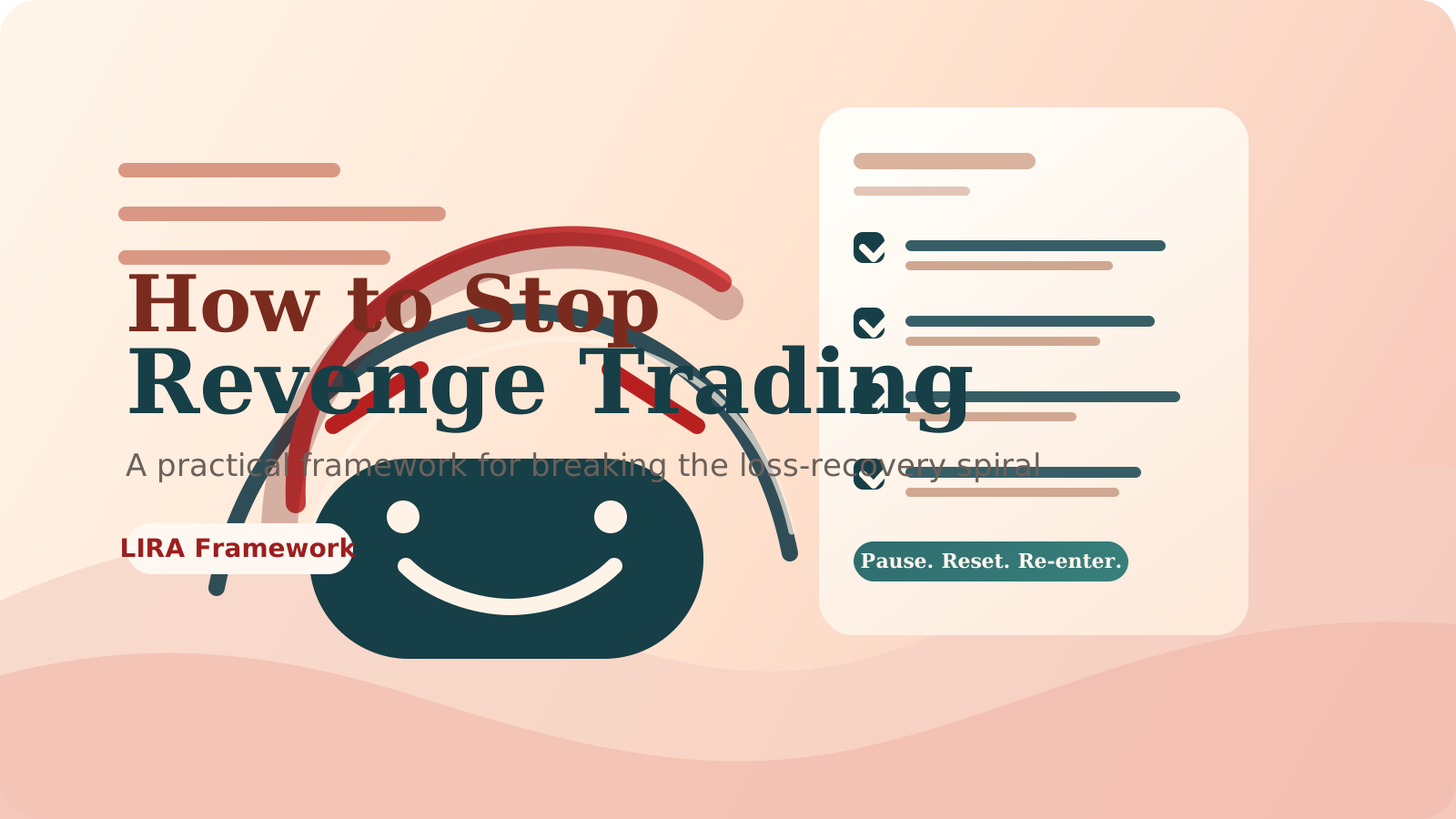
The goal of any practical framework is to create a gap between impulse and action. Revenge trading happens when that gap is zero. The LIRA Framework, Label, Isolate, Reset, Authorize, is a four-step process designed to rebuild that gap in real time.
L: Label
Name what is happening out loud or in writing. Not the market behavior. Your behavior.
"I just lost and I want to trade immediately to recover."
That sentence sounds obvious. Most traders in a revenge-trading spiral have not said it, even internally. Labeling the impulse for what it is, not a market read, not a setup, but a recovery drive, is the first interruption.
I: Isolate
Separate the loss from what comes next. The loss is closed. It exists in the past. The next trade has no relationship to it.
Ask: "If I had not just taken that loss, would I be entering this trade right now?"
If the answer is no, if the trade you are considering only makes sense as a recovery vehicle, do not take it. The trade must justify itself on its own terms, not on the terms of what preceded it.
R: Reset
A reset is a physical or procedural break that interrupts the emotional state before it drives the next action. This does not need to be long. It needs to be real.
Specific reset actions that work:
- Stand up, leave the screen for five minutes
- Write down the previous trade in your journal, what you planned, what happened, what you learned, before looking at any new setups
- Run through your pre-trade checklist from the beginning, as if the session is starting fresh
- Check market regime: is the broader tape supportive of new trades right now?
The reset is not about calming down. It is about re-engaging the process that revenge trading bypasses.
A: Authorize
Before entering the next trade, explicitly authorize it against your own rules.
Ask: Does this trade meet my setup criteria? Is the size within my normal parameters? Is the stop defined by the chart, not by what I need to recover?
If you cannot answer all three clearly, the trade is not authorized. Do not enter it.
The LIRA Framework does not prevent losses. It prevents the second, third, and fourth trade that turns a manageable loss into a damaged session.
How a Good Trader Spirals: A Worked Example
Arjun trades Nifty options on weekly expiry. He runs a defined process: he waits for the first 30 minutes to settle, identifies the day's bias from the opening range, and enters positions with a 1:1.5 risk-reward minimum.
At 9:45, he takes a short position based on a breakdown below the opening range low. Stop is 40 points above entry. By 10:05, the market reverses sharply on no visible news. His stop triggers. Loss: within plan.
At 10:08, Arjun notices the market has already started pulling back from the reversal. He thinks: "The original direction was right. This was a stop hunt." He re-enters short, same direction, no new setup has formed, just a feeling that the original thesis is still valid. No checklist. Position size: slightly larger, because the first trade's loss means he needs a bigger winner to get back to even.
By 10:25, the market has pushed higher again. Second stop triggers. Loss: larger than the first, because of the increased size.
At 10:30, Arjun is now down roughly double his planned daily loss limit. He is not angry. He is focused, intensely, narrowly focused on the chart, waiting for the next entry. His thinking has narrowed: he is no longer evaluating the session or managing risk across the day. He is trying to fix the morning.
He takes a third trade. It also fails. By 11:00, he has exceeded his weekly loss limit in a single session.
What went wrong was not the first trade. The first trade was executed within his process. What went wrong was the absence of a reset after the first loss, and the absence of an authorization check before the second. Each subsequent trade degraded his process further, because each one was justified not by the market but by the loss that preceded it.
How to Interrupt the Cycle in Real Time
After a Loss
The most important moment is the 60 to 90 seconds after a trade closes at a loss. This is when the next decision is made under the worst conditions: elevated emotional state, no distance from the outcome, maximum urgency.
Do these in order:
- Do not look for the next trade immediately. Close or minimize the position screen.
- Record the completed trade in your journal before doing anything else. Entry, exit, what the plan was, what actually happened.
- Check your daily loss limit. If you are within it, run the LIRA framework before the next entry. If you have hit it, the session is over for new positions.
- Check the clock. In Indian markets, the first 30 minutes and the last 30 minutes carry the highest emotional volatility risk. If you are in those windows, the threshold for a new trade should be higher than usual.
Before the Next Trade
Before any trade, and especially after a loss, run a three-question check:
- Does this trade qualify by my pre-defined criteria, independently of the previous trade?
- Is my size within my normal range, not adjusted upward to recover faster?
- Is my stop defined by the chart, not by what I need to lose to still break even on the day?
A no to any of these is a hard stop.
During a Revenge-Trading Impulse
When you notice the urgency rising, the feeling that you need to be in something, that the session is slipping away, that you are running out of time to recover, treat that feeling as a signal to pause, not to act.
Urgency is information about your emotional state. It is not information about the market.
Write down what you are feeling and what you are about to do. The act of writing it forces a level of self-awareness that interrupts the automatic sequence from impulse to action.
During End-of-Day Review
End-of-day review is where revenge trading patterns become visible over time, and where the structural changes that reduce them get built.
Review not just outcomes but sequences. Did any trades happen within 5 to 10 minutes of a stop-out? Were any positions sized larger than your standard risk? Were any entries taken without a full setup qualification?
These patterns, when seen clearly in review, become the evidence that motivates structural change, not because you feel bad about them, but because you can see exactly where and how the process broke.
How to Reduce Overtrading Structurally
Interrupting individual impulses matters. But if the conditions that produce revenge trading are always present, interrupting it trade by trade is exhausting and unreliable. The structural changes that reduce overtrading:
Set a hard daily loss limit and make it a session-ending rule, not a guideline. Once the limit is hit, no new positions. Not "I'll be more careful." The session is done. This removes the recovery pressure that drives most overtrading.
Define maximum trades per session in advance. If your plan says four trades per day, the fifth trade requires a conscious override, which creates friction. Friction reduces impulsive action.
Separate your watchlist from your execution. Scanning for setups while in an emotional state after a loss produces low-quality candidates. Build your watchlist before the session, when your state is neutral.
Use a pre-trade checklist every time, not just when you feel uncertain. The checklist is most valuable on the trades where you feel most certain, those are the ones where overconfidence or recovery urgency is most likely to have bypassed your process.
Review your worst trading sessions systematically. Not to feel bad about them, but to find the pattern. Most traders who overtrade have a specific trigger sequence: a particular type of loss, a particular time of day, a particular market condition. Once the trigger is known, it can be prepared for.
Common Mistakes Traders Make Around Revenge Trading
Treating it as a discipline problem rather than a process problem. Telling yourself to "be more disciplined" does not work because the impulse to revenge trade bypasses deliberate thinking. Process structures, checklists, loss limits, mandatory review, work because they create friction at the right moment.
Waiting until they are calm to review. If you only review when you feel good about your trading, you are reviewing your successes. Review your worst sessions when the memory is fresh enough to be accurate.
Adjusting their stop to avoid taking the loss. Moving a stop further away from price to avoid realizing a loss is one of the clearest signs that identity and outcome are entangled. A stop exists to define risk, not to delay acknowledgment.
Confusing high activity with effort. Overtrading feels like working hard. Taking more trades, being in the market longer, reacting to more moves, it feels like engagement. It is often the opposite: a loss of selectivity that is the core of edge.
Only journaling wins. A journal that records only your good trades is a collection of confirmation bias. The trades that teach you the most are the ones where the process broke down.
Practical Checklist: Before, During, and After
Before the Session
- Daily loss limit defined and written down
- Maximum number of trades set
- Watchlist built while market is closed or pre-open
- Pre-trade criteria reviewed
Before Each Trade
- Does this meet my full setup criteria?
- Is size within normal parameters?
- Is stop defined by the chart?
- Am I in a recovery mindset from the previous trade?
After a Loss
- Record the trade in the journal immediately
- Check remaining daily loss budget
- Run LIRA: Label, Isolate, Reset, Authorize
- Wait a minimum of 5 minutes before evaluating new entries
End of Day
- Were any trades taken within 5 minutes of a prior stop-out?
- Were any positions sized above normal?
- Were any entries taken without full setup qualification?
- What was the emotional state pattern across the session?
Key Takeaway
Revenge trading is not a character flaw. It is a predictable behavioral pattern that emerges when identity, urgency, and loss are combined without a process structure to interrupt them.
The traders who manage it well are not more emotionally resilient in some innate sense. They have better structures: a daily loss limit they treat as a hard stop, a checklist they run before every trade, a journal they review honestly, and a framework like LIRA that creates a gap between impulse and action at exactly the moment when the gap matters most.
Every trader will feel the pull toward recovery after a loss. The question is what happens in the 90 seconds after that feeling arrives. That moment, repeated across hundreds of sessions, is where trading discipline is actually built or lost.
Building the Review Habit That Catches Patterns Early
The structural changes above are most effective when they are informed by real data from your own trading history. Patterns like revenge trading show up clearly when you can see sequences of trades, not just individual outcomes.
A trading journal that captures entry time, exit time, emotional state, and setup quality gives you the evidence you need to identify your specific triggers. How to Build a Trading Journal That Improves Decision Making walks through how to set that up in practice.
For traders who want to go deeper into the broader psychology of execution, Mastering Trading Psychology covers the wider decision-quality landscape that revenge trading sits within.
If you want a structured way to review these patterns, TradInvest's journaling and analytics tools are designed to make session review specific and repeatable rather than vague and retrospective.
The review habit will not prevent every bad session. What it does is make the bad sessions informative rather than just expensive.
Spread the good words
Give your view.
Give your view
Comments
0Use this insight inside the product
TradInvest is built to connect market context, strategy quality, and post-trade learning. Read the market with Pulse, narrow your watchlist with rotation and momentum, then review what actually worked.
Related posts
More insight tied to the same trading workflow.