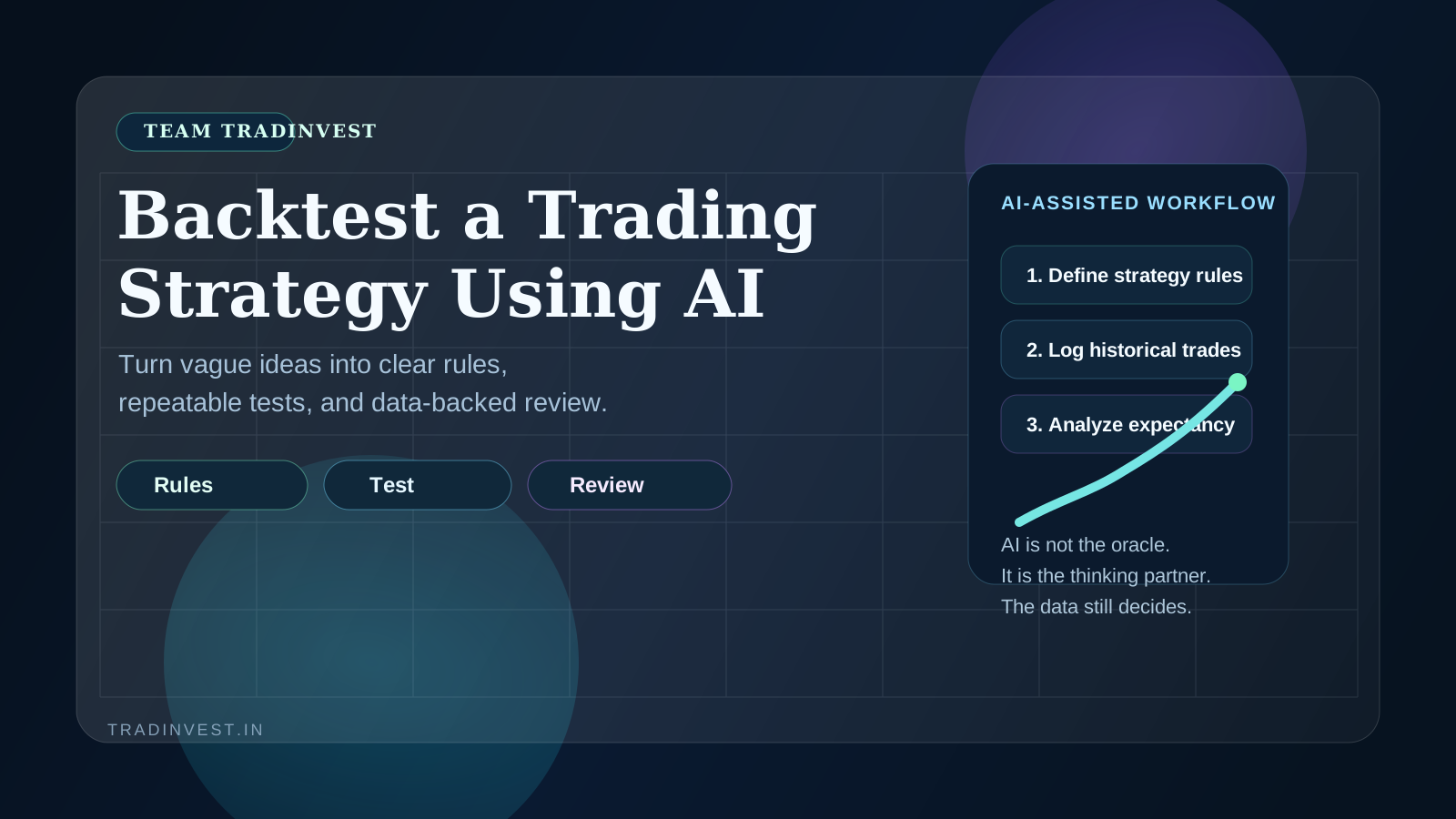
You have a strategy. Maybe it's a simple moving average crossover. Maybe you exit when RSI hits 70. Maybe you've been paper-trading it in your head for weeks and it "feels" right.
But there's one question you haven't answered yet: does it actually work?
Not in theory. Not in your memory of three trades that went well. Actually work — across 30, 50, 100 trade setups — with real numbers behind it.
For most beginners, backtesting felt like it required Python, databases, and a computer science degree. So they skipped it.
That barrier no longer exists. AI tools like ChatGPT and Claude have changed what's possible for everyday traders. You don't need to code. You don't need expensive software. You need clarity about your strategy, a few free tools, and a process.
This guide gives you that process — step by step.
Backtesting with AI, in one sentence: use AI to turn a vague trading idea into clear rules, a repeatable test process, and a data-backed review instead of relying on memory or gut feel.
Why Most Traders Fail Without Backtesting
Here's a hard truth: most retail traders are running strategies they've never actually tested. They watched a YouTube video, tried it on a few live trades, made some money, and decided it works.
That's not edge. That's luck wearing the costume of skill.
There are a few specific traps that catch beginners:
The illusion of strategy. You have a rule like "buy when the stock breaks out." But what counts as a breakout? From what timeframe? With what volume? Without precise rules, you don't have a strategy — you have a preference. Preferences don't scale.
Hindsight bias. Looking at a chart after the fact, everything looks obvious. "Of course it was going up — look at that setup." That clarity disappears when you're watching price move in real time. Backtesting forces you to define rules before you see the outcome.
Overconfidence from small samples. Three winning trades proves nothing. Even a broken clock is right twice a day. You need volume — enough trades to filter out noise and see whether your edge is real or accidental.
Backtesting doesn't guarantee you'll win. But skipping it almost guarantees you won't know why you're losing.
What Backtesting Actually Means (Simple Language)
Forget the technical definition. Here's the simplest way to think about it:
Backtesting is replaying history with your rules turned on.
You go back through past charts. You apply your entry and exit conditions exactly as you've defined them. You record every trade that would have triggered. Then you look at what those trades produced.
That's it.
Think of it like a cricket coach reviewing match footage. The game already happened. You can't change it. But you can study what worked, what didn't, and why — so the next time you're on the field, you're not guessing.
The goal isn't to find a strategy that won every time in the past. That doesn't exist. The goal is to find a strategy that had a consistent edge — one where the wins were bigger than the losses often enough that trading it made mathematical sense.
When you know your strategy's win rate and average risk-reward, you're no longer hoping it works. You know what to expect.
The New Edge — Using AI for Backtesting
Until recently, backtesting required one of two things: either expensive platforms (Amibroker, TradeStation) or coding skills to write scripts in Python or Pine Script.
Both options left out the majority of retail traders.
AI changes that in three specific ways.
Prompt-based thinking. AI tools like ChatGPT and Claude are built for language, not code. You can describe your strategy in plain English and the AI helps you convert it into precise, testable rules. What used to require a programmer now requires a clear sentence.
Data structuring. AI can help you design the right spreadsheet, create trade log templates, and identify what data you actually need to record — without you having to figure this out from scratch.
Logic automation. Once your rules are defined, AI can help you scan through historical price data (that you pull manually or from free sources), flag which setups qualify, and even help you calculate the results. It won't do everything automatically, but it will do the heavy thinking — which was always the hard part.
The tools you'll use in this guide:
- ChatGPT or Claude — for defining rules, building prompts, and analyzing results
- Google Sheets or Excel — for logging and calculating
- TradingView (free tier) — for pulling historical chart data manually
- Screener.in or Chartink — for finding historical stock data (India-focused)
No subscriptions. No code. No excuses.
The Complete Beginner Roadmap
This is the core of the guide. Follow these six steps in order.
Step 1: Define Your Strategy Clearly
Before you touch any tool — AI or otherwise — you need to know exactly what your strategy says to do.
Most beginners skip this step because they think they already know their strategy. They don't. They know a rough idea.
There's a difference between "I buy breakouts" and this:
Entry: Price closes above the 20-day high on a daily candle, with volume at least 1.5x the 20-day average volume.
Stop Loss: Below the low of the breakout candle.
Target: 2x the distance from entry to stop loss (2:1 R:R).
Exit Rule: If target isn't hit within 10 trading sessions, exit at market close on day 10.
Write your strategy in this format. Entry condition. Stop loss. Target or exit rule. Timeframe. Universe of stocks you're trading (Nifty 50? Midcap? F&O stocks only?).
If you can't write it this precisely, you don't have a strategy yet. That's okay — it just means Step 1 is where you need to spend time.
Step 2: Convert Your Strategy into AI-Friendly Rules
Once your strategy is written clearly, you need to phrase it in a way AI can work with.
Here's how to prompt ChatGPT or Claude:
"I have a trading strategy I want to backtest manually. Here are the rules:
[paste your entry, SL, target, timeframe, and stock universe]Please help me:
- Check if these rules are precise enough to be tested
- Identify any ambiguities or missing conditions
- Create a checklist I can use each time I look at a chart to decide if a trade qualifies"
The AI will ask clarifying questions and help you tighten your logic. This single step often reveals gaps in your strategy you didn't know existed.
Step 3: Use AI to Generate a Backtest Plan
Now you'll use AI to design the actual backtest process.
Here's a sample prompt:
"I want to backtest the following strategy over the last 6 months on Nifty 50 stocks, manually using TradingView charts and a Google Sheet to record results.
Strategy: [paste rules]
Please create:
- A step-by-step process for how I should scroll through charts and identify qualifying setups
- A Google Sheets template with the columns I need to record for each trade
- The calculations I should run at the end to evaluate results (win rate, average R:R, max drawdown)"
Claude or ChatGPT will give you a complete framework. You're not building this from scratch — you're directing AI to build it for you.
Step 4: Use Simple Tools (No Coding)
Here's your basic tech stack:
TradingView (free): Go to any stock, switch to your timeframe (daily, 15-min, etc.), and scroll back 6–12 months. Manually identify each candle where your entry conditions were met. Note the date, entry price, stop loss, and target.
Google Sheets: This is your backtest log. At minimum, track:
| Column | What to Record |
|---|---|
| Date | When the setup triggered |
| Stock | Which instrument |
| Entry Price | Exact entry level |
| Stop Loss | Where you'd exit if wrong |
| Target | Where you'd exit if right |
| Result | Win / Loss / Scratch |
| P&L in R | +2R, -1R, etc. |
| Notes | What made this setup qualify |
AI-assisted hybrid: Once you've logged 15–20 trades, paste the data into ChatGPT or Claude and ask it to analyze patterns. Which setups performed better? Is there a time-of-day pattern? Did certain market conditions affect results?
You're doing the manual data collection. AI is doing the analytical thinking.
Step 5: Record Trades Like a Mini Journal
Every trade you log in your backtest should have a brief note: why it qualified, what happened, and anything unusual.
This isn't bureaucracy. It's where the real learning happens.
After 30 trades, you'll start noticing things. "Every time I took this setup near a major resistance level, it failed." "Setups that triggered on Monday had a lower win rate." These are insights that pure number-crunching won't surface.
Keep it simple. One or two sentences per trade. You'll thank yourself later.
Step 6: Analyze Your Results
Once you have 30–50 trades logged, it's time to evaluate.
The three numbers that matter most for a beginner:
Win Rate: What percentage of trades were winners? A 40% win rate can be highly profitable — it depends on your next metric.
Average Risk-Reward Ratio: On winning trades, how much did you make relative to your risk? If you risk 1% and your average winner returns 2.5%, a 40% win rate gives you positive expectancy.
Max Drawdown: What was the longest or deepest losing streak? This tells you whether you could psychologically survive trading this strategy live. A strategy that requires surviving 10 consecutive losses before recovering is technically profitable but practically unusable for most traders.
Paste your sheet data into Claude and ask: "Based on these backtest results, is this strategy worth trading live? What are the weaknesses I should address?"
The AI won't make the decision for you — but it will frame the question clearly.
A Full Example: The 20-Day Breakout Strategy
Let's walk through a complete example so you can see how this works in practice.
The Strategy
- Universe: Nifty 100 stocks
- Timeframe: Daily chart
- Entry: Price closes above the 20-day high, with volume > 1.5x the 20-day average
- Stop Loss: Low of the breakout candle
- Target: 2R (twice the SL distance)
- Max Hold: 15 trading sessions
How AI Helps
You open Claude and paste this strategy. You ask it to flag any ambiguities.
Claude might respond: "What happens if the breakout candle has a very wide range, making the SL unusually large? Do you still take the trade? Also, do you allow re-entries if price pulls back and breaks out again?"
Good questions. You hadn't thought about those. You add two more rules: maximum SL of 3% from entry, and no re-entries within 5 sessions of a failed breakout.
Now your strategy is tighter.
Running the Backtest
You go to TradingView. You pick 10 Nifty 100 stocks at random. You scroll back 6 months on each and mark every candle where the breakout condition was met. You log each one in your Google Sheet.
After 40 trades:
- Win rate: 38%
- Average winner: +2.1R
- Average loser: -1R
- Expectancy: (0.38 × 2.1) - (0.62 × 1) = +0.18R per trade
- Max consecutive losses: 6
The strategy has positive expectancy. The drawdown is manageable. You know, from data, that this is worth paper-trading live before committing real capital.
That's what backtesting gives you: confidence built on evidence, not hope.
Common Mistakes Beginners Make
Overfitting. You backtest a strategy, find it doesn't work, then tweak the rules until it does. Congratulations — you've now built a strategy that's perfectly optimized for the past and useless for the future. Define your rules before you backtest, not after.
Too few trades. Twenty trades is a start, not a conclusion. You need at least 30, ideally 50–100, before the numbers start to mean anything statistically.
Changing rules midway. You're three weeks in and your strategy is losing. You adjust the entry condition. Now your earlier data is useless because it was based on different rules. Start over, or keep two separate logs.
Blind trust in AI. AI will help you structure your thinking and analyze data. It won't tell you if your strategy will work in the future. Markets change. What backtested well in a trending market may perform differently in a choppy one. Use AI as a thinking partner, not an oracle.
Ignoring costs. In Indian markets, brokerage, STT, and slippage add up. Add a 0.1–0.2% friction cost per trade in your calculations and see if the edge survives. Many strategies that look profitable on paper break down after costs.
The Real Insight: What Backtesting Is Actually For
Most people approach backtesting looking for a guarantee. They want a strategy with a 70% win rate that never loses more than five times in a row.
That strategy doesn't exist.
What backtesting actually gives you is something more valuable: a reference point for your own behavior.
When you know your strategy wins 40% of the time, you stop panicking after three losses in a row. You've seen this before — in your data. You know it's within normal variance.
When you know your average winner is 2.3R, you stop cutting winners early because you're nervous. You have a target. You let it run.
Backtesting builds the one thing that actually separates consistent traders from inconsistent ones: conviction that isn't dependent on the last trade.
You're not trading blind anymore. You're trading with a map.
That map isn't perfect. Markets shift. Strategies stop working. You'll need to re-evaluate periodically. But you'll do it with data, not gut feel.
That is the edge.
What to Do Next
Don't let this become another article you read and forget. Here's a concrete three-step action plan you can start today:
-
Pick one strategy you're already curious about. It doesn't need to be complex. A moving average crossover, an RSI reversal setup, a breakout — whatever you've been thinking about.
-
Run a 30-trade backtest. Use TradingView for charts, AI to define your rules precisely, and Google Sheets to log results. Aim to finish within two weeks.
-
Evaluate and improve. After 30 trades, paste your results into Claude or ChatGPT and ask for an honest assessment. Identify the one or two conditions that most reliably preceded winning trades. Tighten your rules around those.
Then do it again with the improved version.
That feedback loop — define, test, evaluate, refine — is how trading strategies actually get built. Not from YouTube, not from tips. From your own data.
Where TradInvest Fits In
If you already journal trades or review setups after the fact, AI-assisted backtesting becomes even more useful. It helps you test the rules before you risk money, then compare those backtested expectations with your real execution later.
That is where the process becomes stronger: strategy logic, market context, and trade review stop living in separate places.
If you want a cleaner structure for the review side, start with our guide on how to build a trading journal. If you want stronger market context before testing directional strategies, the TIP Factors explainer shows how TradInvest thinks about regime, participation, and decision quality.
Frequently Asked Questions
1. Can I backtest a trading strategy without any software?
Yes. The simplest approach is to use TradingView's free chart view to scroll back through historical price data, apply your rules manually, and log the results in Google Sheets. AI tools like ChatGPT and Claude help you define your rules precisely and analyze the results — no paid software required.
2. How many trades do I need for a backtest to be valid?
A minimum of 30 trades gives you a rough signal, but 50–100 trades is a more reliable sample. Fewer than 30 trades and you're likely looking at noise rather than edge. If your strategy doesn't produce enough setups in 6 months of data, extend the lookback period or expand the stock universe.
3. Is using AI for backtesting reliable?
AI is a tool for thinking clearly, not a source of guaranteed results. It helps you define rules, spot logical gaps, and analyze data — but it doesn't have real-time market data and it can't predict future performance. Use AI to structure your process; use your own data to validate results.
4. What's the difference between backtesting and paper trading?
Backtesting uses historical data to simulate how a strategy would have performed in the past. Paper trading runs your strategy in real time with simulated money (no real capital at risk). Both are valuable. Use backtesting to validate your strategy's logic first, then paper trade it for 2–4 weeks to understand how it feels to trade in real time before going live.
5. Can I use Claude or ChatGPT to automatically generate backtest results?
Not fully automatically — at least not without some setup. You still need to manually pull historical price data (from TradingView or NSE) and log it. But AI can significantly reduce the cognitive work: defining rules, building your spreadsheet structure, calculating expectancy, and identifying patterns in your results. A hybrid approach — human data collection plus AI analysis — is the most practical starting point for beginners.
Spread the good words
Give your view.
Give your view
Comments
0Use this insight inside the product
TradInvest is built to connect market context, strategy quality, and post-trade learning. Read the market with Pulse, narrow your watchlist with rotation and momentum, then review what actually worked.