Most traders pick stocks one by one. The better workflow is to rank them first.
That shift sounds small, but it changes the entire quality of your watchlist. Instead of asking, "Does this chart look good?" you start asking, "Is this one of the strongest names in the entire universe right now?"
Relative strength ranking is the process of comparing stocks across a defined universe and scoring them from strongest to weakest based on multi-timeframe outperformance.
If you do that consistently, stock selection becomes less subjective, less narrative-driven, and much closer to a repeatable process. This article shows how to build that ranking logic, how to use it in practice, and how to connect it to actual trade selection.
If you are new to relative strength itself, start with our foundational guide to relative strength in trading. This article builds on that idea and takes it into ranking and prioritisation.
Why Most Stock Picking Breaks Down
Here is the problem with how many retail traders select stocks.
They scan what is moving, notice a breakout, read a news angle, like the story, and buy. That can work occasionally, but it is not a robust selection process. It is still one-stock-at-a-time thinking.
The weakness in that approach is simple: it never asks whether the stock you are looking at is actually better than the dozens or hundreds of alternatives available right now.
A stock can look strong in isolation and still be mediocre relative to the broader market. A 15% six-month move sounds impressive until you discover most of the better names in the same universe are up 25%, 35%, or 50%.
That is why ranking matters. Ranking forces comparison. And comparison is where real selectivity starts.
Before capital is allocated in many institutional workflows, stocks are compared, filtered, and prioritised. The exact model varies, but the principle is consistent: leaders get attention first. Ranking is what creates that hierarchy.
What Relative Strength Ranking Actually Means
Knowing a stock has "good relative strength" is useful. Knowing it ranks in the top 10% of a defined universe over multiple timeframes is far more actionable.
That is the difference between an observation and a ranking system.
Relative strength ranking means:
- define a stock universe
- calculate performance over one or more lookback windows
- convert those values into comparable ranks or percentiles
- sort the universe from strongest to weakest
At the end of that process, every stock has a position in the hierarchy.
That matters for three reasons:
Comparison is built in. You are not evaluating one stock in isolation. You are asking where it stands relative to all the other candidates competing for your attention.
The process is more objective. A ranking model reduces narrative bias. The score is not based on whether you like the story. It is based on measured outperformance.
The output is dynamic. Run the model weekly and the movement itself becomes information. Which stocks are holding rank? Which ones are climbing? Which ones are fading? That tells you as much as the score itself.
Why a Ranking Model Works Better Than a Raw Watchlist
A normal watchlist is usually an unstructured list of names you happen to be following. A ranking model is a decision tool.
That difference matters because stock selection is not just about finding a good chart. It is about deciding where limited attention and limited capital should go first.
A ranking model helps in four ways:
It creates a priority order. If you have ten possible setups, ranking tells you which two deserve deeper work.
It improves consistency. The same stock should not look attractive one week and uninteresting the next simply because your mood or attention shifted. A ranking model gives you a stable comparison method.
It reduces underperformance risk. When your process starts by filtering for stronger relative performers, you are less likely to end up stuck in dead money while better names move elsewhere.
It makes review possible. If you skipped a stock that later ran hard, you can go back and ask where it ranked at the time. That makes your selection process easier to refine.
How to Rank Stocks by Relative Strength
A practical relative strength ranking model has four parts:
1. Define the Universe
Your results are only as useful as the universe you rank.
Common choices for Indian traders:
- Nifty 50 for large-cap leadership
- Nifty 500 for broader market leadership and better dispersion
- sector-only universes when you already have a strong thematic view
- custom watchlists when you trade a smaller curated pool
The key is consistency. A stock ranking in the top decile of Nifty 500 tells you something very different from a stock ranking in the top decile of a 30-name personal list.
2. Choose the Timeframes
Single-window ranking is too narrow. Multi-timeframe ranking gives you a fuller picture of leadership.
The most practical windows are:
- 3-month return for recent acceleration
- 6-month return for intermediate confirmation
- 12-month return for structural leadership
Each one answers a different question. Short windows tell you what is heating up. Longer windows tell you whether the move has real durability.
3. Calculate the Returns
At the base level, you are just measuring percentage return over each window.
Raw RS Return = ((Current Price - Prior Price) / Prior Price) × 100
Use adjusted prices where relevant so splits and other corporate actions do not distort the result.
4. Convert to Percentiles or Rank Scores
Raw returns alone are messy. Percentiles make the output comparable.
If a stock is at the 92nd percentile over six months, it means it outperformed 92% of the universe over that period. That is much easier to interpret than a raw percentage in isolation.
A simple classification structure:
| Percentile | Meaning |
|---|---|
| 90 to 100 | Leaders |
| 70 to 89 | Strong contenders |
| 40 to 69 | Neutral |
| 20 to 39 | Laggards |
| Below 20 | Weakest names |
The top decile is where leadership usually lives. That does not make every top-decile stock a buy. It tells you where to focus.
The Multi-Timeframe Ranking Model
The real advantage comes when you stop treating relative strength as a single snapshot and start reading it as a layered signal.
12-Month Rank
This is your structural filter.
If a stock has held a high rank over a 12-month window, it suggests the market has been rewarding it for longer than a short burst or one catalyst. That is where durable leadership often starts.
6-Month Rank
This is your confirmation layer.
The six-month window tells you whether the longer-term leadership is still alive. If the 12-month rank is strong but the 6-month rank is slipping badly, the move may be maturing rather than strengthening.
3-Month Rank
This is your acceleration layer.
The three-month window helps you catch names where momentum is reasserting itself. A stock can be a legitimate leader on 12-month and 6-month data, but still be in a pause or base. When the 3-month rank starts improving again, timing often gets better.
The clean summary:
- 12M tells you where leadership has existed
- 6M tells you whether that leadership is still valid
- 3M tells you whether momentum is re-accelerating
A Simple Relative Strength Ranking Formula
One practical composite model:
Composite RS Score = (12M Percentile × 0.40) + (6M Percentile × 0.30) + (3M Percentile × 0.30)
This is not the only valid weighting, but it is a strong starting point.
- 12-month gets the largest weight because long-duration leadership is harder to fake
- 6-month confirms trend quality
- 3-month adds timing sensitivity
Worked Example
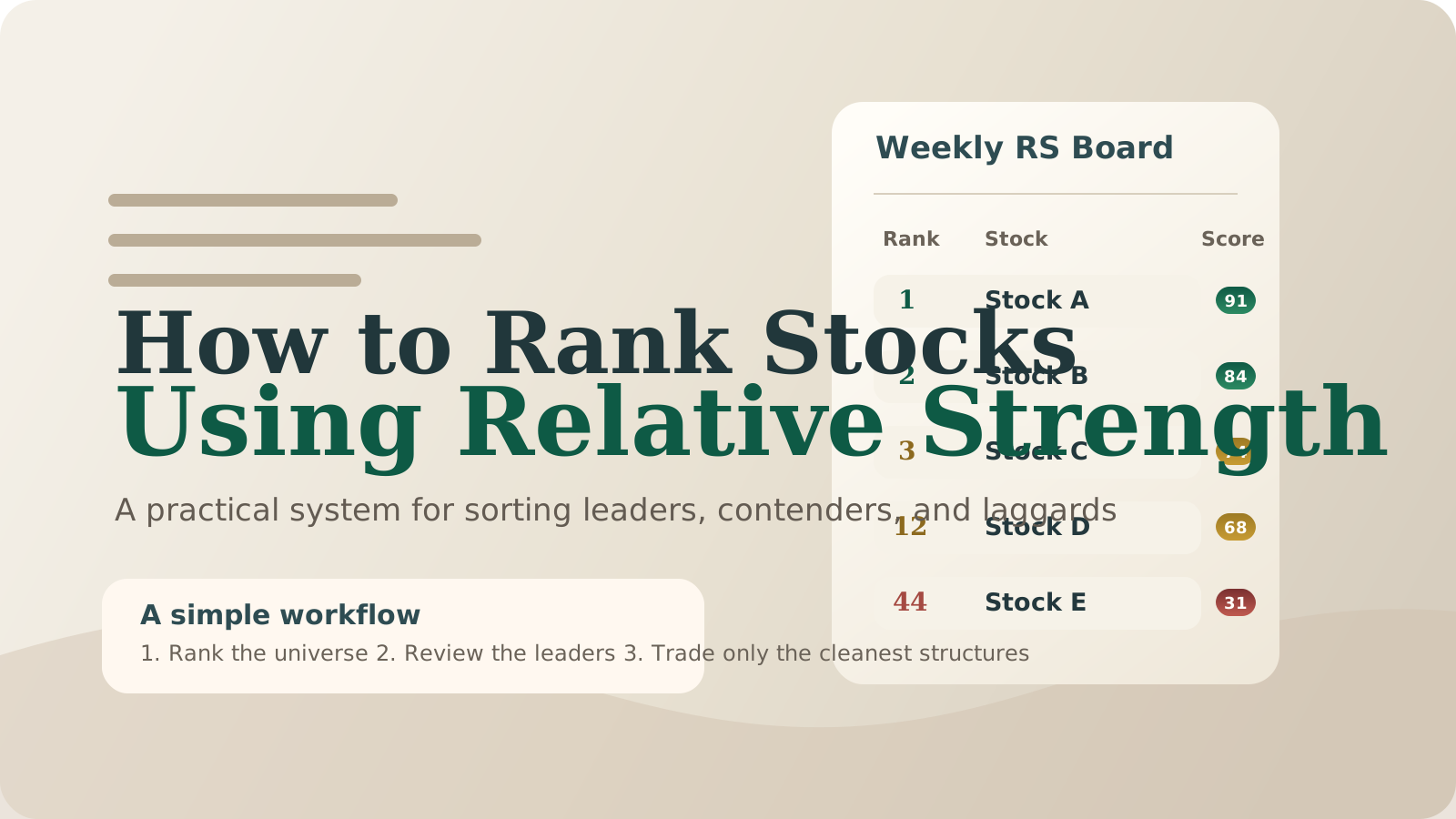
| Stock | 12M Percentile | 6M Percentile | 3M Percentile | Composite Score |
|---|---|---|---|---|
| Stock A | 94 | 88 | 91 | 91.3 |
| Stock B | 87 | 91 | 72 | 84.5 |
| Stock C | 72 | 68 | 85 | 74.3 |
How to read it:
- Stock A is the clean leader because it is strong across all three windows
- Stock B has strong long-duration leadership but weaker short-term momentum
- Stock C is improving recently, but the longer-term evidence is weaker
That gives you hierarchy. And hierarchy is the point.
Run this weekly across your universe and your shortlist becomes much easier to maintain.
From Ranking to Trade Selection
A high relative strength rank tells you which names deserve attention. It does not tell you exactly when to buy. That requires structure.
Here is the workflow:
Step 1: Filter to the Leaders
Take the top 10% to 15% of your universe by composite score. That becomes your active working list.
Step 2: Look for Price Structure
The best candidates are often not the names in a vertical move. They are the names ranking highly while building a tight consolidation, base, or pullback structure.
High rank plus constructive structure is far more useful than high rank plus exhaustion.
Step 3: Confirm with Volume
During consolidation, volume should usually contract. On expansion or breakout, volume should expand. That gives you evidence the move is attracting participation, not just drifting higher on weak activity.
Step 4: Enter with Defined Risk
Use a clear trigger, a defined stop, and a position size that fits the setup rather than the story.
A strong rank is a selection edge. It does not remove the need for execution discipline.
If you want a cleaner environment for applying this process, TradInvest Edge is where we connect stronger-stock selection with broader execution workflow. For the broader product view, see our features page.
Advanced Filters That Make the Model Better
These refinements improve ranking quality without overcomplicating the model.
Rank Stability
Two stocks may both have an 85 composite score, but one may have held a stable rank for four weeks while the other jumped there after one news-driven burst.
The stable one is usually the cleaner candidate.
Sector-First Ranking
Rank sectors before ranking stocks. Then rank stocks inside the strongest sectors.
That puts you in stronger names within stronger parts of the market, which usually improves selection quality.
Rotation Detection
When a new group of stocks starts climbing the rankings together, that often reveals sector rotation before it becomes obvious in popular commentary.
Regime Awareness
Even a good ranking model performs differently depending on market regime. In trending, broad-participation markets, high-RS names often follow through cleanly. In unstable or narrow markets, rankings can still help, but setups need more selectivity.
That is why RS ranking works better when combined with a broader environment filter. Our guide on how to identify market regime helps with that layer.
Common Mistakes in Relative Strength Ranking
Using only short-term data. Three-month leaders alone often include short-lived spikes and event-driven noise.
Changing the universe too often. If the ranked pool changes every week, the score history becomes much less meaningful.
Tweaking the weights to justify a stock you already want. The model should drive the shortlist, not endorse a bias you already had.
Buying top-ranked stocks blindly. A top-ranked stock can still be too extended, too loose, or poorly timed.
Ignoring the broader market environment. A strong stock list does not eliminate the effect of a weak market regime.
Key Takeaways
- Relative strength ranking turns stock selection into a comparison process, not a story-driven guess
- A useful ranking model starts with a defined universe and multi-timeframe scoring
- 12M, 6M, and 3M windows work well because they separate structure, confirmation, and timing
- Percentile scoring makes comparisons easier across a large stock universe
- The ranking model should create a shortlist; price structure and volume still decide execution
- Ranking sectors before stocks often improves the quality of your final candidates
A Better Way to Use This Weekly
The best use of a relative strength ranking model is not to generate random excitement every day. It is to build a repeatable weekly workflow.
- Run the ranking model on the same universe every week.
- Review the top-ranked sectors first.
- Pull the top-ranked stocks from those sectors.
- Look for clean bases, consolidations, and volume behaviour.
- Cross-check the broader market environment before sizing aggressively.
If you follow that process consistently, your stock selection gets cleaner over time.
To go deeper into the underlying idea, read Relative Strength in Trading: What It Is and How to Use It. If you want to connect stock leadership to broader market context, read How to Identify Market Regime Before Taking a Trade.
If you want TradInvest to help reduce the mechanical work of screening and prioritisation, our pricing page and features page show how the workflow fits together.
Spread the good words
Give your view.
Give your view
Comments
0Use this insight inside the product
TradInvest is built to connect market context, strategy quality, and post-trade learning. Read the market with Pulse, narrow your watchlist with rotation and momentum, then review what actually worked.
Related posts
More insight tied to the same trading workflow.