When traders first start using relative strength seriously, the timeframe question comes up almost immediately.
Should you measure RS over three months? Six? A full year? Some traders swear by the 12-month window. Others think 12 months is too slow and prefer the three-month cut. A few just average them together and hope for the best.
Relative strength timeframe selection is really about deciding whether you are measuring recent acceleration, intermediate confirmation, or longer-duration leadership.
The confusion is understandable. Most content on this topic either picks a winner arbitrarily or hedges so heavily it says nothing useful. Neither helps you build a better workflow.
Here is the more useful framing: 3-month, 6-month, and 12-month RS are not competitors. They measure different things. The question is not which one is best, but which one is right for what you are trying to do.
This article explains what each window captures well, where each one fails, and how to combine them into a practical system you can actually use. If you want the foundational primer on relative strength before going further, start with the TradInvest RS guide.
Why Traders Get Confused About RS Timeframe Selection
Most of the confusion comes from treating RS as a single signal rather than a family of signals.
A stock can look like a leader on a 12-month basis and a laggard on a 3-month basis simultaneously. That is not a contradiction. It means the stock had a strong structural run over the past year but has been losing ground recently. Whether that matters depends entirely on why you are measuring it.
If you are building a long-term positional watchlist, the 12-month picture matters most. If you are looking for a breakout entry this week, the 3-month picture is more relevant. If you are trying to confirm that a thesis is still intact after a rough patch, the 6-month window often gives the clearest read.
The mistake most traders make is picking one timeframe and applying it to every decision. The second mistake is using all three without a clear logic for how they fit together.
Both problems have the same solution: understand what each window is actually measuring, then build a workflow that assigns each window to the right job.
3-Month Relative Strength: What It Captures and Where It Fails
What it captures well
The 3-month RS window measures recent momentum. It answers the question: which stocks are attracting buying pressure right now, relative to everything else?
This makes it genuinely useful for:
- Breakout timing. When a stock's 3-month RS is rising and approaching the top quartile of its universe, that often precedes a price breakout. The RS acceleration is the early signal; the price move follows.
- Detecting new leadership. In a sector rotation, new leaders emerge before they appear on 6-month or 12-month charts. The 3-month window catches them first.
- Watchlist trimming. If a stock you have been tracking shows deteriorating 3-month RS even though it still looks good on longer timeframes, that is a reason to move it lower on your priority list temporarily.
For Indian traders specifically, the 3-month window is useful for catching fast-moving leadership shifts in the Nifty 500, especially after major events like earnings seasons, RBI policy decisions, or sharp index moves. These events create short, definable windows where relative winners separate from the pack quickly.
Where it fails
The 3-month window is noisy. It picks up a lot of moves that do not last.
A stock that rallies hard on a single catalyst, a strong quarterly result, a positive brokerage upgrade, a news-driven sector re-rating, will shoot up the 3-month RS rankings. Three weeks later, once the catalyst fades, it may drop just as fast. If you were using 3-month RS alone to build your watchlist, you just loaded up on a name that had no durable support behind it.
In event-driven markets, short-window RS is particularly unreliable as a standalone filter. India’s markets are prone to sharp, episodic moves around results cycles and macro events. The 3-month window absorbs these without clearly distinguishing between sustainable demand and a one-time spike.
Bottom line on 3-month RS: Useful for timing and early signal detection. Not reliable enough to stand alone as a selection filter.
6-Month Relative Strength: What It Captures and Where It Fails
What it captures well
The 6-month RS window is the confirmation layer. It answers the question: has the strength we are seeing held up long enough to suggest there is real, sustained buying behind it?
Six months is roughly two earnings cycles in the Indian market. A stock that has maintained top-quartile RS across two reporting periods has held its position through the most common catalysts for re-rating and disappointment. That durability is meaningful.
This makes 6-month RS useful for:
- Confirming 3-month signals. When short-term RS acceleration aligns with a strong 6-month rank, the setup has both timing and durability behind it. When they diverge, be more cautious.
- Portfolio maintenance. If a stock you own starts slipping in 6-month RS even while still holding its 12-month rank, that is your first real warning that the trend is weakening, not a reason to exit immediately, but a reason to watch more closely.
- Sector rotation context. Six-month sector RS is one of the cleanest ways to read which sectors are genuinely gaining traction versus which are just bouncing. You can see this more clearly using the market regime identification framework alongside RS data.
Where it fails
The 6-month window can lag meaningful trend changes. In a fast-trending market, like sharp recovery rallies or strong post-event moves, six months can be enough to miss a meaningful portion of the move while you wait for confirmation.
It also smooths over the kind of early rotation signals that matter for proactive positioning. By the time a new sector leader shows up clearly in 6-month RS, the fastest money is often behind it.
Bottom line on 6-month RS: The most balanced of the three windows. Best used as a confirmation tool rather than a discovery tool.
12-Month Relative Strength: What It Captures and Where It Fails
What it captures well
The 12-month RS window measures structural leadership. It answers the question: over the course of a full market cycle, has this stock consistently attracted more demand than its peers?
A stock that holds the top quartile of its universe for twelve months has done so across multiple market conditions, rallies, corrections, and sideways phases. That consistency is often one of the strongest pieces of evidence available in price data that longer-duration participation has been real rather than incidental.
This makes 12-month RS useful for:
- Universe filtering. When building a watchlist from scratch, starting with the top decile of 12-month RS across the Nifty 500 gives you a pre-filtered set of structurally strong names.
- Positional trade selection. For trades with multi-week to multi-month holding periods, structural RS is the most relevant filter. Short-term noise matters less; sustained demand matters more.
- Sector-level conviction. Twelve-month sector RS tells you which parts of the market have had durable capital inflows, not just episodic strength.
Where it fails
The 12-month window is slow to update. A stock that peaked eight months ago and has been quietly deteriorating since can still carry a high 12-month RS score simply because the early part of the lookback was so strong.
It also misses early-stage breakouts. A stock that has been dormant for two years and just started a major new move will have a weak 12-month RS score for months, even as it quietly becomes one of the better emerging setups in the market.
Bottom line on 12-month RS: The best filter for structural conviction. But use it as a starting point, not a final answer.
Side-by-Side Comparison
| 3-Month RS | 6-Month RS | 12-Month RS | |
|---|---|---|---|
| What it measures | Recent momentum | Intermediate trend | Structural leadership |
| Best used for | Breakout timing, new leader detection | Confirmation, portfolio monitoring | Universe filtering, positional selection |
| Main weakness | Noisy, event-driven spikes | Lags fast-moving rotations | Slow to reflect trend change |
| Signal quality | Lower, needs confirmation | Medium, best as a confirmer | Higher, but can lag |
| Update frequency needed | Weekly | Bi-weekly | Monthly |
| Works best for | Swing traders | Swing and positional traders | Positional traders |
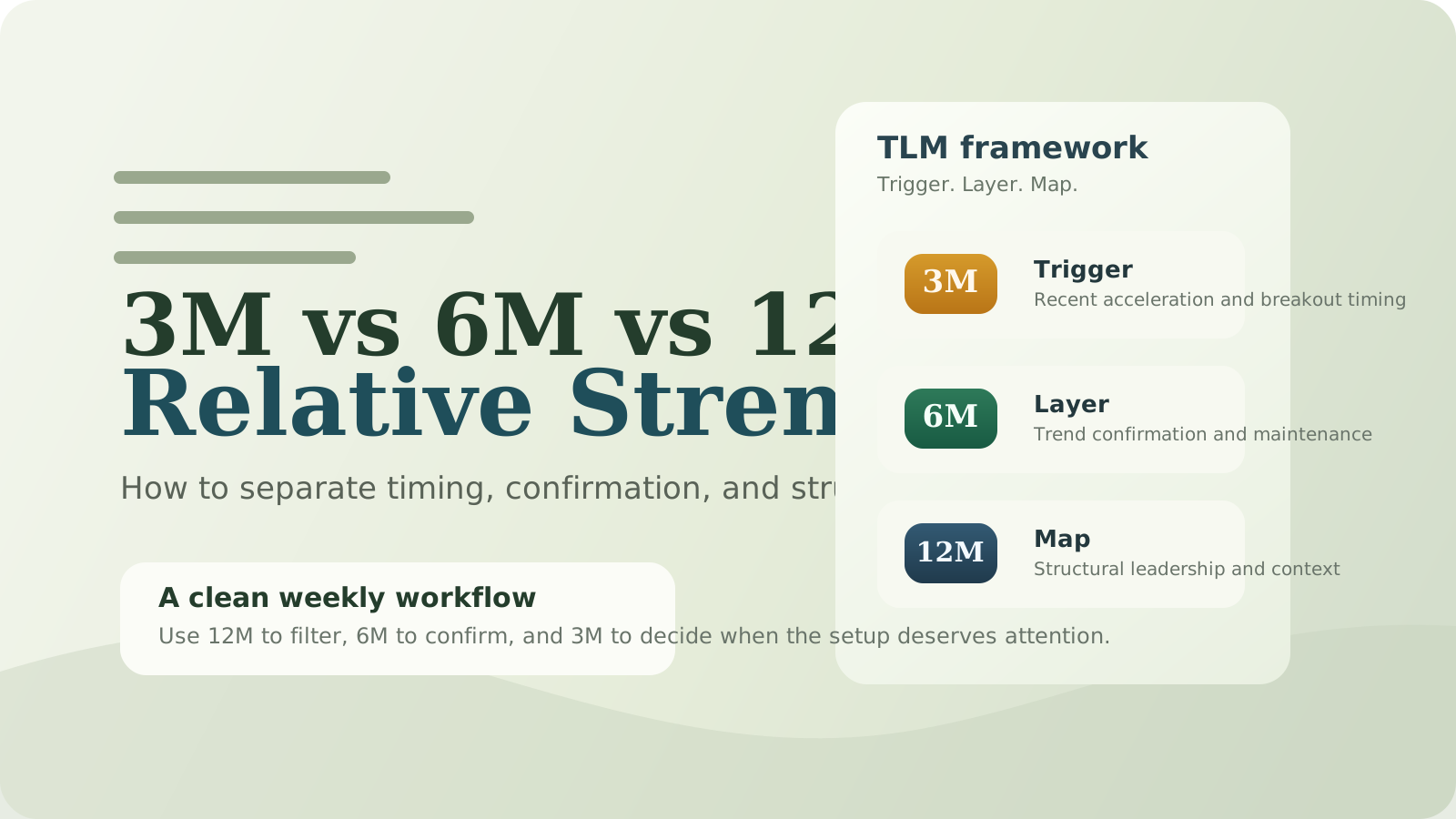
The TLM Framework: Trigger, Layer, Map
Rather than thinking about three separate rankings, think about three jobs that need to get done before any RS-based trade can be taken with real confidence.
T: Trigger (3-Month RS)
The 3-month window is your trigger scanner. It surfaces stocks that are showing accelerating relative strength right now. It generates candidates, not conclusions.
L: Layer (6-Month RS)
The 6-month window is your confirmation layer. Before acting on a 3-month signal, check whether the 6-month RS supports it. If a stock ranks in the top quartile on both 3-month and 6-month RS, the signal has both momentum and durability behind it.
M: Map (12-Month RS)
The 12-month window is your structural map. It tells you whether you are operating in a part of the market that has genuine longer-duration support, or whether you are chasing a short-term move in a structurally weak name. Before sizing a position, check the 12-month RS context.
A clean setup under the TLM framework looks like this: a stock showing 3-month RS acceleration, confirmed by a strong 6-month rank, in a stock that has maintained top-half 12-month RS. All three windows pointing in the same direction is not common, but when it happens it is usually worth attention.
You do not need all three to align for every trade. But knowing which layers are missing tells you where the risk is coming from.
For a deeper look at building a weighted RS scoring model across these timeframes, see the RS ranking system article.
Worked Example: The Same Stock Across Three Windows
Consider a hypothetical mid-cap stock in the Nifty 500, call it Stock X, during a period of sector rotation into capital goods.
12-month RS: The stock ranks at the 61st percentile. Decent, but not a standout. For most of the past year, the sector was out of favour and the stock drifted sideways while the broader market moved higher.
6-month RS: The picture shifts. Over the past six months, as the sector began attracting flows, the stock climbed to the 78th percentile. The recent move has been real and sustained enough to show up meaningfully at this window.
3-month RS: The stock is now at the 91st percentile. In the last quarter, it has been one of the strongest performers in the universe. Volume has expanded. The price action has been clean.
How do you read this under the TLM framework?
- The Trigger is strong: 91st percentile on 3-month RS suggests active, current buying.
- The Layer is confirming: 78th percentile on 6-month RS tells you this is not just a three-week spike.
- The Map is incomplete: 61st percentile on 12-month RS means structural leadership is still emerging rather than fully established.
This is a legitimate swing trade candidate with controlled risk, but not yet the same quality of positional candidate as a stock that is already strong across all three windows. You might take a smaller initial position and add only if the 6-month and later the 12-month RS continue improving. The framework tells you not just whether to act, but how much conviction the data supports.
Matching Timeframe to Task
Stock ranking and universe filtering
Use 12-month RS as the primary sort, 6-month RS as the secondary filter. This combination gives you structurally strong names that are still in active trend.
Watchlist preparation
Use all three windows, but weight the 6-month most heavily. You want names with durable recent strength that are entering a timing window.
Breakout timing
Lead with 3-month RS acceleration. You are looking for stocks where the RS rank is rising week over week, not just sitting high. Confirm with 6-month before acting.
Market regime and broad context
Use 12-month sector-level RS to understand where sustained capital has flowed over the full cycle. Combine with a regime assessment using the market regime framework for a fuller picture.
Common Mistakes
Using one timeframe for everything. A swing trader relying only on 12-month RS will usually be late. A positional trader relying only on 3-month RS will get whipsawed more often than needed.
Treating RS rank as a buy signal. A high RS rank tells you a stock is a leader relative to peers. It does not tell you the stock is about to move immediately. You still need price structure, volume, and entry logic.
Ignoring RS deterioration in existing holdings. Watching how your holdings evolve across 3-month and 6-month windows is one of the most practical early warning systems available.
Not accounting for universe size. A stock ranked at the 85th percentile in a 30-stock watchlist is very different from a stock at the 85th percentile across Nifty 500.
Chasing 3-month spikes in event-driven conditions. Around earnings season or major macro events, short-window RS picks up more noise. Require 6-month confirmation more strictly in these periods.
Key Takeaway
There is no single best RS timeframe. There is a right timeframe for each job.
The 3-month window surfaces what is working right now. The 6-month window confirms whether it has been working long enough to trust. The 12-month window tells you whether you are operating in structurally supported territory or chasing a short-term move in a weak name.
Used together under a clear framework, Trigger, Layer, Map, these three windows give you more information than any single one could. Used in isolation, each one has blind spots that will cost you.
The practical habit is simple: run all three. Know what each one is telling you. And be explicit about which window is driving which decision.
If you want to continue the RS workflow, read the stock ranking system article next. If you want to connect relative strength with a cleaner selection and execution process, you can also review the TradInvest features page, TradInvest Edge, or current pricing details.
Spread the good words
Give your view.
Give your view
Comments
0Use this insight inside the product
TradInvest is built to connect market context, strategy quality, and post-trade learning. Read the market with Pulse, narrow your watchlist with rotation and momentum, then review what actually worked.
Related posts
More insight tied to the same trading workflow.