Most traders discover sector rotation the same way: they notice their holdings are not moving even though the market is rising, and only then check which sectors are actually leading.
By then, they are usually late.
Sector rotation relative strength is the process of measuring which sectors are gaining or losing leadership relative to the broader market.
This article explains what sector rotation is in practical terms, why traders consistently spot it late, and how relative strength data gives you a structured way to detect leadership shifts early enough to act on them.
If you are new to relative strength as a concept, the TradInvest RS guide is the right starting point. This article assumes you understand the basics and are ready to apply them at the sector level.
What Sector Rotation Actually Means
Sector rotation is not just a macro concept. It is a capital-flow shift.
At any point in a market cycle, money is not distributed evenly across all sectors. It tends to concentrate in the sectors offering better perceived opportunity under current conditions. As those conditions change, leadership changes too. Capital gradually leaves one group and begins moving into another.
That is sector rotation.
The reason this matters for stock selection is direct: the best individual stock in a sector that is losing sponsorship will often underperform a decent stock in a sector that is gaining it. Sector context shapes stock outcomes more than most traders account for.
In the Indian market, this happens repeatedly. PSU banks lead for months while private banks lag. IT cools off while capital goods starts improving. Pharma firms up in risk-off phases while consumer-facing sectors lose momentum. These shifts are not random. They show up in sector-level relative strength before they become obvious in commentary.
Why Most Traders Spot Rotation Too Late
The typical retail sequence is familiar.
A sector starts outperforming quietly. The early RS signal is there, but muted. The sector moves from the 55th percentile to the 65th percentile over a few weeks. That is not dramatic enough to trigger headlines, so traders focused only on individual stocks miss it.
Then the move accelerates. A few stocks in the sector break out. Media coverage increases. More traders notice and begin chasing. By that point, the leading names are often already well off their bases and the easy entry is gone.
Then, once the story is widely accepted, leadership often starts cooling. The sector may still look fine on price, but the underlying RS is already flattening. Traders who bought the story rather than the data are left with positions that stop working and no clear reason why.
This cycle repeats because narrative usually lags price and relative performance. By the time a rotation is obvious enough to show up in mainstream commentary, the RS data has often been signaling it for weeks.
How Relative Strength Reveals Sector Leadership Changes
Relative strength at the sector level works the same way RS works at the stock level. You are measuring performance relative to a benchmark, but the unit is a sector index rather than an individual stock.
For Indian traders, that usually means comparing Nifty sectoral indices, such as Nifty Bank, Nifty IT, Nifty Pharma, Nifty FMCG, Nifty Auto, Nifty Realty, Nifty Energy, Nifty Capital Goods, or Nifty PSU Bank, against a broader benchmark like Nifty 500.
Three RS behaviours are especially useful:
RS trend change. A sector that has spent months in the lower half of the rankings starts climbing week after week. The absolute rank may still be mediocre, but direction has improved. This is often the earliest rotation signal.
RS divergence from price. A sector index is still rising or holding highs, but its RS is no longer improving because other sectors are now rising faster. That is often the first sign leadership is fading.
RS convergence across multiple windows. When 3-month and 6-month sector RS begin improving together, the move has lasted long enough to look more like a real trend than a short spike. The multi-timeframe RS article goes deeper into this logic.
The FADE Framework: Four Signals That Confirm a Rotation
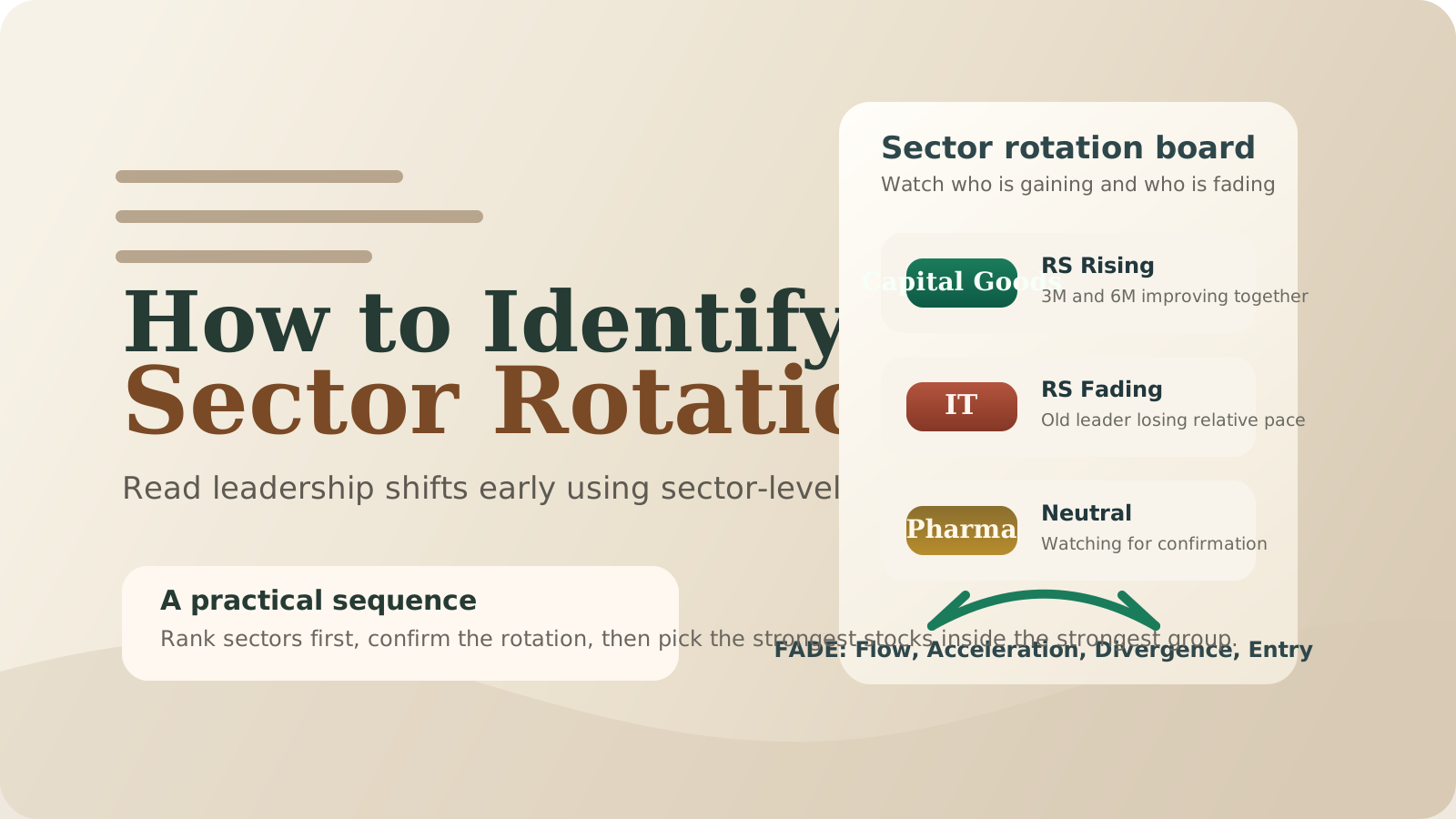
Rather than reacting to one data point, it helps to read rotation through a sequence. The FADE framework, Flow, Acceleration, Divergence, Entry, provides that structure.
F: Flow
Start with direction. Is the sector's RS rank improving or deteriorating over the last four to six weeks? A move from the 48th to the 61st percentile on 6-month RS tells you flow is turning positive.
A: Acceleration
Next, check the shorter window. If 6-month RS is improving and 3-month RS is rising even faster, the near-term buying is intensifying. That combination is one of the clearest early signals of a live rotation.
D: Divergence
Rotation is always relative. A gaining sector usually has a counterpart that is losing relative strength. If capital goods is climbing while IT or another former leader is flattening or slipping, that gives the move more structure and more credibility.
E: Entry
Once the sector-level signal is established, move down to stock selection. Which stocks inside the improving sector are leading on stock-level RS? Those are your candidates. This is where the stock ranking article becomes the natural next layer.
Worked Example: Capital Goods Gaining as IT Loses Leadership
Consider a scenario that has played out in different forms more than once in the Indian market.
The setup
IT has been a leadership sector for a while. Its 12-month RS is still strong, sitting around the 80th percentile relative to the Nifty 500. But over the last eight weeks, the 3-month RS has been slipping from the upper 70s into the low 60s even though price has not broken down.
At the same time, Nifty Capital Goods has been sitting in the middle of the pack on the 6-month window, but its 3-month RS has climbed sharply from the high 50s into the 80s. Price is breaking out of a broad consolidation and volume is improving.
What the FADE framework shows
- Flow: Capital goods 6-month RS is improving. IT's medium-term RS is flattening.
- Acceleration: Capital goods 3-month RS is rising sharply while IT's short-term RS is fading.
- Divergence: One sector is gaining leadership while the other is losing it.
- Entry: Inside capital goods, the strongest stocks are already breaking out of sound multi-week bases.
How a trader uses it
At the point where FADE confirms the move, usually a few weeks into the divergence but before the narrative is crowded, the sector is still actionable. The setup is not based on prediction. It is based on reading what the RS data is already saying.
That distinction matters. You are not trying to guess the next hot sector. You are trying to identify where leadership is already shifting before the crowd fully recognizes it.
From Sector Strength to Stock Selection
Identifying a rotating sector is only the first step. The trade still happens at the stock level.
Step 1: Rank stocks within the leading sector
Using the multi-timeframe logic from the ranking article, calculate composite RS scores for stocks only within the sector that has already passed the sector-rotation filter.
Step 2: Find the leaders inside the leader
Not every stock in a strong sector participates equally. The best candidates are usually the stocks outperforming both the broader market and their own sector index.
Step 3: Confirm the price structure
Strong RS is not an entry by itself. You still want a constructive base, a clean consolidation, or a breakout with participation. The cleanest trades usually come from the combination of strong sector RS, strong stock RS, and good structure.
Step 4: Check the broader regime
Rotation behaves differently depending on the market backdrop. In healthy trending conditions, new sector leadership can persist for weeks or months. In unstable or choppy conditions, leadership changes are noisier. Before sizing aggressively, check the broader environment using the market regime framework.
How Sector Rotation Reads Differently in the Indian Market
The Indian market has a few features that make sector-rotation reading especially important.
Event-driven acceleration is common. Budget announcements, RBI policy decisions, and result seasons can accelerate sector moves quickly. This makes short-window RS more useful, but also noisier.
PSU and private-sector splits matter. In India, leadership can rotate within what looks like the same broad sector. PSU banks and private banks do not always move together. The same is true in energy and other policy-sensitive areas.
Mid-cap sector strength often leads large-cap recognition. Sector improvement sometimes appears first in mid-cap names before the headline large-caps catch up. That gives alert traders an earlier read.
Nifty 50 composition can distort sector reads. Because the headline index is heavily influenced by financials and IT, benchmarking sectors against Nifty 500 often gives a cleaner rotation signal than comparing everything against Nifty 50.
Side-by-Side: Early Rotation Signal vs Late Rotation Signal
| Signal Type | What You See | When You See It | Usefulness |
|---|---|---|---|
| 3-month RS acceleration | Short-term RS rank rising sharply | 2 to 4 weeks into rotation | Early, but needs confirmation |
| 6-month RS trend change | Medium-term RS rank improving | 4 to 8 weeks in | Reliable confirmation |
| Price breakout in sector index | Sector index making new highs | 6 to 10 weeks in | Still tradable, but crowding rises |
| Financial media coverage | Analysts and stories highlight the sector | 8 to 14 weeks in | Early edge is mostly gone |
| RS divergence from old leader | Former leader flattens while new one rises | 3 to 6 weeks in | One of the best early signals |
Common Mistakes in Sector Rotation Trading
Waiting for price confirmation alone. By the time a sector breakout is obvious to everyone, many of the strongest stocks are already extended.
Tracking only one sector in isolation. Rotation is relative. Watching the gaining sector without watching what is losing strength gives you only half the picture.
Treating sector RS as a substitute for stock selection. A strong sector does not make every stock in it attractive. The two-step funnel, sector first, stock second, still matters.
Ignoring regime context. A rotation trade in a deteriorating market regime is not the same setup as a rotation trade in a healthy uptrend.
Mistaking short-term spikes for true rotation. One sharp 3-month jump around a single event is not enough on its own. Real rotation usually shows itself across more than one timeframe.
Key Takeaway
Sector rotation is not something you only understand after the move is obvious. It is something you can detect while it is still developing.
The practical workflow is straightforward: rank sectors by relative strength weekly, look for FADE signals, and move to stock selection only after the sector-level picture is supported by more than one layer of evidence.
For Indian traders especially, treating sector context as a primary filter rather than an afterthought materially improves stock selection. The best individual setups are often sitting inside the strongest sectors, not floating independently of them.
If you want to continue this workflow, the next useful reads are the relative strength guide, the stock ranking article, and the 3M vs 6M vs 12M RS comparison. If you want to see how this connects to the product side, you can also review TradInvest features, TradInvest Edge, or the current pricing page.
Spread the good words
Give your view.
Give your view
Comments
0Use this insight inside the product
TradInvest is built to connect market context, strategy quality, and post-trade learning. Read the market with Pulse, narrow your watchlist with rotation and momentum, then review what actually worked.
Related posts
More insight tied to the same trading workflow.