The most common version of the entry problem in swing trading is not finding the right stock. Most traders who use relative strength have a reasonable ability to identify names with strong RS, good structure, and sector alignment. The problem is timing -- specifically, entering a technically valid setup too early, too late, or at a point in the sector cycle where the probability of sustained follow-through is materially lower than the chart alone suggests.
Sector rotation swing trading is not a separate strategy from RS-based selection. It is a timing layer applied on top of it. When a stock's RS, the sector's RS trajectory, and the stage of the rotation are all evaluated together, entry quality improves in a measurable way: fewer setups that fail immediately, fewer positions entered at the front end of a move that turns out to be over, and fewer entries made too early into sectors that have not yet confirmed leadership.
This article explains how sector rotation phase changes entry quality, what the specific timing errors look like, and how to align stock-level and sector-level RS into an entry process that produces setups with broader confirmation behind them.
In practical terms, sector rotation swing trading means entering strong stocks when their sector is still attracting fresh capital, not after the sector has already become crowded or begun fading.
Why Strong Stock Selection Still Produces Weak Entries
Assume a trader has correctly identified a stock with a composite RS score at the 84th percentile, a tight consolidation base, volume contraction, and a clear breakout trigger. By any reasonable RS-based selection standard, this is a qualified watchlist candidate. The entry logic is sound.
But if the sector this stock belongs to has just completed a six-month leadership cycle and is now in early distribution -- with institutional flows beginning to rotate toward a different sector entirely -- the breakout from the base is likely to fail. Not because the stock's individual setup was poor, but because the macro capital flow that would drive the follow-through is no longer directed at this sector.
Price structure and stock-level RS are backward-looking to some degree. They reflect what has happened to the stock. Sector RS trajectory and rotation phase reflect what is currently happening to the flow of institutional capital. When these two point in the same direction, entry probability is highest. When they diverge -- stock looks good, sector is fading -- the entry is structurally compromised regardless of how clean the chart appears.
This divergence is the entry problem that sector rotation timing solves.
What Sector Rotation Adds to Entry Timing
The sector rotation article explains how to read sector RS trends and detect early rotation signals. What that framework provides for entry timing is a way to place any individual stock setup in the context of where its sector is in the rotation cycle.
A sector rotation cycle has three broad phases that matter for entry quality.
Early rotation: Sector RS is beginning to climb after a period of underperformance. The 3-month sector RS is improving but the 6-month sector RS is still in the lower half of the rankings. Individual stocks within the sector are starting to show RS improvement but the evidence is not yet broad. Price breakouts from setups in this sector are available, but they carry higher failure risk because the rotation has not yet confirmed -- the early RS signal may or may not be sustained.
Confirmed leadership: The sector's 3-month and 6-month RS are both in the top quartile and either improving or stable. The FADE signals described in the sector rotation article are all present. Individual stock RS within the sector is broadly strong, not concentrated in one or two names. Breakout setups in this sector have the highest probability of follow-through because institutional capital is actively and broadly flowing into the space. This is the phase where entry quality is highest.
Late-cycle or crowded phase: The sector's move has been well-publicised. The 12-month RS is very high, reflecting the full cycle of outperformance. Analyst coverage and financial media attention on the sector has grown. Individual stock setups still appear because prices are elevated and many traders are looking for entries in the perceived leadership. But the 3-month RS for many names is beginning to peak or decline even as the 12-month RS remains high. Entries in this phase carry materially higher failure risk because the freshest capital has already been deployed and the marginal buyer is increasingly less informed. This phase is where late-cycle entries, which look valid on charts, fail most consistently.
Identifying which phase the sector is in before making an entry decision is the core of sector-rotation-based entry timing.
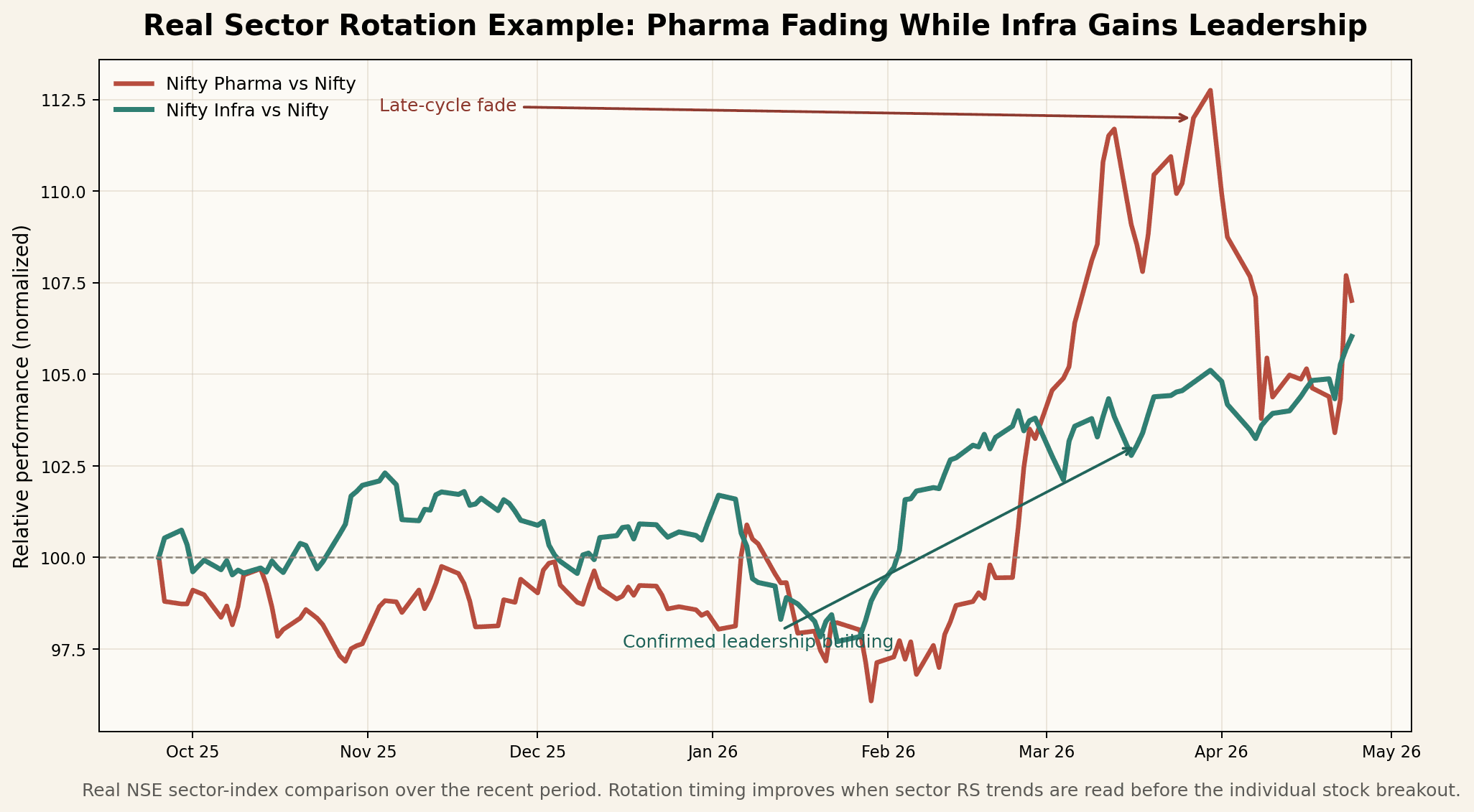
Worked Example 1: Strong Stock, Wrong Sector Phase
A mid-cap pharmaceutical stock has the following RS profile: 12-month RS at the 81st percentile, 6-month RS at the 76th percentile, 3-month RS at the 79th percentile. Composite score: approximately 79. The stock has been building a six-week consolidation base with volume contraction. The setup scores highly on the pre-breakout criteria described in the pre-breakout selection article.
The sector context, evaluated separately:
Nifty Pharma's sector RS trajectory over the preceding eight weeks:
| Week | Nifty Pharma 3M Sector RS | Nifty Pharma 6M Sector RS |
|---|---|---|
| -8 weeks | 88 | 84 |
| -6 weeks | 84 | 83 |
| -4 weeks | 79 | 80 |
| -2 weeks | 73 | 76 |
| Current | 67 | 72 |
The sector 3-month RS has declined 21 points over eight weeks. The 6-month RS has declined 12 points. Nifty Pharma was a strong leader two months ago and is now losing its relative position. Capital is rotating out of the sector even as individual pharma stocks still show elevated 12-month and 6-month RS scores that reflect the prior leadership period.
The entry decision:
The stock's individual RS looks attractive. The consolidation base looks clean. But the sector phase is clearly late-cycle -- the 3-month sector RS has already declined sharply from its peak, and the 6-month is following. Entering a pharma stock breakout in this sector context means betting against the direction of the capital flow that would provide the institutional buying pressure needed to sustain the breakout.
What happens: The stock attempts the breakout on average volume. It clears the trigger level and holds for two sessions. On the third session, the broader pharma sector has a weak day as capital continues rotating toward energy and capital goods. Without sector support, selling arrives at the breakout level. The stock fails to build on the initial move and reverses back into the base. The technically valid setup has failed at the sector context layer.
The real chart below uses SUNPHARMA.NS as a live-market illustration of this problem: the stock can still look orderly while the sector-relative line has already started to fade.
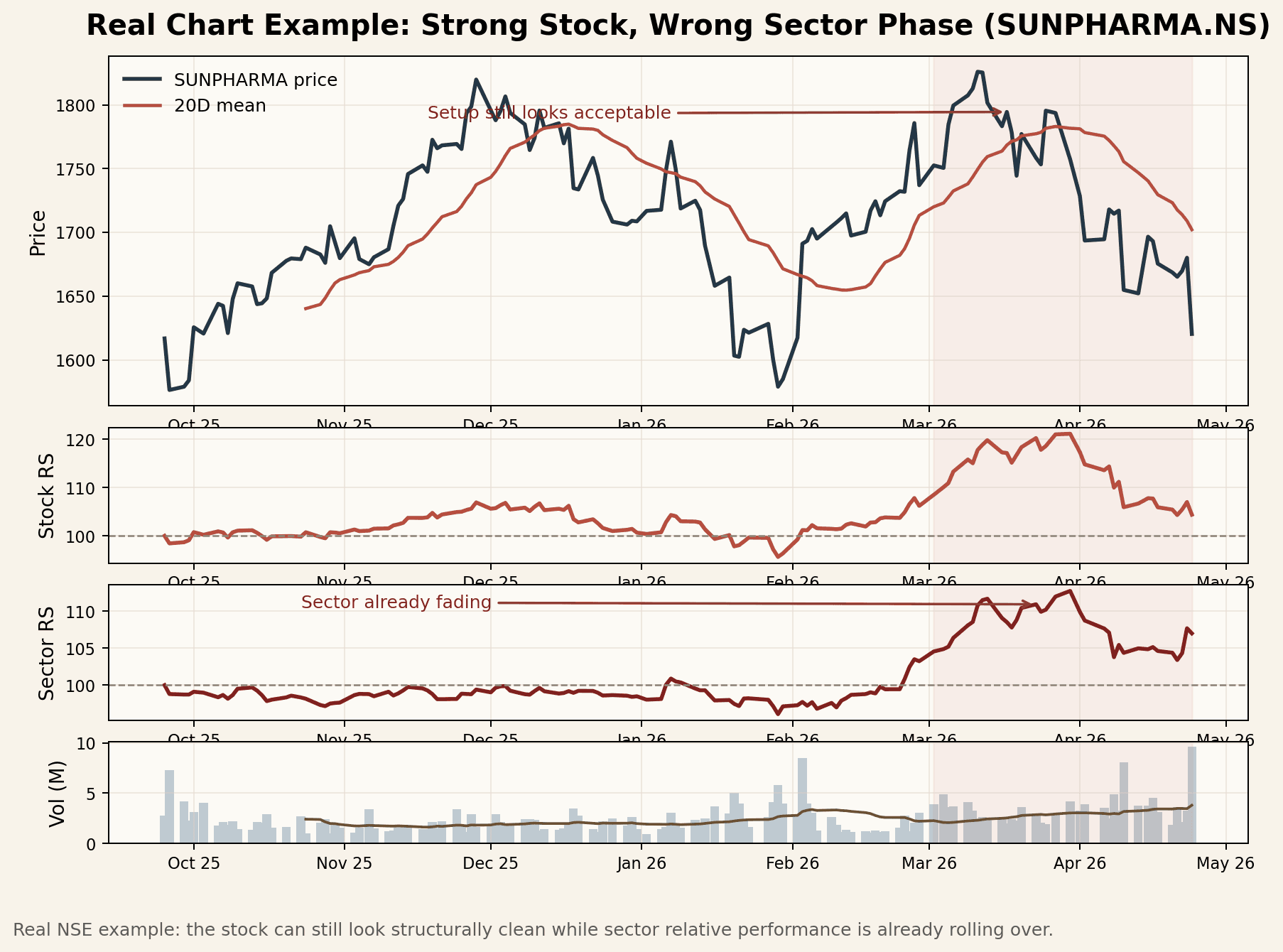
The lesson: The stock's individual RS was legitimate and was not yet showing deterioration. But the sector context had already turned negative. A trader who evaluated sector rotation phase before the entry would have identified the mismatch and waited for either sector RS stabilisation or a different sector for the entry. The chart looked ready. The sector said wait.
Worked Example 2: Stock RS, Sector RS, and Structure in Alignment
A mid-cap capital goods stock has the following profile: 12-month RS at the 85th percentile, 6-month RS at the 82nd percentile, 3-month RS at the 88th percentile. Composite score: approximately 85. Six-week consolidation base with volume contraction and a clear breakout trigger.
The sector context:
Nifty Capital Goods sector RS over the same eight weeks:
| Week | Capital Goods 3M Sector RS | Capital Goods 6M Sector RS |
|---|---|---|
| -8 weeks | 61 | 68 |
| -6 weeks | 66 | 70 |
| -4 weeks | 71 | 73 |
| -2 weeks | 78 | 76 |
| Current | 83 | 79 |
Both the 3-month and 6-month sector RS are improving simultaneously. The sector has moved from mid-table to the top quartile over eight weeks. This is the confirmed leadership phase -- not too early (the 6-month RS is now also strong), and not late-cycle (the 12-month sector RS is still in the 60s, meaning this rotation has not yet become the consensus crowded trade).
The entry decision:
All three layers align. Stock RS is strong across all timeframes and improving. Sector RS is in confirmed leadership phase with both short and medium-term RS in the top quartile. The price structure has the base quality and volume signature described in the pre-breakout framework. Market regime, per a check of the Nifty 500 trend, is in a trending phase supportive of breakout follow-through.
What happens: The stock breaks out from the base on above-average volume. Volume expands further on the day following the breakout -- confirmation that the move has participation. The sector continues gaining RS over the following weeks, providing the capital flow tailwind that absorbs any selling at the breakout level. The position trends for four to five weeks and produces a return in the 18-22% range from the entry.
The real chart below uses LT.NS as a live-market illustration of the higher-quality version of this setup: stock RS and sector RS are both still constructive going into the entry.
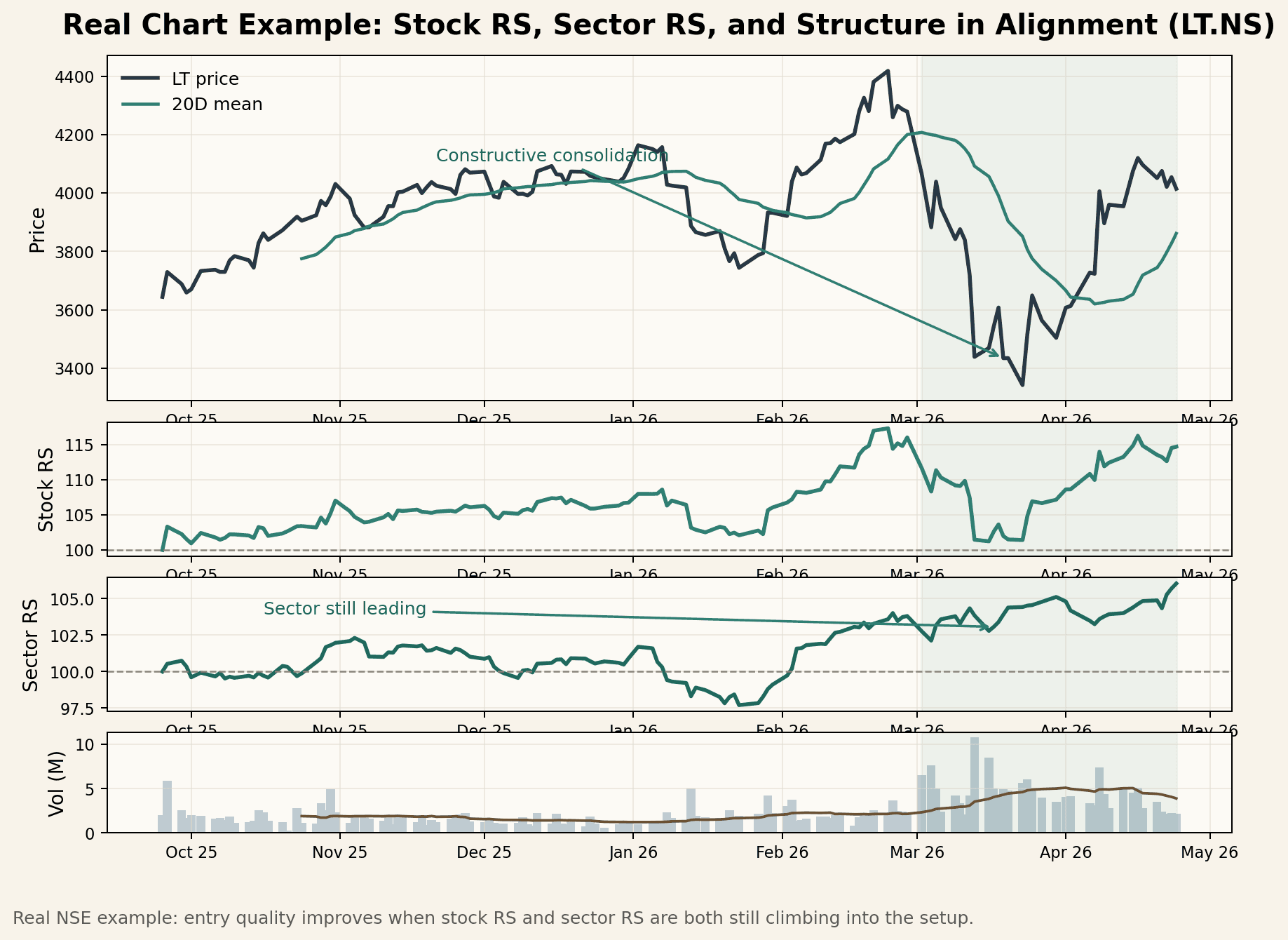
The contrast with Example 1: The stock-level setup quality in both examples was comparable. The difference was entirely in the sector phase and the direction of sector RS. In Example 1, sector capital was flowing out. In Example 2, it was flowing in. That single contextual difference produced a failed breakout in one case and a sustained trend in the other.
How to Distinguish Early Rotation, Confirmed Leadership, and Late-Cycle Entries
The three rotation phases produce different entry quality, and each has specific RS signatures that make them identifiable.
Early rotation is characterised by improving 3-month sector RS that is not yet confirmed by the 6-month. The sector is moving from below-average RS toward the middle of the rankings, but the medium-term trend has not yet changed. Individual stocks in the sector may show excellent 3-month RS improvement, making them look like strong candidates. The risk is that the rotation does not persist -- many early rotation signals reverse before they confirm, particularly when they are driven by single events like policy announcements rather than sustained capital flow.
For entries during early rotation: smaller initial size, require additional confirmation before adding, accept that the probability of a failed breakout is higher than in confirmed leadership phase. The 3-month vs 6-month RS article explains why requiring 6-month confirmation before treating a sector as a confirmed leader is a higher-quality filter.
Confirmed leadership is when both 3-month and 6-month sector RS are in the top half or top quartile and improving together. The 12-month sector RS may be building toward the top quartile but has not yet reached extreme levels that would signal late-cycle crowding. This is the highest-quality entry window. Standard position sizing applies. Price structure confirmation is still required, but the sector context is no longer a headwind.
Late-cycle crowded entries occur when the 12-month sector RS is very high (top decile), sector media coverage has become consensus, and the 3-month RS is beginning to plateau or decline even as the broader narrative remains bullish. Individual stocks in the sector can still produce chart breakouts -- the price is elevated and there are still buyers -- but the institutional supply of new capital directed at the sector is diminishing. Without that supply, breakouts lack the buying pressure to sustain. The marginal buyer is increasingly momentum-driven retail rather than informed institutional, and retail momentum buying fails at resistance levels much more frequently.
For entries in late-cycle sectors: reduce position size significantly, require a much higher structural standard from the individual stock (tighter base, more volume confirmation), and apply a tighter trailing stop from entry. The cost of being right is lower because the move is more likely to be short-duration. The cost of being wrong is the same as any other setup.
How Market Regime Changes Entry Quality in Each Phase
Sector rotation phase and market regime interact. The same sector phase produces different entry quality depending on the broader market environment.
In a trending market regime, early rotation entries in promising sectors carry higher probability than in a choppy regime. The macro tailwind supports continuation. A sector beginning to gain RS during a Nifty 500 uptrend is more likely to confirm its leadership than a sector showing the same RS signals in a range-bound or deteriorating market.
In a choppy or range-bound regime, even confirmed-leadership-phase sector stocks fail at higher rates. The market does not provide the directional bid that allows breakouts to run. Sector confirmation requirements should be higher in choppy regimes -- requiring not just top-quartile sector RS but also recent sector RS acceleration (the 3-month RS improving faster than the 6-month in the most recent two weeks). The market regime article provides the framework for this assessment.
In a deteriorating market regime, even the best sector rotation setups are lower probability. The regime check should come before the sector phase assessment: if the regime is clearly deteriorating, the entry criteria should tighten across the board regardless of how attractive individual sector setups appear.
For Indian Traders: Specific Sector Rotation Timing Risks
Policy-driven sector moves create false early-rotation signals. Indian sectors frequently see sharp RS acceleration following budget announcements, PLI scheme expansions, or infrastructure spending decisions. The 3-month sector RS jumps quickly on a concentrated event. This looks like early rotation but may not be -- if the move is driven by one announcement rather than sustained capital reallocation, the 6-month RS confirmation may never arrive. Requiring 6-month sector RS confirmation before treating any Indian policy-driven sector move as a confirmed rotation entry is especially important.
PSU and capital-goods timing risk. PSU sector moves in India are frequently front-loaded. Institutional and informed money enters early on policy signals. By the time the trade becomes consensus -- when financial media is covering the "PSU infrastructure supercycle" or "defence localisation theme" -- the 12-month sector RS is already very high and the early-phase returns have been made. Entries into PSU names at this stage are late-cycle by definition, regardless of how clean the individual stock setup looks. Checking how long the sector RS has been in the top quartile (three to four months is still early; ten to twelve months is late) is the most direct timing check for PSU sector plays.
Fast leadership shifts compress the confirmation window. Indian markets can rotate sector leadership in two to three weeks rather than the four to eight weeks typical in more developed markets. This means the confirmed leadership window -- between early rotation and late-cycle crowding -- can be shorter. Traders who wait for excessive confirmation before entering may find the best entry window has passed. The practical adjustment: in Indian markets, 6-month sector RS crossing into the top quartile alongside an improving 3-month RS is sufficient confirmation. Waiting for the 12-month to also confirm is often too late.
Earnings-season sector distortions. During quarterly results season, sector RS can move sharply on aggregate results quality rather than on structural capital allocation. A sector with uniformly strong results will see its 3-month RS spike quickly. If the results quality is the entire basis of the RS move and the results were one-time or seasonal rather than structural, the sector RS will reverse after the reporting cycle ends. Entries made on earnings-season sector RS spikes should require additional weeks of post-earnings RS stability before treating the move as a confirmed rotation rather than a results-cycle distortion.
Side-by-Side: Early Rotation vs Confirmed Leadership vs Late-Cycle Entry
| Dimension | Early Rotation | Confirmed Leadership | Late-Cycle |
|---|---|---|---|
| 3M sector RS | Improving from below average | Top quartile and accelerating | Plateauing or beginning to decline |
| 6M sector RS | Still in lower half | Top quartile and improving | Very high but flattening |
| 12M sector RS | Building | Upper-middle to top | Near top decile |
| Media / consensus | Not yet noted | Starting to appear | Widespread coverage |
| Institutional phase | Early accumulation | Active deployment | Distribution beginning |
| Entry quality | Lower, higher failure rate | Highest | Lower, crowded |
| Position sizing | 50-75% of standard | Standard | 25-50% of standard |
| Confirmation required | Higher, require 6M confirmation | Standard price structure | Much higher structure standard |
| Stop tightness | Standard | Standard to slightly wider | Tighter, less room |
Common Mistakes in Sector Rotation Entry Timing
Entering strong stocks without checking sector phase. The most common error. A stock with an 85th percentile composite RS in a sector with declining sector RS is not a confirmed entry candidate. The stock-level RS is a necessary but insufficient condition. The sector phase check is what determines whether the capital flow environment supports the entry.
Treating every 3-month sector RS improvement as confirmed rotation. Early rotation signals fail regularly. A single event can push the 3-month sector RS sharply without the 6-month following. Requiring the 6-month sector RS to also improve before committing standard position size filters most false early-rotation signals.
Confusing high 12-month sector RS with current leadership. A sector with a very high 12-month RS has been a leader -- past tense. Whether it is currently receiving fresh institutional capital is answered by the 3-month and 6-month RS, not the 12-month. High 12-month RS combined with declining 3-month RS is a late-cycle signal, not a confirmation of ongoing strength.
Not adjusting size by rotation phase. Full position size in an early-rotation entry carries meaningfully higher risk than the same size in a confirmed-leadership entry. The size should reflect the probability -- smaller during early rotation (where failure rate is higher), standard during confirmed leadership, smaller again during late-cycle entries.
Ignoring the regime before assessing rotation phase. Sector rotation analysis should be performed within the context of the broader market regime. The same sector rotation signal in a trending regime and a deteriorating regime has very different reliability. Regime comes first.
Practical Entry Timing Checklist
Before entering any swing trade, run through this sequence. It is designed to be completed in five to seven minutes once the habit is established.
Stock RS check
- Is the composite RS score in the top quartile (above 75th percentile)?
- Is the 3-month RS stable or improving?
- Has the stock showed RS improvement during the consolidation phase?
Sector RS and phase check
- What is the 3-month sector RS percentile? Is it in the top half and improving?
- What is the 6-month sector RS percentile? Is it also in the top half and improving?
- Based on both: is the sector in early rotation, confirmed leadership, or late-cycle phase?
- Adjust position size based on phase (see table above)
Market regime check
- Is the Nifty 500 in a trending, range-bound, or deteriorating regime?
- If deteriorating: apply highest confirmation standards or wait
- If range-bound: require faster 3-month and 6-month sector RS improvement for confirmation
Price structure check
- Is the stock in a recognisable consolidation with volume contraction?
- Is the entry trigger clearly defined?
- Is there sufficient room between entry and the next resistance level?
Context checks
- Are there policy events, results dates, or expiry sessions in the coming week that increase non-directional event risk?
- Is liquidity sufficient for the planned position size?
- Is the sector a PSU or policy-driven sector where timing risk is structurally higher?
Final position size
- Confirmed leadership phase + trending regime: standard size
- Early rotation + trending regime: 50-75% of standard
- Confirmed leadership + choppy regime: 50-75% of standard
- Late-cycle + any regime: 25-50% of standard
- Early rotation + choppy regime: wait or minimum size only
Key Takeaway
Strong stock selection and clean chart structure are necessary conditions for a quality swing entry. They are not sufficient conditions when the sector phase is wrong.
The sector rotation cycle -- early, confirmed leadership, late-cycle -- changes the probability that any given breakout from any given setup will produce sustained follow-through. In confirmed leadership, the capital flow environment supports continuation. In early rotation, the support is uncertain. In late-cycle, it is diminishing regardless of how attractive individual setups look.
Identifying the sector phase before committing to an entry is not an additional complexity on top of the existing selection process. It is a timing filter that answers the question the price chart cannot: is institutional capital currently moving toward this sector, or away from it?
The practical implementation is simple: check 3-month and 6-month sector RS alongside stock-level RS in the same weekly watchlist review. Require both to be improving and in the top half of rankings for a standard position size entry. Allow early-rotation entries with reduced size. Avoid late-cycle entries or require much higher structural standards from the individual setup.
The full TradInvest RS and sector content series -- foundational RS guide, ranking system, sector rotation identification, watchlist building, pre-breakout selection, price structure and context, deterioration monitoring, and exit management -- builds toward a complete, data-grounded swing trading process. This article is the entry-timing integration point: where sector rotation phase, stock RS, and price structure combine into a single entry decision with a defined confidence level and appropriate size.
If you want to operationalise this faster, the most relevant next pages are features, Edge, and pricing. They show how TradInvest packages the same RS-and-sector workflow without changing the decision rules laid out here.
Spread the good words
Give your view.
Give your view
Comments
0Use this insight inside the product
TradInvest is built to connect market context, strategy quality, and post-trade learning. Read the market with Pulse, narrow your watchlist with rotation and momentum, then review what actually worked.
Related posts
More insight tied to the same trading workflow.