Here is a pattern that plays out more often than most traders admit.
The setup was right. The direction was right. The entry was clean. The stock did what the analysis said it would. And yet, at the end of the month, the account is flat or slightly negative.
When traders investigate why, they usually blame the few trades that went wrong. But the more common explanation is simpler and harder to see: position sizing was inconsistent. The winning trades were sized too small to contribute meaningfully. The losing trades were sized too large, sometimes because of conviction, sometimes because of urgency, sometimes for no reason that can be articulated at all.
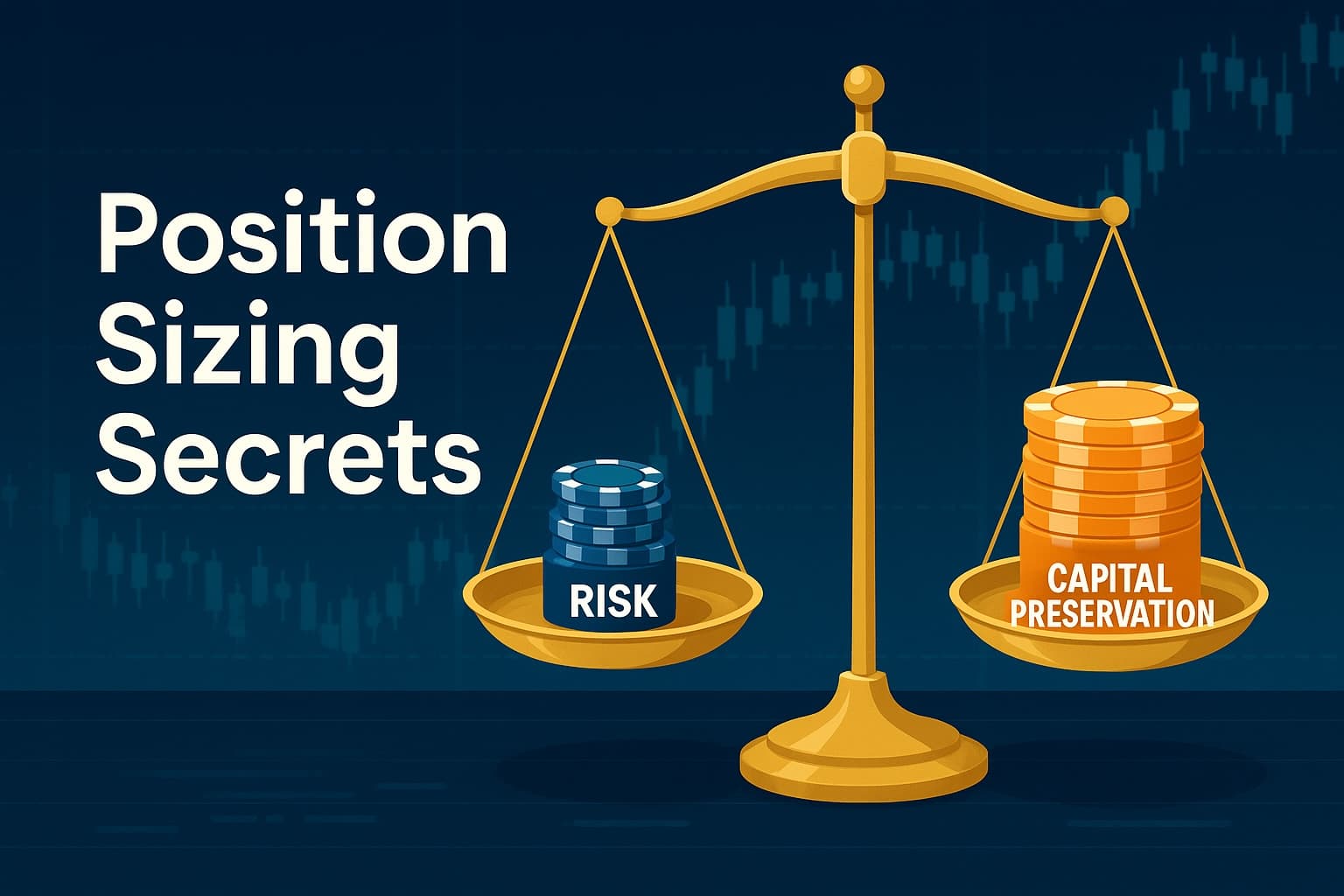
Position sizing is not a detail. It is the mechanism that determines whether a profitable strategy produces a profitable account. Get it wrong consistently and a positive expectancy trade selection process produces a negative result.
This article explains what position sizing is actually solving, where the mistakes happen, and how to build a practical sizing discipline that works in the specific context of Indian retail trading.
What Position Sizing Is Actually Solving
Most explanations of position sizing focus on limiting loss: "risk only 1% per trade." That is a floor, not a complete framework.
What position sizing is actually managing is the relationship between three numbers that are almost never in balance by default:
- How much you can lose if the trade stops out (defined by stop distance and position size)
- How much of your account you are willing to lose on any single trade (defined by risk tolerance)
- How much you gain when the trade works (defined by the same position size, applied to a larger move)
If these three numbers are not managed deliberately, they drift. The result is what most traders experience: outsized losses on bad weeks, undersized gains on good weeks, and a net result that bears no resemblance to what the strategy should theoretically produce.
Position sizing does not make bad trades good. It ensures that when the strategy works correctly over time, the results in the account reflect that, rather than being destroyed by a handful of oversized losses or diminished by chronic undersizing on winners.
The Most Common Misunderstanding
Most traders think about position size in terms of how many shares or lots they want to trade. They look at the price, decide how many units feel right for the setup, and enter. Sometimes they take more if they "feel confident." Sometimes they take less if they are nervous.
The problem is that this approach has no fixed relationship to the stop loss distance. And without that relationship, risk per trade is completely unpredictable.
Consider two trades in the same week:
- Trade A: Rs. 100 stock, stop at Rs. 97. Stop distance = 3%. Trader buys 200 shares = Rs. 20,000 position. Risk if stopped = Rs. 600.
- Trade B: Rs. 100 stock, stop at Rs. 99. Stop distance = 1%. Trader also buys 200 shares = Rs. 20,000 position. Risk if stopped = Rs. 200.
The trader took the same number of shares in both trades. But the actual risk in Trade A is three times the risk in Trade B. If the trader's account is Rs. 5,00,000, Trade A risked 0.12% of capital and Trade B risked 0.04% of capital. Neither was deliberately chosen. Both happened by default.
Now flip it: Trade A has a tight stop but the trader took a larger position, and Trade B has a wider stop with a smaller position. Suddenly the risks are inverted again, and still neither was deliberately managed.
The correct way to size is not shares-first. It is risk-first. Decide how much of the account is at risk on this trade, then calculate position size backward from the stop distance.
The Basic Sizing Formula
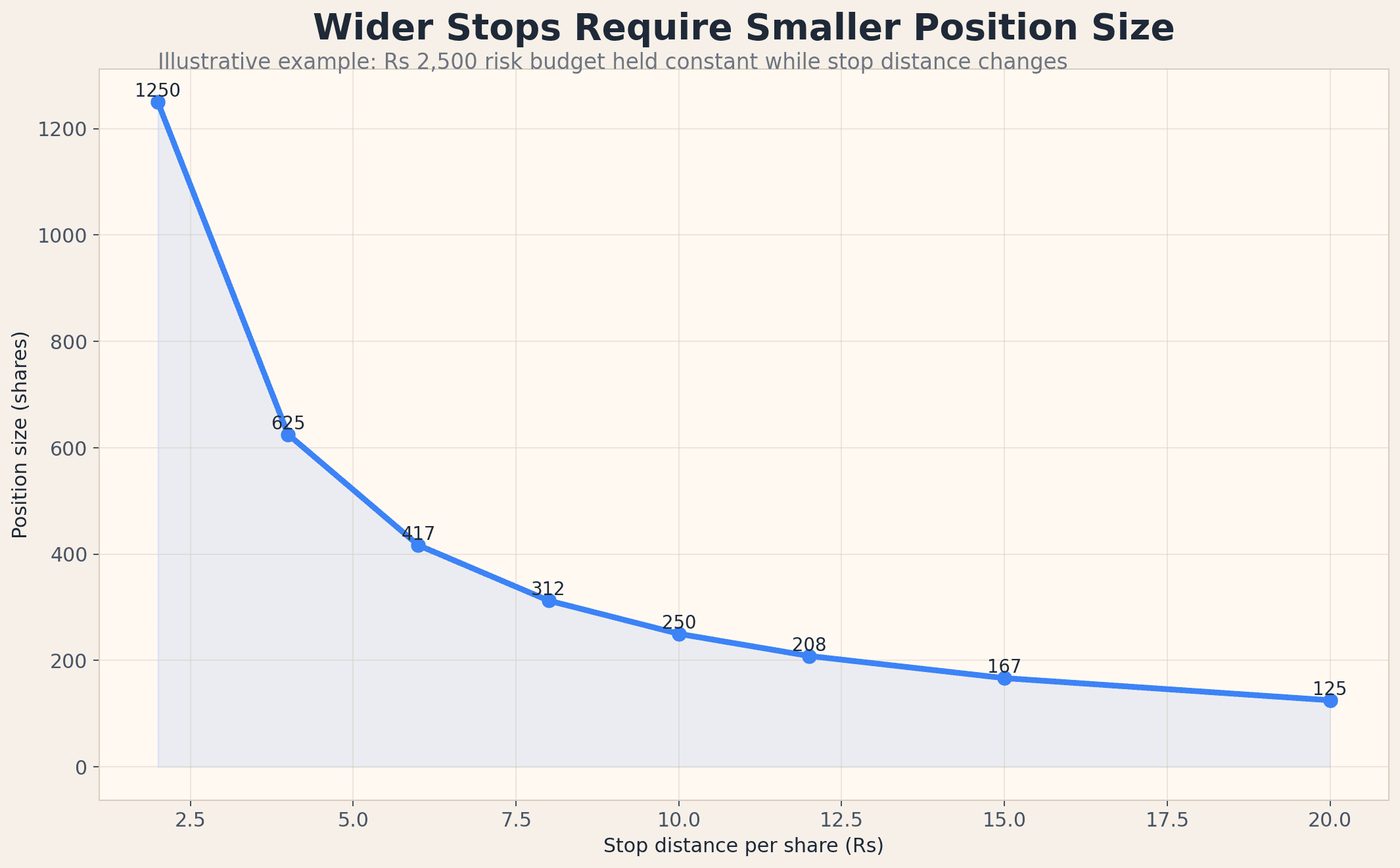
Position size = Risk amount / Stop distance per unit

Where:
Risk amount = Account size × Risk percentage per trade
Stop distance = Entry price - Stop price (for a long trade)
Example:
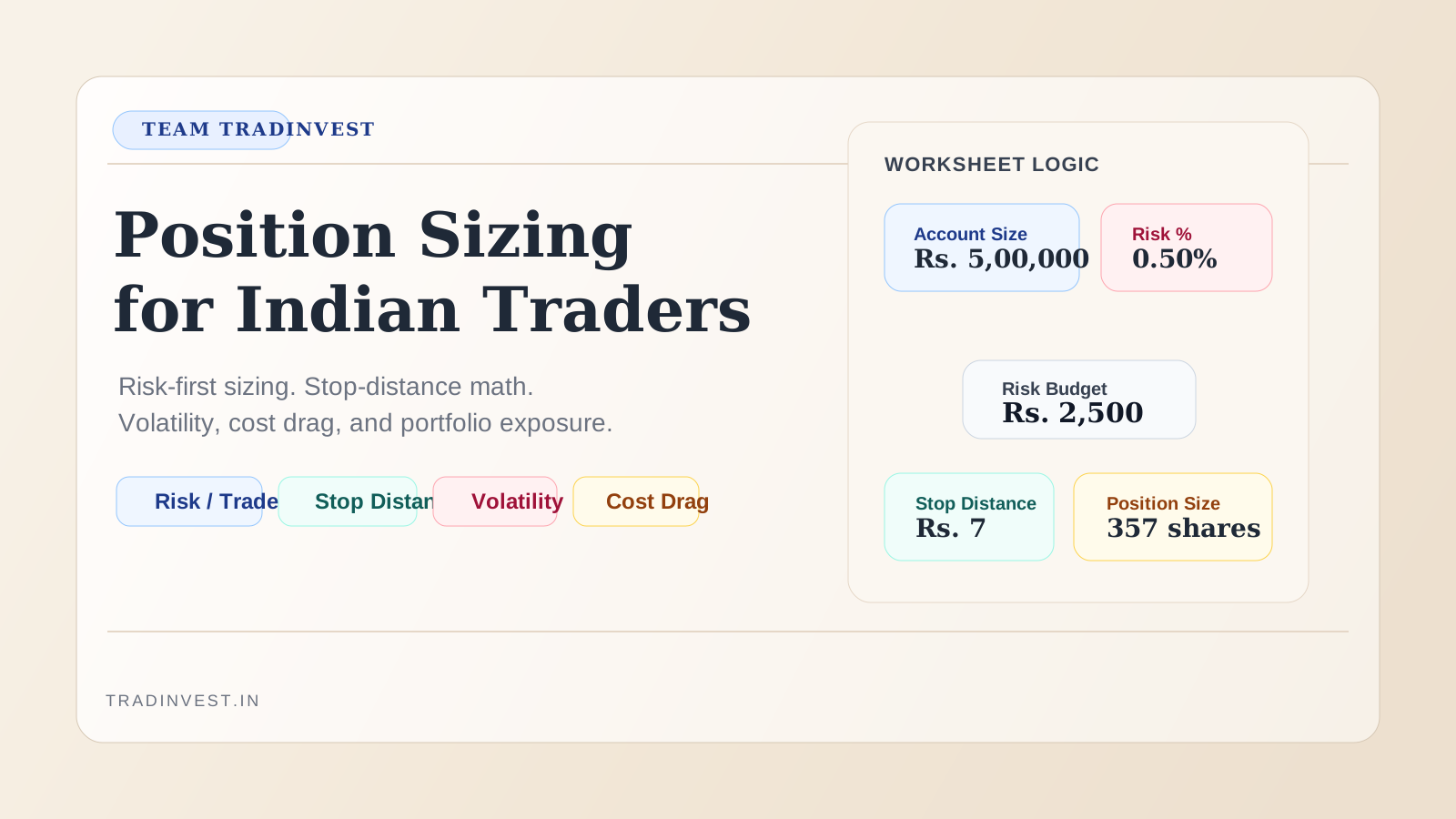
- Account size: Rs. 5,00,000
- Risk per trade: 0.5% of account = Rs. 2,500
- Entry: Rs. 200
- Stop: Rs. 193
- Stop distance: Rs. 7 per share
Position size = Rs. 2,500 / Rs. 7 = 357 shares
Position value = 357 × Rs. 200 = Rs. 71,400
The result is a position where, if the trade stops out, exactly Rs. 2,500 is lost — regardless of what the stock price is, what the volatility is, or how the trader feels about the setup.
This is the foundation. Everything else in this article is a refinement of this principle.
Worked Example 1: Right on Direction, Wrong on Sizing
A trader with a Rs. 5,00,000 account is looking at two setups on the same day.
Setup 1: A mid-cap stock they know well. Strong RS, clean base, high conviction. They buy 1,000 shares at Rs. 150. Stop is at Rs. 144. Stop distance is Rs. 6 per share.
Risk if stopped = 1,000 × Rs. 6 = Rs. 6,000 = 1.2% of account
Setup 2: A stock they are less certain about. They buy 200 shares at Rs. 500. Stop is at Rs. 488. Stop distance is Rs. 12 per share.
Risk if stopped = 200 × Rs. 12 = Rs. 2,400 = 0.48% of account
Both trades work. Setup 1 hits its 3R target (Rs. 18 per share profit). Setup 2 also hits 3R (Rs. 36 per share profit).
Profit from Setup 1 = 1,000 × Rs. 18 = Rs. 18,000
Profit from Setup 2 = 200 × Rs. 36 = Rs. 7,200
Now both trades fail:
Loss from Setup 1 = Rs. 6,000
Loss from Setup 2 = Rs. 2,400
The high-conviction trade in Setup 1 is 2.5 times larger in loss than Setup 2. But it is only 2.5 times larger in gain because the target was expressed as the same R-multiple. The trader got lucky that Setup 1 worked, because if it had failed instead, the account would have taken a disproportionate hit.
Now rebuild this correctly:
Risk budget per trade: 0.5% = Rs. 2,500.
Setup 1 correct size = Rs. 2,500 / Rs. 6 = 417 shares (vs 1,000 taken)
Setup 2 correct size = Rs. 2,500 / Rs. 12 = 208 shares (vs 200 taken -- coincidentally close)
Under the risk-first approach, both trades risk Rs. 2,500. If Setup 1 hits 3R, profit is 417 × Rs. 18 = Rs. 7,506. If it fails, loss is Rs. 2,500. The results are symmetrical and predictable. The account is not hostage to a single outsized position.
The adjustment here is not about being more cautious. It is about being more consistent. Consistent sizing is what allows expectancy to compound. Inconsistent sizing creates a situation where the account's performance bears no relationship to the strategy's actual edge.
Worked Example 2: The Volatility and Cost Interaction
Position sizing cannot be calculated without accounting for the actual volatility of what is being traded. A stop at 1% on a low-volatility blue-chip is structurally different from a stop at 1% on a high-beta mid-cap.
Scenario: A trader wants to take two trades at the same risk-per-trade of Rs. 2,500.
Trade A is a Nifty 50 large-cap, daily ATR (Average True Range) of approximately Rs. 15.
Trade B is a mid-cap growth stock, daily ATR of approximately Rs. 45.
If both stops are set at 1x ATR:
- Trade A stop distance = Rs. 15
- Trade B stop distance = Rs. 45
Trade A size = Rs. 2,500 / Rs. 15 = 167 shares
Trade B size = Rs. 2,500 / Rs. 45 = 56 shares
Trade A has almost three times the share count as Trade B, even though the risk is identical. This is correct. The larger position in Trade A reflects the fact that the tighter volatility requires more units to create the same dollar risk.
Now add the cost layer. From the trading costs article, intraday charges on a Rs. 1 lakh position approximate Rs. 83 in total friction. Trade A's position value is 167 × entry price. If entry is Rs. 300:
Trade A value = 167 × Rs. 300 = Rs. 50,100
Trade A charges ≈ Rs. 42 (roughly half of the Rs. 1 lakh charge, proportional to size)
Trade B at 56 units at Rs. 800 per share:
Trade B value = 56 × Rs. 800 = Rs. 44,800
Trade B charges ≈ Rs. 37
In both cases, charges are small relative to the Rs. 2,500 risk budget. But now consider a trader who sizes Trade B at 200 units (perhaps feeling the stock will move faster):
Position value = 200 × Rs. 800 = Rs. 1,60,000
Risk if stopped = 200 × Rs. 45 = Rs. 9,000 (3.6% of Rs. 5L account)
Charges ≈ Rs. 133
The risk jumped to 3.6% of account, charges scaled with position, and if the stop is hit, the loss is Rs. 9,000 plus Rs. 133 in charges. A single oversized trade in a volatile name can produce a loss that requires four to five winning trades at the correct size to recover.
This is the sizing-volatility interaction that most traders fail to think through. High-volatility positions require smaller unit counts for the same risk exposure, not larger ones.
The Five Variables That Actually Matter
Position sizing decisions are not arbitrary. They follow from five inputs that can be assessed before every trade.
1. Account size and risk percentage The risk percentage is a policy decision, not a per-trade judgment. It should be set once and applied consistently. Common ranges for active traders are 0.25% to 1% per trade, depending on strategy type and account size. Lower percentages are appropriate for more frequent traders; higher percentages create too much exposure when multiple positions are open simultaneously.
2. Stop distance Stop distance is determined by the setup, not by the desired position size. A stop placed at a technically meaningful level — below support, beyond a consolidation boundary, outside the ATR range — will vary from trade to trade. The position size adjusts to the stop, never the other way around.
3. Volatility High-volatility instruments require proportionally smaller position sizes for the same risk amount. Using ATR as a reference makes this calculation consistent. A stop at 1x ATR is a defined unit of risk for that instrument's current conditions.
4. Cost drag at the intended position size As noted above, trading costs in India are not trivial, particularly for intraday trades. For very small positions, fixed brokerage becomes disproportionately large as a percentage of expected profit. A position too small to generate meaningful gross profit after charges is not worth taking. This is the minimum viable position size consideration, which is distinct from the maximum risk calculation.
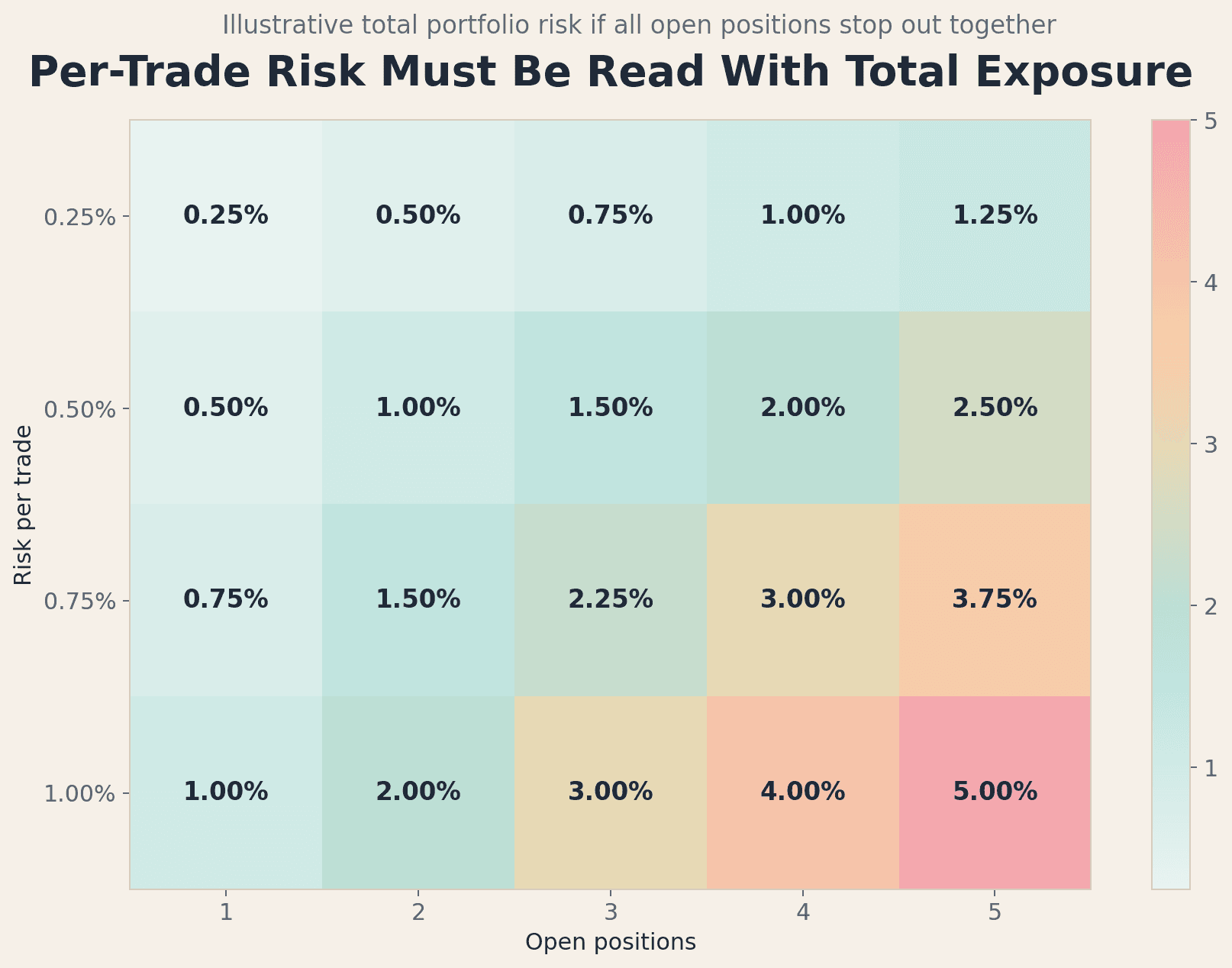
5. Number of simultaneous positions If a trader runs three to five positions simultaneously, each at 1% risk, the total portfolio risk at any moment is 3-5% of capital. During correlated market moves — a broad Nifty selloff, for example — these positions are not independent. They are likely to be stopped out together. The per-trade risk budget must be set in the context of how many positions will be open at the same time.
How Conviction Should and Should Not Change Sizing
Many experienced traders vary position size by conviction. This is defensible under one condition: if you have verified evidence from your trade history that your high-conviction calls actually outperform your low-conviction calls.
Without that evidence, varying size by conviction is a form of emotional sizing. It rewards the feeling of confidence rather than the historical accuracy of your judgment, which is a very different thing.
A more structured approach: maintain a baseline size for all compliant setups, and allow a 1.25x to 1.5x multiple for setups that meet a higher structural standard — not because they "feel right," but because they score higher on an objective pre-trade criteria set. The trading journal and weekly review process are what create this evidence base over time.
Without that review, conviction is just confidence. And confidence has no systematic relationship with edge.
Common Sizing Mistakes
Sizing up after losses to "recover"
This is the most dangerous pattern. After a loss, the temptation is to take a larger position on the next trade to get back to even faster. The problem is that the next trade has no higher probability of success than the previous one. Sizing up after a loss raises the risk at exactly the moment when the account can least absorb another hit. It is the mechanism behind blown accounts. The revenge trading article addresses this pattern in depth.
Using the same position size regardless of stop distance
As shown in the worked examples, identical unit counts with different stop distances produce wildly different risk exposures. This is the most common sizing mistake among traders who think they are being consistent but are actually absorbing completely unpredictable risk per trade.
Oversizing in liquid instruments because they "move fast"
Fast-moving instruments require smaller unit counts, not larger ones. The point of a trade is not to maximise the position value. It is to capture a defined risk-reward structure. A large position in a fast-moving mid-cap that stops out clean produces the same Rs. 2,500 loss as a smaller position in a slow-moving large-cap. The experience of the trade feels different. The outcome on the account should be identical.
Ignoring correlation when running multiple positions
Three positions in banking stocks are not three independent bets. They are one bet on the banking sector with three units of exposure. If Nifty Bank sells off, all three positions deteriorate together. The risk budget per position needs to shrink when sector concentration is high.
Undersizing to avoid loss, then oversizing when it works
This pattern — tentative entry, then adding aggressively on a winning position — sounds like it manages risk. In practice, it means the heaviest exposure arrives late in the move, when the risk-reward of the original setup no longer applies. The correct time to determine position size is before entry. Adding can be appropriate in specific setups with defined rules, but averaging up emotionally is a different thing entirely.
For Indian Traders: Specific Sizing Considerations
Expiry weeks
Weekly and monthly F&O expiry sessions in India create volatility profiles that differ from normal sessions. Positions carried into expiry face pin risk, accelerated time decay, and directional volatility driven by options positioning rather than fundamental factors. Sizing for expiry sessions should be smaller — or positions should not be initiated in the final day or two before expiry unless the strategy is specifically designed for that environment.
Overnight gap risk
Indian markets gap at open in response to global overnight moves, domestic news, and pre-open auction dynamics. A position held overnight carries gap risk that cannot be managed with an intraday stop. If a stock gaps down through a stop level, the actual loss may be meaningfully larger than the planned risk. Position sizing for overnight holds must account for this. One approach: size overnight positions at 50-75% of the intraday maximum, with the explicit acknowledgment that gap moves can exceed the stop-loss plan.
Leverage in futures and options
Futures in India require margin that is a fraction of the contract's notional value. A trader putting up Rs. 1,20,000 margin on a futures contract with a notional value of Rs. 16,00,000 is operating at approximately 13x leverage. At this leverage, a 0.5% adverse move in the underlying is a 6.5% move against the margin deployed. The risk-first sizing formula applies to the notional value of the contract, not the margin. Many traders calculate risk on margin, which dramatically understates actual exposure.
For options buyers, the maximum loss is the premium paid. But the sizing discipline still applies: how many lots should be bought such that if the option expires worthless (or is stopped out), the account loss is within the defined risk budget? A trader who buys too many lots of a cheap option because "it is only Rs. 5" may have total premium exposure of Rs. 20,000 across four lots. If the option expires worthless, that is 4% of a Rs. 5,00,000 account lost on one trade.
Cost drag on small intraday positions
As covered in the charges article, fixed brokerage (Rs. 20 per order with discount brokers) creates a minimum viable position threshold. On a very small position, the Rs. 40 round-trip brokerage represents a meaningful percentage of the gross profit available at the target. Below a position value of approximately Rs. 40,000 to 50,000 for intraday equity, the cost drag becomes material relative to the gross edge. This is the floor below which further reduction in position size is counterproductive from a cost perspective, even if the risk calculation suggests a smaller size.
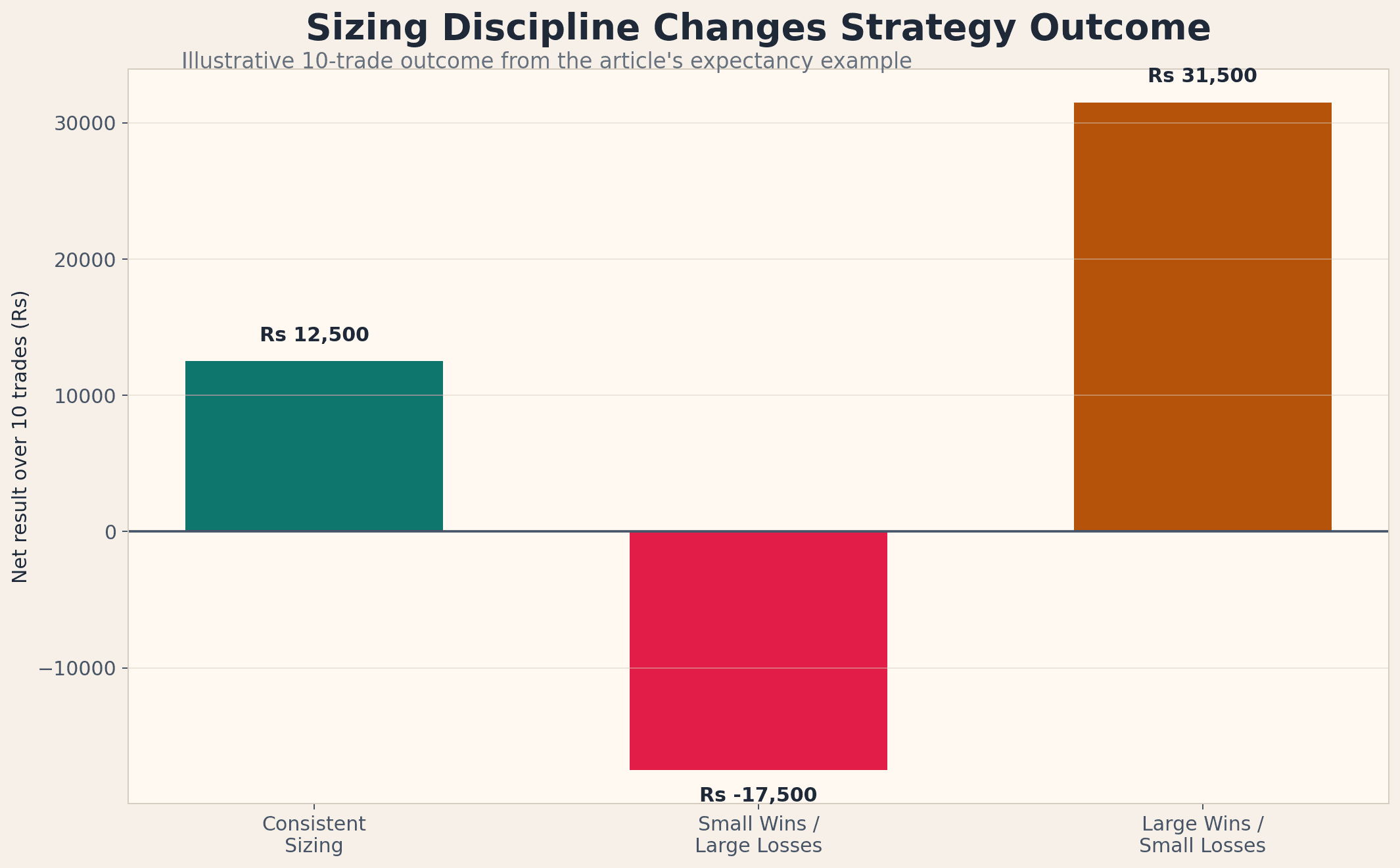
Side-by-Side: Consistent vs Inconsistent Sizing Over 10 Trades
Assume a strategy with 50% win rate, 2R average winner, 1R average loser. Account: Rs. 5,00,000. Correct risk per trade: Rs. 2,500 (0.5%).
| Approach | Avg winner | Avg loser | Result over 10 trades (5W, 5L) |
|---|---|---|---|
| Consistent sizing (0.5% per trade) | Rs. 5,000 | Rs. 2,500 | Rs. 25,000 - Rs. 12,500 = +Rs. 12,500 |
| Inconsistent (small wins, large losses) | Rs. 2,500 (undersized) | Rs. 6,000 (oversized) | Rs. 12,500 - Rs. 30,000 = -Rs. 17,500 |
| Inconsistent (large wins, small losses) | Rs. 7,500 (oversized) | Rs. 1,200 (undersized) | Rs. 37,500 - Rs. 6,000 = +Rs. 31,500 |
The third row looks attractive, but it requires consistently taking larger size on winning trades and smaller size on losing ones -- which requires predicting in advance which trades will win. That is not a sizing strategy. That is a selection fantasy.
The first row is achievable, sustainable, and repeatable. The second row -- which represents the most common pattern among retail traders -- produces a loss from a theoretically profitable strategy.
A Practical Implementation Checklist
Before sizing any trade, work through this sequence. It takes under two minutes once the habit is built.
Step 1: Define the stop Where is the stop, and why? It should be at a technically meaningful level, not at a fixed percentage. What is the stop distance in rupees per unit?
Step 2: Set the risk amount What is the risk budget for this trade? Use the pre-determined percentage of account size. Do not adjust this based on how the trade feels.
Risk amount = Account size × Risk % per trade
Step 3: Calculate position size
Units = Risk amount / Stop distance per unit
Step 4: Check the position value Is the position value large enough that charges are not disproportionate to the expected gross profit? If the position is too small, consider whether the trade is worth taking at all.
Step 5: Check total portfolio exposure How many other positions are currently open? Are they in correlated sectors or instruments? What is the total portfolio risk if all open positions hit their stops simultaneously?
Step 6: Apply any context adjustments Is today an expiry session? Is this an overnight hold? Does the instrument have high gap risk? If yes, apply a conservative multiplier (0.5x to 0.75x) to the calculated size.
Step 7: Record the sizing rationale Log the intended size and the reasoning in the trade journal before entry. After the trade closes, review whether the sizing decision was correct regardless of outcome.
Key Takeaway
Position sizing is not a risk management detail. It is the core mechanism that determines whether a strategy's theoretical edge translates into actual account performance.
The principle is straightforward: decide how much of the account is at risk on any trade as a fixed policy, calculate position size from the stop distance rather than from share preference, and apply that calculation consistently regardless of how the setup feels.
Where Indian traders need specific adaptations -- smaller size in expiry sessions, accounting for gap risk on overnight holds, using notional rather than margin for futures risk calculation, and respecting the cost floor for small intraday positions -- these are adjustments to the baseline framework, not departures from it.
The R-multiple framework is the natural companion to this article: once sizing is consistent, R-multiples become the clean lens for evaluating whether trade results match the strategy's expectancy. Without consistent sizing, R-multiple analysis is noise.
The weekly review process is where sizing discipline is audited. Reviewing sizing consistency alongside setup quality and execution quality each week surfaces the pattern before it compounds into a month of unexplained underperformance.
Consistent sizing does not guarantee profitability. It guarantees that the account reflects what the strategy actually produces over time, rather than a distorted version of it shaped by inconsistent risk allocation.
That is what it is for.
Spread the good words
Give your view.
Give your view
Comments
0Use this insight inside the product
TradInvest is built to connect market context, strategy quality, and post-trade learning. Read the market with Pulse, narrow your watchlist with rotation and momentum, then review what actually worked.
Related posts
More insight tied to the same trading workflow.