Ask most retail traders how their strategy is performing and the first number they mention is win rate. "I win about 65% of my trades." The assumption underneath that statement is that a 65% win rate is a good thing, that it signals a working strategy, and that the main job is to keep that number up.
This assumption is wrong often enough to deserve a harder look.
Trading expectancy is the metric that actually tells you whether a strategy has an edge. Win rate is one input into that calculation. It is not the answer by itself, and in many cases it is actively misleading -- a high win rate combined with poor average wins relative to average losses produces a strategy that destroys capital over time, slowly and consistently enough that the trader never quite identifies the cause.
This article explains what expectancy actually means, why win rate is an incomplete signal, and how to use expectancy as the primary measure of strategy health.
The Win Rate Trap
Here is the simplest version of the problem.
A trader wins 70 out of 100 trades. By most intuitive standards, that sounds excellent. But if the 70 wins average Rs. 800 each, and the 30 losses average Rs. 3,000 each, the arithmetic is brutal:
Total profit from winners: 70 × Rs. 800 = Rs. 56,000
Total loss from losers:    30 × Rs. 3,000 = Rs. 90,000
Net result:                -Rs. 34,000
A 70% win rate, tracked carefully over 100 trades, produced a Rs. 34,000 loss. The win rate looked like evidence of skill. The expectancy told a different story.
Now the reverse. A trader wins only 40 out of 100 trades. Intuitively, that sounds like a poor strategy. But if the 40 wins average Rs. 4,500 each and the 60 losses average Rs. 1,000 each:
Total profit from winners: 40 × Rs. 4,500 = Rs. 1,80,000
Total loss from losers:    60 × Rs. 1,000 = Rs. 60,000
Net result:                +Rs. 1,20,000
A 40% win rate produced Rs. 1,20,000 in profit over the same 100 trades. The win rate looked like a liability. The expectancy showed the opposite.
Win rate without average win and average loss is not a meaningful number. The two examples above demonstrate this as clearly as math can. The question is not "do I win most of my trades." The question is "on average, how much do I make per trade when I take this trade."
That is what expectancy answers.
What Expectancy Actually Means
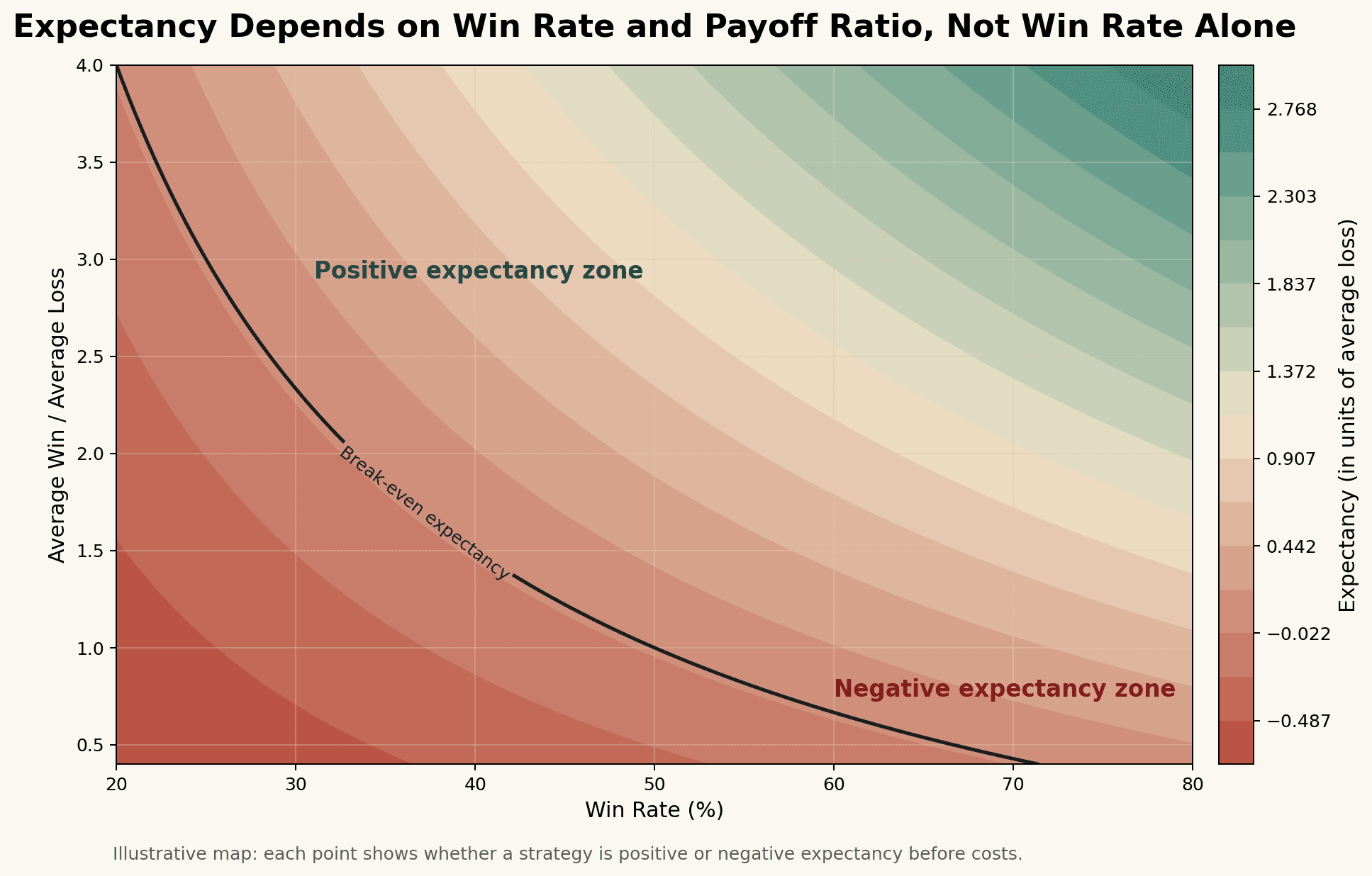
Trading expectancy is the average net profit or loss per trade, expressed across a representative sample of trades, accounting for both how often you win and how much you win or lose when you do.
The formula:
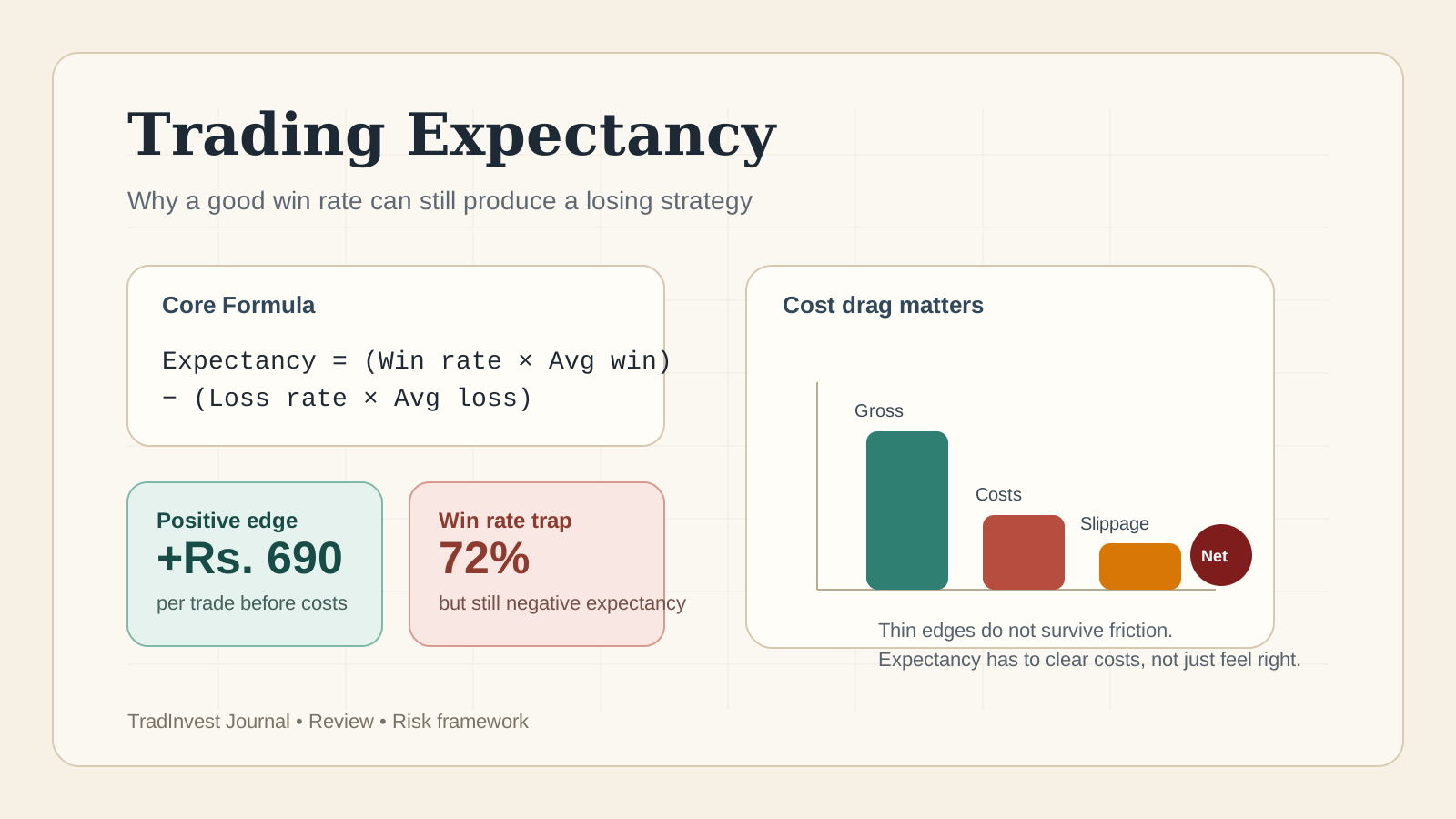
Expectancy = (Win rate × Average win) - (Loss rate × Average loss)

Where:
Win rate = Proportion of trades that are winners (e.g., 0.45 for 45%)
Loss rate = 1 - Win rate (e.g., 0.55 for 55%)
Average win = Mean profit on winning trades (in rupees)
Average loss = Mean loss on losing trades (in rupees, as a positive number)
If expectancy is positive, the strategy makes money on average per trade. If it is negative, the strategy loses money on average per trade. If it is close to zero, the strategy is roughly breakeven and costs will determine whether it is profitable or not.
A concrete example:
Win rate: 0.45
Average win: Rs. 3,000
Average loss: Rs. 1,200

Expectancy = (0.45 × 3,000) - (0.55 × 1,200)
           = Rs. 1,350 - Rs. 660
           = Rs. 690 per trade
This strategy produces an average of Rs. 690 per trade over time. That number, multiplied by the number of trades taken in a period, gives an estimate of the gross profit available before costs.
What makes this number powerful is that it collapses win rate, average win, and average loss into a single figure that represents the actual economic output of the strategy per trade taken.
Worked Comparison 1: High Win Rate, Negative Expectancy
A breakeven-obsessed intraday trader exits quickly at any sign of a reversal and holds losers, telling themselves the trade will "come back." The result over 100 trades:
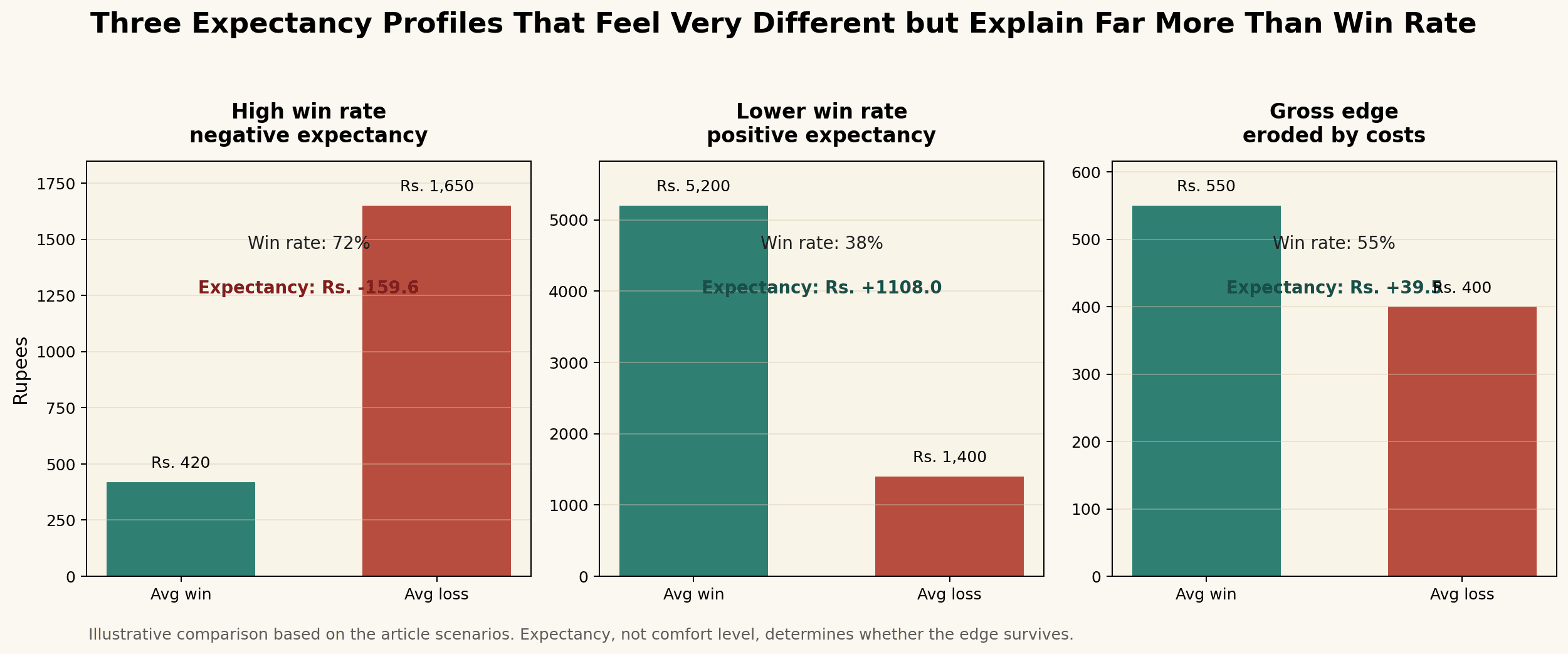
- Win rate: 72%
- Average win: Rs. 420
- Average loss: Rs. 1,650
Expectancy = (0.72 × 420) - (0.28 × 1,650)
           = Rs. 302.40 - Rs. 462.00
           = -Rs. 159.60 per trade
Over 100 trades, this strategy loses Rs. 15,960 before costs.
The 72% win rate is real. The trader really does close most trades in profit. But the losses, when they come, are four times the size of the wins. The psychological experience is deceptive: most days end in the green, which feels like success. The account is deteriorating anyway.
This pattern -- cutting winners early, holding losers long -- is one of the most common sources of negative expectancy in retail trading. It produces a high win rate and a shrinking account simultaneously.
Worked Comparison 2: Low Win Rate, Positive Expectancy
A swing trader who uses the discipline described in the R-multiple framework -- entering only at high-quality setups with defined stops and targets -- has a lower hit rate but a very different outcome.
Over 80 trades:
- Win rate: 38%
- Average win: Rs. 5,200
- Average loss: Rs. 1,400
Expectancy = (0.38 × 5,200) - (0.62 × 1,400)
           = Rs. 1,976 - Rs. 868
           = Rs. 1,108 per trade
Over 80 trades, this strategy generates Rs. 88,640 in gross profit. The trader loses more trades than they win -- 49 losses versus 30 wins -- but the asymmetry between wins and losses produces a strongly positive result.
The experience of this strategy is uncomfortable. More than half the trades are losers. There are stretches of multiple consecutive losing trades. Without a clear understanding of expectancy, this trader might conclude the strategy is broken and abandon it at exactly the wrong moment.
Expectancy explains why the losing trades are part of the plan, not a sign the plan is failing.
Worked Comparison 3: Positive Expectancy Before Costs, Negative After
This is the comparison that matters most for Indian short-term traders.
An intraday equity trader with a Rs. 1,00,000 position per trade has calculated their expectancy as follows, based on recent journal data:
- Win rate: 55%
- Average win: Rs. 550
- Average loss: Rs. 400
Expectancy = (0.55 × 550) - (0.45 × 400)
           = Rs. 302.50 - Rs. 180.00
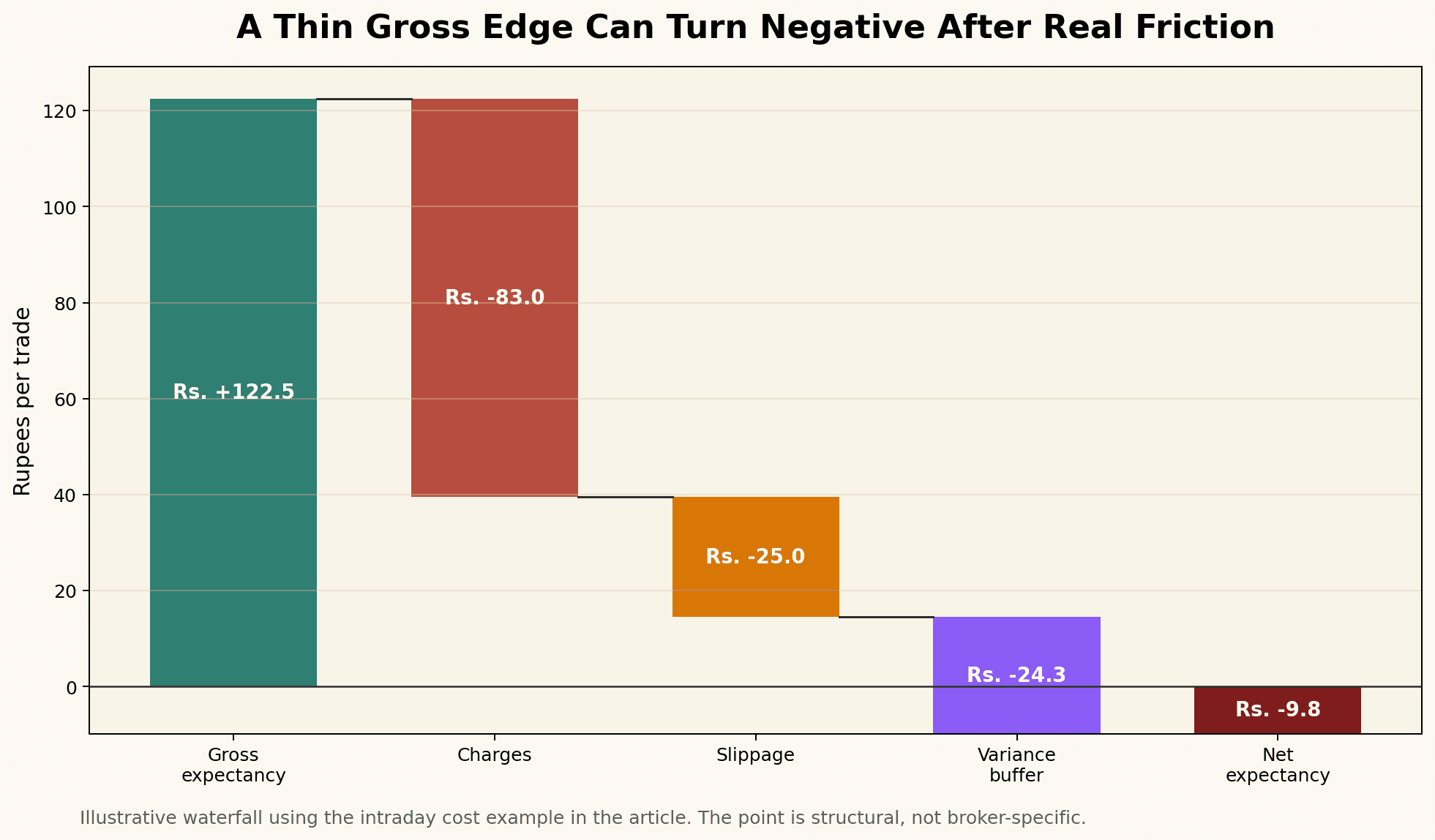
           = Rs. 122.50 per trade (gross)
This strategy appears to have a positive edge. Rs. 122.50 per trade times 200 trades per month = Rs. 24,500 gross monthly profit. On paper, this looks like a working system.
Now add costs.
As detailed in the trading charges article, intraday equity charges on a Rs. 1,00,000 position approximate Rs. 82 to Rs. 85 per round trip. With a discount broker flat-fee structure, this is largely fixed regardless of the profit or loss on the trade.
Net expectancy = Rs. 122.50 - Rs. 83.00 = Rs. 39.50 per trade
The gross edge was Rs. 122.50. After costs, it shrinks to Rs. 39.50. The strategy is still technically profitable, but the margin is thin. Now consider execution slippage -- entering a few rupees away from the ideal level, exiting slightly late -- which might cost another Rs. 20 to Rs. 30 per trade in effective friction.
Net expectancy after costs and slippage = Rs. 39.50 - Rs. 25 = Rs. 14.50 per trade
Rs. 14.50 per trade on a Rs. 1,00,000 position is a 0.0145% net edge per trade. Over 200 trades per month, that is Rs. 2,900 monthly net. Small but still positive.
But: if the trader's win rate slips slightly due to a change in market regime, or the average win declines slightly as they tighten exits:
- Win rate drops to 52%
- Average win drops to Rs. 510
Gross expectancy = (0.52 × 510) - (0.48 × 400) = Rs. 265.20 - Rs. 192 = Rs. 73.20
Net after costs = Rs. 73.20 - Rs. 83 = -Rs. 9.80 per trade
A marginal positive-expectancy strategy just turned negative from two small parameter shifts -- entirely within the normal variance of any strategy. The strategy did not break. The edge was simply not large enough to survive the cost environment and normal fluctuation.
This is the fundamental problem with thin-edge high-frequency trading in India. The cost structure is real, unavoidable, and applied to every trade whether it wins or loses. A gross expectancy of Rs. 100 to Rs. 150 per trade on a Rs. 1,00,000 intraday position is not comfortable margin. It is a fragile balance.
How the Components of Expectancy Can Be Separately Improved
Breaking expectancy into its components suggests where work can be done.
Win rate can be improved by tightening setup quality -- taking only A-grade setups, as discussed in the price structure article. Fewer trades, higher selection standard, higher hit rate. The cost is fewer trading opportunities. The benefit is a cleaner expectancy calculation with less noise.
Average win is primarily a function of target discipline and the market's willingness to give. Cutting winners too early is the fastest way to compress average win. Letting winning trades develop to their natural targets -- adjusting stops to protect profit rather than exiting early -- is what maintains average win. This requires both structural rules and the emotional capacity to hold through noise.
Average loss is controlled by stop placement and stop discipline. A wide stop that is frequently hit creates a large average loss. A stop that is frequently moved further away (giving the trade "more room") inflates average loss unpredictably. Fixed stops at technically meaningful levels, not moved in the loss direction, is what keeps average loss controlled.
Cost drag is reduced by trading less frequently, selecting larger moves relative to position size, and choosing instruments where the gross edge available is meaningfully larger than the per-trade charge. For short-term traders in India, this specifically means: fewer trades per day, larger expected gross moves per trade, and consistent evaluation of whether small-profit-target strategies are actually clearing the cost hurdle.
These are not independent levers. Improving one often affects another. Tightening setup quality improves win rate but reduces trade frequency, which reduces cost drag. Holding for larger targets improves average win but reduces win rate. Understanding how they interact, for a specific strategy, requires data from a trading journal tracked over enough trades to be statistically meaningful.
The Relationship Between Expectancy and Position Sizing
Expectancy is expressed per trade, not per rupee deployed. This creates an important relationship with position sizing.
A strategy with Rs. 690 expectancy per trade at a Rs. 1,00,000 position size produces 0.69% return per trade on capital deployed. At consistent sizing, this compounds predictably over time.
Now the same strategy is run with inconsistent sizing -- some trades at Rs. 50,000, some at Rs. 2,00,000. The expectancy per trade remains Rs. 690 on average, but the per-trade return on capital deployed varies from 1.38% to 0.345%. Over time, this inconsistency makes it impossible to evaluate whether the expectancy is stable, declining, or improving. The signal is buried in noise created by sizing variation.
Consistent position sizing, as covered in the position sizing article, is a prerequisite for measuring expectancy accurately. Without consistent sizing, the expectancy number calculated from the journal is not the true expectancy of the strategy -- it is a blend of strategy expectancy and sizing decisions that cannot be separated.
For Indian Traders: Where Expectancy Degrades Fastest
Intraday equity with small average moves. When a strategy is designed around 0.20% to 0.35% gross moves intraday, the Rs. 82 to Rs. 85 per-trade charge on a Rs. 1 lakh position consumes a significant portion of average gross profit. The gross expectancy must be meaningfully above the cost per trade to survive normal variance. Strategies that depend on a very high win rate combined with small average wins are particularly vulnerable to cost erosion.
Options with low premiums. The flat brokerage structure (Rs. 20 per order) makes round-trip costs on low-premium options disproportionately large relative to the premium at stake. A strategy trading Rs. 5 premiums extensively may find that brokerage alone represents 4 to 6% of the total premium outlay per round trip. Unless the strategy achieves very high accuracy or very large premium expansion, the cost structure kills the expectancy.
Frequent futures scalping. Futures STT at 0.05% on notional contract value (post Budget 2026 rates) means that a single Nifty futures lot at a Rs. 16-17 lakh notional carries Rs. 800 to Rs. 900 in STT on the sell side alone. A frequent scalping strategy in futures that targets Rs. 500 to Rs. 1,000 per lot gross is operating below or at the cost of STT alone. The gross expectancy must account for this before any claim of positive edge can be made.
Expiry week behaviour. Indian traders who increase trading frequency during expiry weeks -- because "there is more movement" -- often do so into a higher-volatility, lower-predictability environment where historical expectancy does not apply. The increased frequency amplifies cost drag while the edge from the strategy may not be present in expiry conditions. Expectancy tracked separately for expiry vs non-expiry sessions frequently reveals that the expiry session subset is significantly worse.
How to Track Expectancy in a Weekly Review
Expectancy is not a one-time calculation. It is a metric that should be tracked regularly and evaluated for stability over time.
The minimum data required:
- Number of trades
- Number of winners and losers
- Gross profit on each winner
- Gross loss on each loser
- Total charges per trade (or by segment)
From these, the weekly or monthly expectancy can be calculated:
Win rate = Winners / Total trades
Average win = Total gross profit from winners / Number of winners
Average loss = Total gross loss from losers / Number of losers

Gross expectancy = (Win rate × Average win) - (Loss rate × Average loss)
Net expectancy = Gross expectancy - Average charge per trade
What to look for when reviewing expectancy data:
- Is gross expectancy positive? If not, the strategy needs work on setup quality or exit discipline before cost reduction even matters.
- Is the gap between gross and net expectancy shrinking? This may indicate that trade selection has improved enough that the same cost is consuming a smaller fraction of the gross edge.
- Is win rate stable over different market regimes? A strategy whose win rate collapses in choppy markets but is solid in trending markets should not be traded in choppy conditions.
- Is average win declining over time? This often signals that exits are being tightened due to fear or impatience, which compresses the most controllable component of expectancy.
The weekly review framework provides the structure for running this analysis without letting it become a two-hour exercise each weekend. Expectancy should be calculated at the end of every review cycle, not just when results feel poor.
A trading journal that captures entry price, exit price, stop price, and charges per trade has everything needed to calculate expectancy automatically. The TradInvest journaling framework is designed to capture exactly these fields consistently.
Common Mistakes in Thinking About Expectancy
Calculating expectancy over too few trades. Expectancy over 15 trades is noise. A 50% win rate calculated over 15 trades might reflect anything from 30% to 70% true win rate, depending on the sample. A minimum of 50 to 100 trades is needed before the calculation carries meaningful signal. Traders who look at one bad week and conclude their expectancy is negative are working with too small a sample.
Mixing strategy types in one expectancy calculation. If a trader takes breakout setups, countertrend setups, and news-driven setups in the same journal without tagging them separately, the expectancy number is an average across three different strategies. A positive overall number could be masking one strong strategy and two losing ones. Separate tagging and separate expectancy calculations by setup type is essential for useful analysis.
Confusing gross and net expectancy. A gross expectancy that looks profitable and a net expectancy that is negative are very different situations with different solutions. Gross expectancy can be improved through better setup selection and exit discipline. Net expectancy is also affected by cost management, instrument selection, and trade frequency. Conflating them produces the wrong diagnosis and the wrong intervention.
Using win rate as a proxy for expectancy. As shown in the comparisons above, a 70% win rate can coexist with a deeply negative expectancy, and a 38% win rate can coexist with a strongly positive one. Win rate should be tracked because it is a component of expectancy, not because it is a standalone signal. The moment a trader reports their win rate as evidence that the strategy works, they have stopped using the right metric.
Not accounting for costs in the expectancy calculation. Gross expectancy before costs is not the edge. Net expectancy after all charges, slippage, and execution friction is the edge. Calculating gross and calling it the system's return overstates the edge in most short-term trading strategies, sometimes substantially.
Pre-Review Expectancy Checklist
Run through this at the end of every trading week, alongside the process checks in the PEMA framework.
Data checks
- All trades logged with entry, exit, stop, gross P&L, and charges
- Trades tagged by setup type
- Sample size sufficient (minimum 20 trades per setup type before drawing conclusions)
Gross expectancy
- Win rate calculated for the period
- Average win calculated from all winning trades
- Average loss calculated from all losing trades
- Gross expectancy formula applied
Net expectancy
- Average charge per trade calculated (or estimated by segment)
- Net expectancy = gross expectancy minus average charge
- Is net expectancy positive, negative, or near zero?
Trend check
- Compare this period's expectancy to the prior two periods
- Is gross expectancy stable, improving, or declining?
- Is average win holding steady or compressing?
- Is average loss controlled or expanding?
Context check
- Was this period's market regime typical for this strategy?
- Were any trades taken in expiry sessions or high-event conditions that may not reflect normal expectancy?
- Should this period's data be flagged as atypical?
Action
- If gross expectancy is positive and net is thin: evaluate cost reduction options (fewer trades, larger moves, instrument selection)
- If gross expectancy is negative: diagnose whether the issue is win rate, average win, or average loss, and trace it to a specific behaviour pattern
- If expectancy has been negative for three or more consecutive review periods: the strategy needs reassessment, not just discipline
Key Takeaway
Win rate is a component of expectancy. It is not a measure of strategy quality by itself.
The formula for trading expectancy is simple:
Expectancy = (Win rate × Average win) - (Loss rate × Average loss)
But the implications of this formula are anything but simple when applied to real trading conditions. A strategy with positive gross expectancy may have negative net expectancy after Indian market charges. A strategy with a 70% win rate may be losing money if the average loss is too large relative to the average win. A strategy that appears to work in trending markets may have zero or negative expectancy in choppy conditions.
The traders who improve consistently are not those who chase win rate. They are those who understand expectancy -- track it methodically, diagnose it at the component level, and make specific changes to setup quality, exit discipline, or trade frequency when the data shows the edge is eroding.
Tracking this requires consistent sizing (so the expectancy calculation is not polluted by position size variation), consistent journaling (so the data exists), and a weekly review process (so the signal is not buried under weeks of accumulation before it is noticed).
The position sizing article, the journaling framework, and the weekly review process are the three practices that make expectancy tracking possible and useful. Without them, expectancy is a number you calculate once and forget. With them, it becomes the primary feedback loop between your trading behaviour and your results.
If you want to connect expectancy to execution quality, the most useful next reads are R-Multiple Mastery, Position Sizing for Indian Traders, and How to Review Your Trades Weekly. Those three practices are what make this metric usable instead of theoretical. If you want the same review workflow inside the product, the features, Edge, and pricing pages show how TradInvest packages it.
Spread the good words
Give your view.
Give your view
Comments
0Use this insight inside the product
TradInvest is built to connect market context, strategy quality, and post-trade learning. Read the market with Pulse, narrow your watchlist with rotation and momentum, then review what actually worked.
Related posts
More insight tied to the same trading workflow.