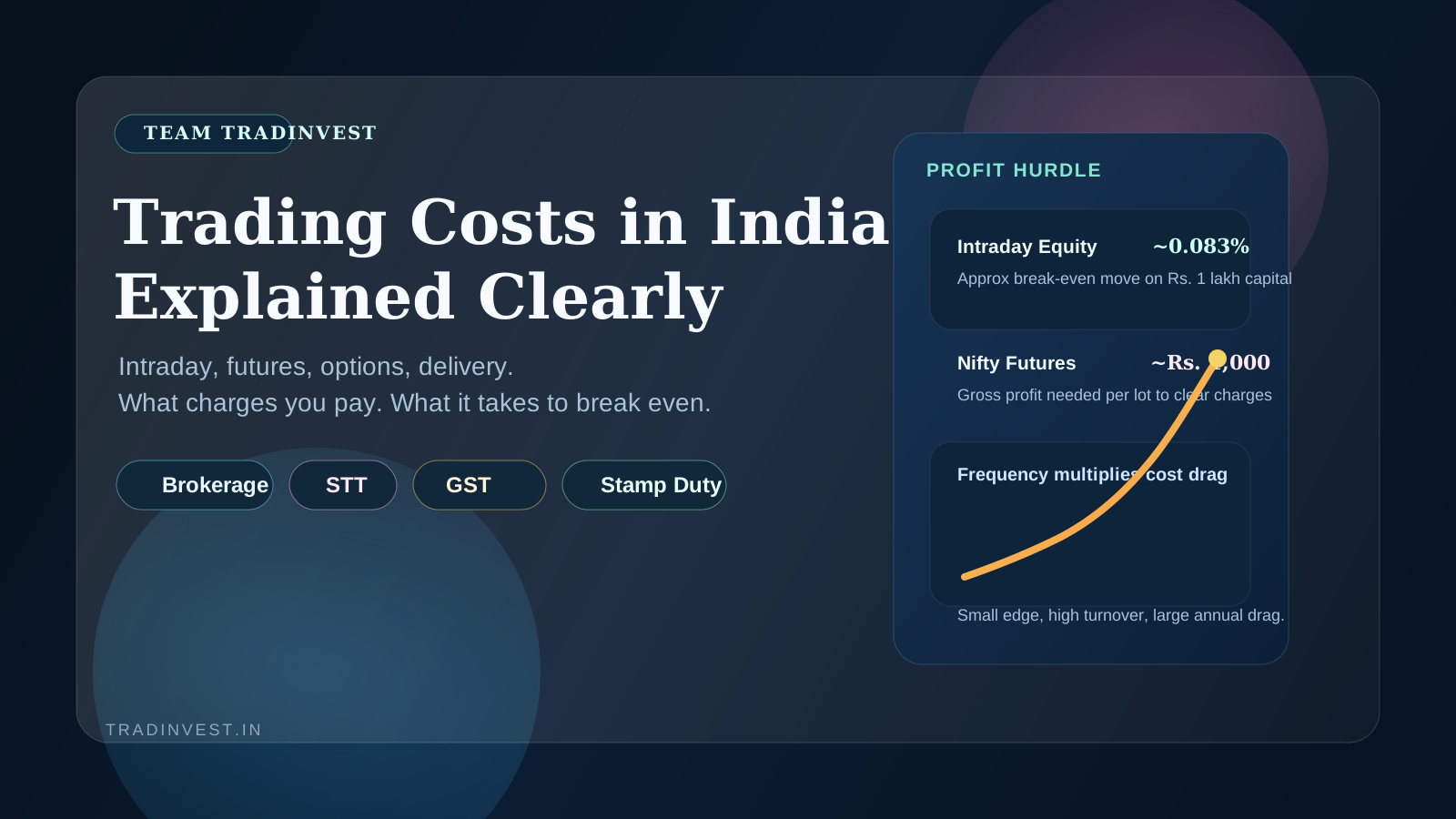
Most traders who struggle with profitability blame their strategy, their emotions, or their timing.
Rarely do they sit down and calculate what the market is charging them simply to participate.
In India, trading costs are not a rounding error. For a short-term trader — intraday, swing, or frequent F&O — the combined weight of brokerage, Securities Transaction Tax, exchange charges, GST, and stamp duty creates a profit hurdle that must be cleared before a single rupee is actually kept. Miss that hurdle, and a directionally correct trade still produces a loss on the contract note.
This article is not about psychology, strategy quality, or trading discipline. It is about cost math. Specifically, it answers: what does it actually cost to put on and take off a short-term trade in India, how much gross profit is needed just to break even, and why frequent trading makes this problem significantly worse.
All rates used in this article are sourced from Zerodha's published charges page, NSE, and SEBI circulars. Where rates were updated in the October 2024 exchange restructuring or the Budget 2026-27 announcements, those updated rates are used. Any figure that may vary by broker or exchange is noted explicitly.
Unless otherwise noted, the worked examples assume a Zerodha-style discount broker fee structure of Rs. 20 per executed order.
What This Article Is and Is Not
Before going further, a clear statement of scope.
This article is not arguing that short-term trading in India is impossible. It is not a list of psychological pitfalls. It is not strategic advice about which setups to trade.
It is a factual breakdown of what the Indian market charges you on every trade, how those charges stack up in practice, and what minimum gross profit is required on any given trade before costs are recovered. The goal is to give you the numbers clearly enough that you can stop wondering why your net P&L looks worse than your trade P&L.
One important distinction used throughout this article:
Transaction charges are costs incurred immediately during the trade — STT, brokerage, exchange charges, GST, stamp duty. These reduce your net result on every single trade, whether the trade is profitable or not.
Income tax is a separate matter, applied to net profits at the end of the financial year, and governed by separate rules depending on how your trading income is classified. This article addresses transaction charges in detail and explains income tax treatment briefly and separately. It does not mix them.
The Full Cost Stack: What You Pay on Every Trade
Indian trading charges have multiple layers. Each one is small in isolation. Together, they create a meaningful friction cost that compounds with every trade.
1. Brokerage
Brokerage is the broker's fee for executing your order.
Discount brokers — Zerodha, Upstox, Angel One, and similar — typically charge a flat fee of Rs. 20 per executed order for intraday equity, F&O, and currency trades. For equity delivery, many discount brokers charge zero brokerage.
Full-service brokers typically charge a percentage of turnover, often between 0.1% and 0.5%, with variations by relationship and volume. For the purpose of this article, all examples use the discount broker flat-rate assumption of Rs. 20 per order, which is the most common structure for active retail traders.
Key point: Brokerage applies per executed order, not per trade. A buy and a sell are two executed orders. An intraday round trip costs Rs. 40 in brokerage alone with a discount broker.
2. Securities Transaction Tax (STT)
STT is a government-levied tax on securities transactions. It is not a broker charge. It is not avoidable. It is charged regardless of whether the trade is profitable.
Current rates (as of April 2026):
| Segment | Buy side | Sell side |
|---|---|---|
| Equity delivery | 0.1% of turnover | 0.1% of turnover |
| Equity intraday | Nil | 0.025% of sell turnover |
| Futures (sell side) | Nil | 0.05% of contract value |
| Options (sell/short) | Nil | 0.15% of premium |
| Options (exercised) | Nil | 0.15% of intrinsic value |
Note: Futures and options STT rates were revised upward in Budget 2024-25 effective October 2024, and again in Budget 2026-27 effective April 2026. The rates above reflect the April 2026 applicable rates. Equity delivery and intraday STT rates are unchanged.
STT is charged on sell turnover for intraday and futures. For delivery, it is charged on both buy and sell turnover. For options, it is charged on premium value when shorting, and on intrinsic value at expiry exercise.
3. Exchange Transaction Charges
These are fees charged by NSE and BSE for processing trades on their platforms. They are calculated on turnover.
NSE rates (post October 2024 uniform fee structure):
| Segment | Rate |
|---|---|
| Equity (delivery and intraday) | 0.00307% of turnover |
| Equity futures | 0.00183% of turnover |
| Equity options | 0.03553% of premium turnover |
BSE rates differ slightly. These examples use NSE rates as NSE handles the majority of equity and F&O volume in India.
4. SEBI Turnover Fee
SEBI charges a regulatory fee on all transactions on recognised exchanges.
Rate: Rs. 10 per crore of turnover, or 0.0001% of turnover.
This is extremely small per trade but applies to every trade across all segments.
5. GST
GST at 18% is applied to the sum of brokerage, exchange transaction charges, and SEBI fees.
GST does not apply to STT or stamp duty directly. It applies to the service charges component only.
6. Stamp Duty
Stamp duty is charged by the Government of India under the Indian Stamp Act. As of 2020, a unified stamp duty structure applies nationally.
Current rates:
| Segment | Rate | Applied on |
|---|---|---|
| Equity delivery | 0.015% | Buy side only |
| Equity intraday | 0.003% | Buy side only |
| Equity futures | 0.002% | Buy side only |
| Equity options | 0.003% | Buy side only |
Stamp duty applies only on the buy side.
7. DP Charges (Delivery trades only)
When you sell delivery-held shares from your demat account, the Depository Participant (your broker's DP) charges a fee for the debit instruction.
At Zerodha, this is Rs. 15.34 per scrip per day (comprising CDSL charge, Zerodha DP charge, and GST). This charge applies once per scrip per sell day, regardless of quantity. A trader selling five different scrips in delivery in one day pays five separate DP charges.
DP charges do not apply to intraday trades since no actual demat movement occurs.
Charge Summary Table
| Charge | Segment | Applied on | Side | Avoidable? |
|---|---|---|---|---|
| Brokerage | All | Order value or flat fee | Buy and sell | Partially (broker choice) |
| STT | Equity, F&O | Turnover / premium | Sell (intraday, F&O); both (delivery) | No |
| Exchange transaction charge | All | Turnover / premium | Buy and sell | No |
| SEBI turnover fee | All | Turnover | Buy and sell | No |
| GST | All | Brokerage + exchange + SEBI fee | Buy and sell | No |
| Stamp duty | All | Turnover / premium | Buy side only | No |
| DP charges | Delivery only | Per scrip sold | Sell side | No (if holding in demat) |
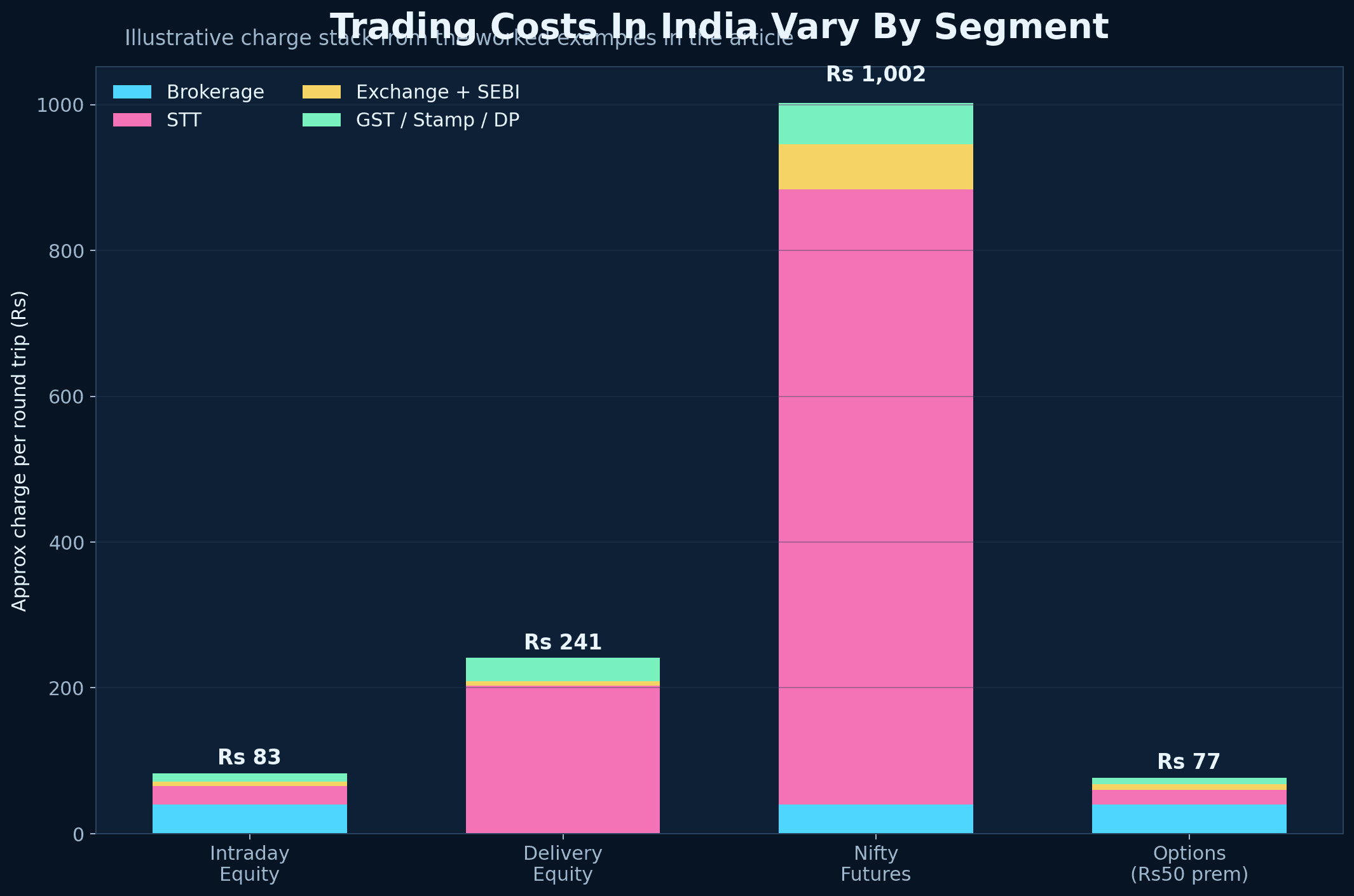
Worked Example A: Equity Intraday at +0.40% Gross Move
Assumptions:
- Capital deployed: Rs. 1,00,000
- Buy price: Rs. 100 per share, quantity 1,000 shares
- Sell price: Rs. 100.40 (a +0.40% move)
- Broker: Discount broker, Rs. 20 flat per order
- Exchange: NSE
Gross profit before charges:
Sell value:  1,000 x 100.40 = Rs. 1,00,400
Buy value:   1,000 x 100.00 = Rs. 1,00,000
Gross profit = Rs. 400
Charges breakdown:
| Charge | Calculation | Amount |
|---|---|---|
| Brokerage (buy) | Flat Rs. 20 | Rs. 20.00 |
| Brokerage (sell) | Flat Rs. 20 | Rs. 20.00 |
| STT (sell side only) | 0.025% x Rs. 1,00,400 | Rs. 25.10 |
| Exchange txn charge (buy) | 0.00307% x Rs. 1,00,000 | Rs. 3.07 |
| Exchange txn charge (sell) | 0.00307% x Rs. 1,00,400 | Rs. 3.08 |
| SEBI fee (buy + sell) | 0.0001% x Rs. 2,00,400 | Rs. 0.20 |
| Stamp duty (buy only) | 0.003% x Rs. 1,00,000 | Rs. 3.00 |
| GST (18% on brokerage + exchange + SEBI) | 18% x (40 + 6.15 + 0.20) | Rs. 8.34 |
| Total charges | Rs. 82.79 |
Net profit:
Net profit = Rs. 400 - Rs. 82.79 = Rs. 317.21
Charges as percentage of gross profit: 20.7%
A 0.40% move captures Rs. 400 gross. After charges, Rs. 317 remains. The friction consumed roughly one in five rupees of profit.
Worked Example B: Equity Intraday Scalp at +0.20% Gross Move
Same setup. Only the sell price changes to Rs. 100.20 (+0.20%).
Gross profit:
Sell value:  1,000 x 100.20 = Rs. 1,00,200
Gross profit = Rs. 200
Charges (virtually identical to Example A at this capital level):
| Charge | Amount |
|---|---|
| Brokerage (buy + sell) | Rs. 40.00 |
| STT | Rs. 25.05 |
| Exchange charges (buy + sell) | Rs. 6.15 |
| SEBI fee | Rs. 0.20 |
| Stamp duty | Rs. 3.00 |
| GST | Rs. 8.31 |
| Total charges | Rs. 82.71 |
Net result:
Net = Rs. 200 - Rs. 82.71 = Rs. 117.29 (profit)
But notice: the charges at this capital level are nearly constant regardless of whether the move is 0.20% or 0.40%. This means the gross move needed to merely survive charges at this position size is approximately:
Charges / Capital = Rs. 82.71 / Rs. 1,00,000 = 0.0827%
A scalp that captures less than 0.083% on a Rs. 1 lakh intraday trade is a loss-making trade even if directionally correct. This is the hidden break-even hurdle.
If the trade captured only 0.08%:
Gross profit = Rs. 80
Charges = Rs. 82.71
Net = -Rs. 2.71 (loss despite a winning trade)
Worked Example C: Equity Delivery Swing Trade at +3%
Assumptions:
- Buy: Rs. 1,00,000 worth of a stock
- Sell: After a few days at +3% gross move
- No brokerage on delivery (discount broker)
- DP charge applies on sell
Gross profit:
Gross = Rs. 1,00,000 x 3% = Rs. 3,000
Charges:
| Charge | Calculation | Amount |
|---|---|---|
| Brokerage | Zero (delivery) | Rs. 0 |
| STT (buy) | 0.1% x Rs. 1,00,000 | Rs. 100.00 |
| STT (sell) | 0.1% x Rs. 1,03,000 | Rs. 103.00 |
| Exchange charge (buy) | 0.00307% x Rs. 1,00,000 | Rs. 3.07 |
| Exchange charge (sell) | 0.00307% x Rs. 1,03,000 | Rs. 3.16 |
| SEBI fee (both sides) | 0.0001% x Rs. 2,03,000 | Rs. 0.20 |
| Stamp duty (buy only) | 0.015% x Rs. 1,00,000 | Rs. 15.00 |
| GST (on exchange + SEBI; no brokerage) | 18% x (6.23 + 0.20) | Rs. 1.16 |
| DP charges | Rs. 15.34 per scrip | Rs. 15.34 |
| Total charges | Rs. 240.93 |
Net profit:
Net = Rs. 3,000 - Rs. 240.93 = Rs. 2,759.07
Charges as % of gross profit: 8.03%
Note the difference vs intraday: delivery is more expensive in STT (both sides at 0.1% vs sell-only at 0.025%), but zero brokerage helps. The total charge burden on a 3% move is about 8% of the gross profit — meaningful but not crippling at this move size.
The break-even move for delivery on Rs. 1 lakh (approximately):
Minimum move = Charges / Capital = Rs. 240.93 / Rs. 2,03,000 ≈ 0.24% (combined buy + sell turnover)
Or roughly Rs. 241 gross profit needed before any net is kept
Worked Example D: Equity Futures — One Lot
Assumptions:
- Nifty futures, one lot (75 units) — using a hypothetical contract price of Rs. 22,500 (illustrative)
- Contract value: 75 x Rs. 22,500 = Rs. 16,87,500 (notional)
- Gross profit: Rs. 500 (a move of approximately 6-7 points, directionally correct)
- Broker: Rs. 20 flat per order
Charges:
| Charge | Calculation | Amount |
|---|---|---|
| Brokerage (buy + sell) | Rs. 20 x 2 | Rs. 40.00 |
| STT (sell side, 0.05% on contract value) | 0.05% x Rs. 16,87,500 | Rs. 843.75 |
| Exchange charge buy (0.00183% x contract) | 0.00183% x Rs. 16,87,500 | Rs. 30.88 |
| Exchange charge sell | 0.00183% x Rs. 16,87,500 | Rs. 30.88 |
| SEBI fee (both sides) | 0.0001% x Rs. 33,75,000 | Rs. 3.38 |
| Stamp duty (buy only, 0.002%) | 0.002% x Rs. 16,87,500 | Rs. 33.75 |
| GST (18% on brokerage + exchange + SEBI) | 18% x (40 + 61.76 + 3.38) | Rs. 18.92 |
| Total charges | Rs. 1,001.56 |
Net result:
Gross profit: Rs. 500
Total charges: Rs. 1,001.56
Net: -Rs. 501.56 (a loss, despite a winning trade)
This is the most important number in this article for futures traders.
A correctly directional trade that captures Rs. 500 gross profit still produces a loss of Rs. 501 after charges. The STT alone on a single lot of futures at this contract value is Rs. 843 — charged on the full notional contract value, not on the profit.
The minimum gross profit needed to break even on one Nifty futures lot at this contract size is approximately Rs. 1,001. In point terms on Nifty, that is roughly 13-14 points of gross move just to recover transaction costs. Any trade that captures fewer points is a loss even if directionally correct.
This is why frequent, small-profit futures trading is structurally difficult in India. The STT on notional value dominates the cost structure at small profit margins.
Worked Example E: Equity Options — Short-Term Premium Trade
Options are where cost misconceptions are most common. Many traders assume options are cheap to trade because premiums are small. The charge structure tells a different story.
Assumptions:
- Buy 1 lot of a stock option at Rs. 50 premium per unit, lot size 200
- Premium paid: Rs. 50 x 200 = Rs. 10,000
- Sell the option at Rs. 65 premium
- Gross profit: Rs. 15 x 200 = Rs. 3,000
Charges on option sell (short position exit, selling to close a bought option):
| Charge | Calculation | Amount |
|---|---|---|
| Brokerage (buy + sell) | Rs. 20 x 2 | Rs. 40.00 |
| STT (sell premium, 0.15%) | 0.15% x (Rs. 65 x 200 = Rs. 13,000) | Rs. 19.50 |
| Exchange charge (buy, 0.03553% of buy premium) | 0.03553% x Rs. 10,000 | Rs. 3.55 |
| Exchange charge (sell, 0.03553% of sell premium) | 0.03553% x Rs. 13,000 | Rs. 4.62 |
| SEBI fee | 0.0001% x Rs. 23,000 | Rs. 0.02 |
| Stamp duty (buy only, 0.003% on premium) | 0.003% x Rs. 10,000 | Rs. 0.30 |
| GST | 18% x (40 + 8.17 + 0.02) | Rs. 8.67 |
| Total charges | Rs. 76.66 |
Net profit:
Gross profit: Rs. 3,000
Charges: Rs. 76.66
Net: Rs. 2,923.34
At this premium level and profit size, charges are about 2.6% of gross profit — relatively benign.
But now change the scenario: a quick scalp where the option moves from Rs. 5 to Rs. 6
- Buy premium: Rs. 5 x 200 = Rs. 1,000
- Sell premium: Rs. 6 x 200 = Rs. 1,200
- Gross profit: Rs. 200
| Charge | Calculation | Amount |
|---|---|---|
| Brokerage | Rs. 40.00 | Rs. 40.00 |
| STT (sell, 0.15% on Rs. 1,200) | Rs. 1.80 | Rs. 1.80 |
| Exchange charges (buy + sell on premium) | 0.03553% x Rs. 2,200 | Rs. 0.78 |
| SEBI fee | Negligible | Rs. 0.00 |
| Stamp duty (0.003% on Rs. 1,000) | Rs. 0.03 | Rs. 0.03 |
| GST | 18% x (40 + 0.78 + 0.00) | Rs. 7.34 |
| Total charges | Rs. 49.95 |
Net profit:
Gross: Rs. 200
Charges: Rs. 49.95
Net: Rs. 150.05
Charges consumed 25% of the gross profit. And notice: brokerage is Rs. 40 out of Rs. 49.95 total charges at this low-premium level. The flat Rs. 20 per order fee dominates the cost structure when premium values are small.
This is the hidden cost trap in low-premium options trading. The Rs. 20 flat brokerage that seems negligible at Rs. 50 premium becomes enormous relative to gross profit at Rs. 5 premium. Low-premium, high-frequency options trading carries disproportionate fixed-cost friction.
The Minimum Profit Hurdle: Segment by Segment
Based on the worked examples above, here is a practical break-even reference.
| Segment | Position size | Approx. total charges | Min. gross profit to break even |
|---|---|---|---|
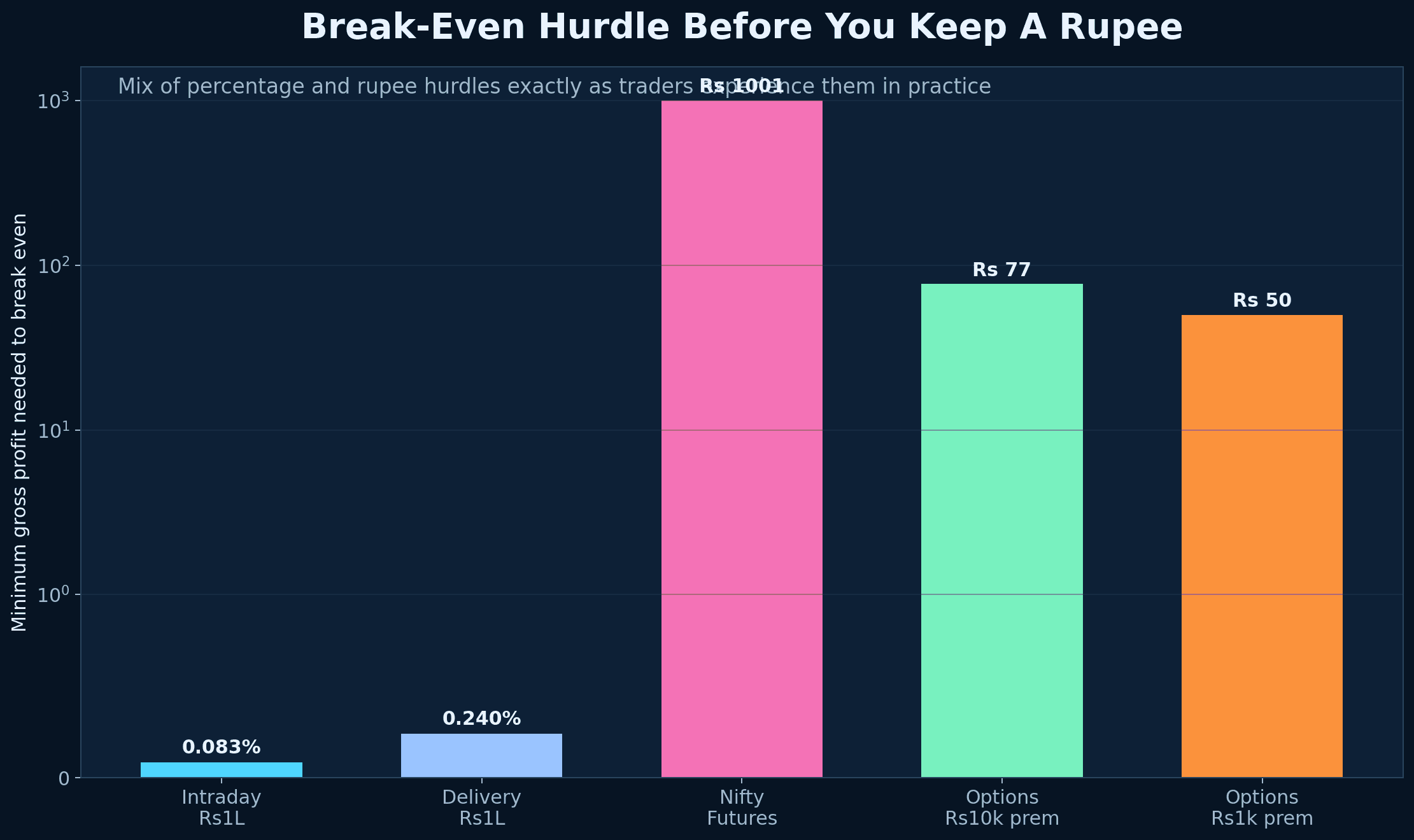
| Equity intraday | Rs. 1,00,000 | Rs. 82-85 | ~Rs. 83 or ~0.083% move |
| Equity delivery | Rs. 1,00,000 (buy and sell) | Rs. 240-250 | ~Rs. 241 or ~0.12% on buy + sell combined |
| Nifty futures (1 lot, ~Rs. 16-17L contract) | 1 lot | Rs. 950-1,050 | ~Rs. 1,000 minimum gross |
| Options (buy and sell, Rs. 50 premium, 200 lot) | Rs. 10,000 premium | Rs. 70-80 | Rs. 77 or 0.77% of premium |
| Options (buy and sell, Rs. 5 premium, 200 lot) | Rs. 1,000 premium | Rs. 48-52 | Rs. 50 or 5% of premium |
Key observation: As position size falls or premium falls, the fixed brokerage component (Rs. 40 for a round trip) becomes a larger percentage of the minimum hurdle. This makes micro-trading in small-lot options particularly costly relative to the profit available.
Why Frequent Trading Makes the Problem Worse
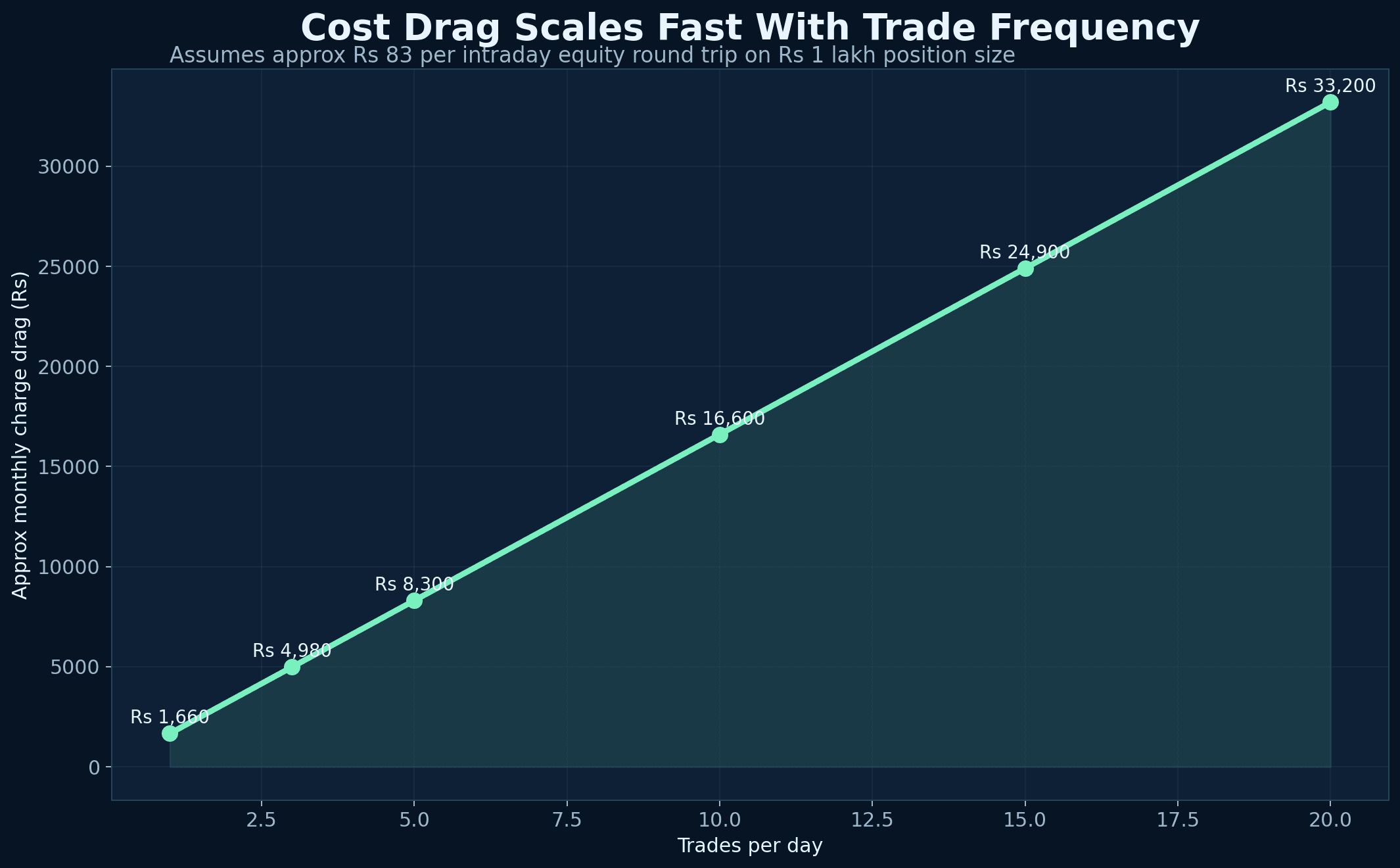
Assume a trader makes 10 intraday trades per day on a Rs. 1 lakh position per trade.
Per trade charges: approximately Rs. 83.
Daily charge drag: Rs. 83 x 10 = Rs. 830
For this trader to break even before any net profit, every single trading day requires generating at least Rs. 830 in gross profit across all 10 trades. That is before a single rupee is kept.
In a month of 20 trading days:
Monthly charge drag: Rs. 830 x 20 = Rs. 16,600
Annual charge drag: Rs. 16,600 x 12 = Rs. 1,99,200
A trader running Rs. 1 lakh per trade at 10 trades per day needs to generate roughly Rs. 2 lakh per year in gross profit just to cover transaction costs. Any profit below that is a net loss on the year, regardless of how many trades were directionally correct.
Increasing trade frequency does not reduce per-trade costs. It multiplies them. Each additional trade adds another layer of friction. A trader who is marginally profitable at 3 trades per day may become unprofitable at 10 trades per day purely from cost amplification, even if the strategy and win rate are identical.
This is the structural problem with high-frequency retail intraday trading in India. The strategy does not need to be poor for the outcome to be negative. The cost structure alone can do the damage.
Transaction Charges vs Income Tax: A Clear Separation
These are two different things. Confusing them produces bad decisions about trading structure.
Transaction charges — STT, exchange fees, GST, stamp duty, brokerage — reduce the net result of every individual trade at the time it is executed. They appear on the contract note. They are incurred whether the trade wins or loses. They cannot be deferred, offset, or avoided.
Income tax is applied separately, on the net profit generated across all trades, at the end of the financial year. The rate and treatment depend on how the trading income is classified.
For equity delivery, profits are typically classified as capital gains — Short Term Capital Gains (STCG) at 20% if held under 12 months, Long Term Capital Gains (LTCG) at 12.5% if held over 12 months, with an LTCG exemption threshold of Rs. 1.25 lakh per financial year.
For equity intraday, profits are classified as speculative business income and taxed at the applicable income tax slab rate. STT paid on intraday trades is allowed as a deduction against business income.
For F&O trading, profits are classified as non-speculative business income, also taxed at slab rate. STT on F&O is allowable as a business expense.
A trader with losses can carry them forward under specific rules — speculative and non-speculative business losses have different carry-forward treatment. Consult a qualified tax professional for your specific situation; this article provides a general overview only.
The critical point: transaction charges hit you on every trade whether or not you are profitable overall. Income tax applies only if you are net profitable after all losses and expenses. They operate on entirely different timelines and should not be conflated in break-even calculations.
Common Misconceptions About Trading Costs in India
"Brokerage is the only cost"
Brokerage is often the smallest component of the total cost stack. In an intraday equity trade, STT at 0.025% on the sell side alone can exceed the brokerage at a discount broker. In futures, STT at 0.05% on notional contract value dominates everything else.
"If I win more than 50% of my trades, I should be profitable"
Not necessarily. A 60% win rate with average wins of Rs. 200 and average losses of Rs. 250 produces a negative expectancy. When transaction charges reduce the average win further and increase the effective average loss, a strategy that looks marginally profitable on paper becomes unprofitable in execution. Win rate tells you only part of the story. Expectancy after charges is the number that matters.
"Small daily profits add up"
They do, but so do charges. A trader targeting Rs. 200 per trade gross must first clear the Rs. 83 charge hurdle on each trade. That means the target is not Rs. 200 — it is Rs. 283 gross to net Rs. 200. Many traders set gross targets without accounting for this adjustment.
"Charges are negligible for active traders"
For a trader doing 10 trades per day at Rs. 1 lakh per position, charges are approximately Rs. 2 lakh per year. Whether that is negligible depends on whether the strategy is generating substantially more than Rs. 2 lakh annually. For many retail traders, annual charge drag is a significant multiple of annual net profit, or exceeds it entirely.
"Options are cheap to trade because premiums are small"
Small premiums make fixed brokerage (Rs. 20 per order) disproportionately expensive as a percentage of the trade value. A Rs. 5 premium option bought and sold costs Rs. 49-52 in charges against a Rs. 1,000 total premium outlay, which is a 5% charge rate before even considering whether the trade is profitable. Low-premium options trading requires larger moves to overcome a proportionally larger cost burden.
A Practical Framework for Thinking About Cost Efficiency
Before taking any short-term trade, it is worth knowing three numbers:
- Your estimated total charges for this trade (brokerage + STT + exchange + GST + stamp).
- Your minimum gross profit target (charges x some sensible multiple, typically at least 2-3x charges to make the trade economically worthwhile).
- Your breakeven price move (what price change is needed to cover charges, calculated before entry).
These three numbers take under two minutes to estimate for a given position size and segment. Knowing them before every trade creates an immediate filter: if the realistic expected gross move on this trade is smaller than the breakeven price move, the trade should not be taken regardless of how attractive the chart looks.
This is not overcautiousness. It is the arithmetic of sustainable trading.
If you want to connect this directly to performance review, the next useful reads are R-Multiple Mastery and How to Review Your Trades Weekly. Cost drag changes expectancy, and expectancy only becomes visible when gross and net outcomes are reviewed honestly.
Key Takeaway
Short-term trading in India is not structurally impossible. But the cost structure is real, it is unavoidable, and it is larger than most traders consciously account for.
The market does not ask only whether you can predict direction. It asks whether your gross edge on each trade is large enough to survive the charges that apply whether the trade wins or loses.
Every trade carries a break-even hurdle. In intraday equity, that hurdle is approximately 0.083% of capital deployed. In futures, it is roughly Rs. 1,000 gross profit per lot at current STT rates. In low-premium options, fixed brokerage alone can represent 4-5% of the total premium outlay on a round trip.
Frequent trading multiplies these costs. A strategy with a marginal edge at low frequency may become a net losing strategy at high frequency purely from cost accumulation.
The traders who survive and compound in Indian short-term markets are not those who ignore costs. They are those who build setups with sufficient gross edge to clear the hurdle, trade selectively enough that cost drag does not swamp the strategy, and understand exactly what they are paying before every trade.
Frequently Asked Questions
Why are trading charges so high in India?
The charge burden in India comes from multiple layers simultaneously — a government tax (STT), exchange fees, a regulator fee (SEBI), GST on services, and stamp duty. None of these is particularly large individually. Their combined effect on a trade with a small gross move is what creates the visible drag. Most mature markets have similar multi-layer cost structures. India's STT rate on futures notional value is particularly significant for F&O traders.
How much profit do intraday charges eat?
On a Rs. 1,00,000 intraday equity position with a Rs. 20 flat brokerage broker, total charges are approximately Rs. 82-85 per round trip. On a gross profit of Rs. 400 (a 0.40% move), charges consume about 20% of the gross. On a Rs. 200 gross profit (0.20% move), charges consume about 41%. The smaller the gross move, the higher the percentage consumed by charges.
What is the break-even point after brokerage and taxes?
For equity intraday on Rs. 1 lakh: approximately Rs. 83 gross profit, or a price move of about 0.083%. For Nifty futures (1 lot at approximately Rs. 16-17 lakh notional): approximately Rs. 1,000 gross profit, or roughly 13-14 index points. For options, the break-even depends heavily on premium size and brokerage structure.
Are options trading charges lower or just misleading?
Options STT (0.15% on premium for short options) is lower in absolute terms than futures STT (0.05% on notional contract value). But for low-premium options, fixed brokerage creates a disproportionate charge burden. A Rs. 5-premium option round trip at Rs. 20 per order costs Rs. 40 in brokerage against Rs. 1,000-1,200 in total premium traded — a 3.3-4% brokerage rate equivalent. Options are not universally cheaper. It depends on the premium level and the broker's structure.
Is swing trading more cost-efficient than intraday trading?
For equity delivery, STT is higher (0.1% on both sides versus 0.025% intraday on sell only), but zero brokerage with discount brokers partially offsets this. The key advantage of delivery trades is that larger gross moves are expected — a 3-5% swing trade carries charges that represent a much smaller percentage of gross profit compared to a 0.30% intraday trade. As a percentage of expected gross profit, delivery swing trading is generally more cost-efficient than intraday scalping, assuming the move is large enough to justify holding overnight risk.
All charge rates in this article are sourced from Zerodha's published charges page, NSE circulars, and SEBI regulatory filings. Rates for F&O STT reflect Budget 2026-27 changes effective April 1, 2026. Rates may vary by broker, exchange, and are subject to change. Readers are advised to verify current rates with their broker before trading. This article is for educational purposes only and does not constitute financial or tax advice. Consult a qualified tax professional for guidance specific to your situation.
Spread the good words
Give your view.
Give your view
Comments
0Use this insight inside the product
TradInvest is built to connect market context, strategy quality, and post-trade learning. Read the market with Pulse, narrow your watchlist with rotation and momentum, then review what actually worked.