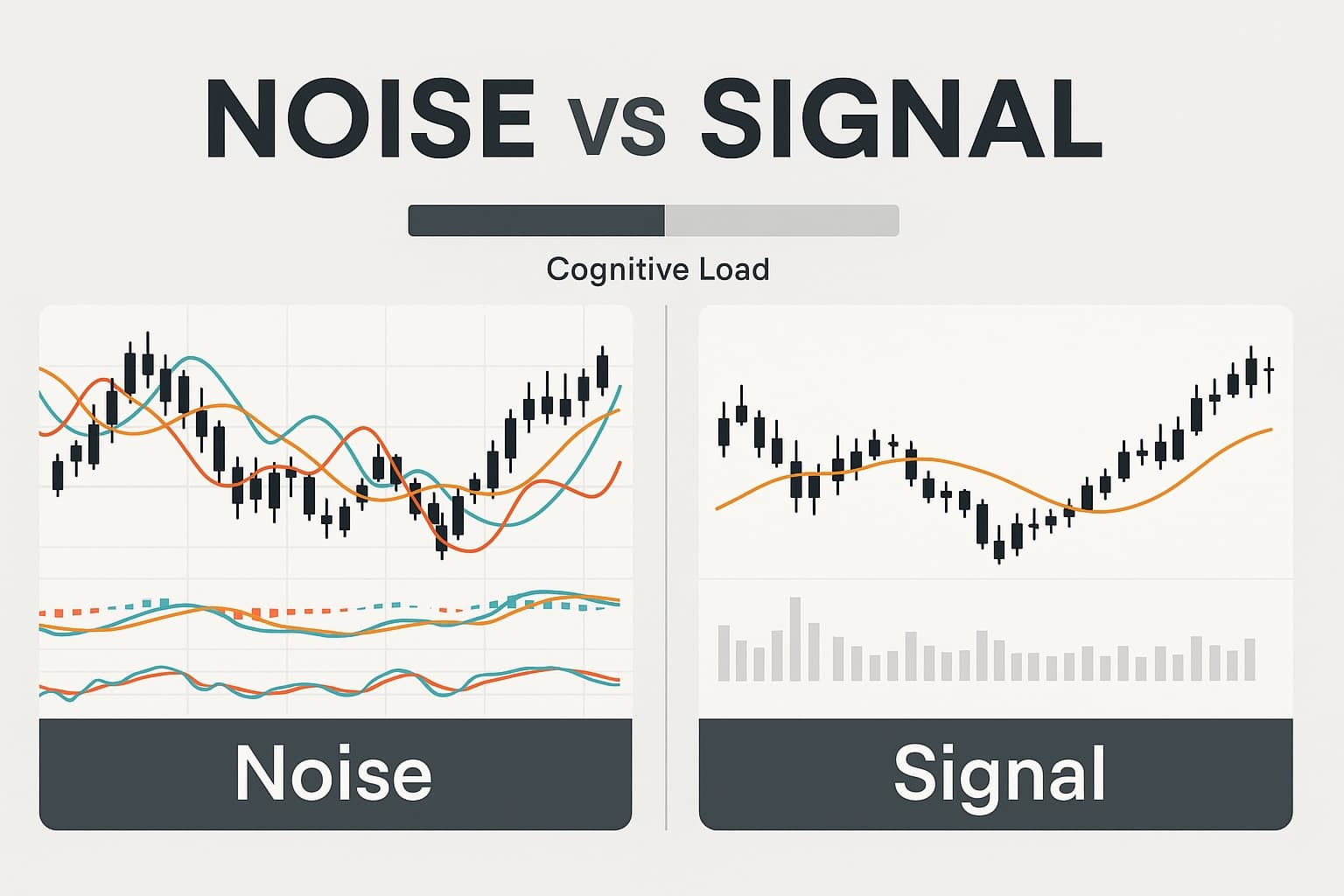
Most traders feel the same trap: more indicators, more noise, less clarity. Volume Price Analysis (VPA) flips that script. It uses only two clues — price and volume — to read the market’s true intent. This approach dates back to Richard Wyckoff and still works because it’s rooted in human behavior, not temporary tech edges.
In this guide you’ll learn:
- Why markets often look “manipulated,” and why that’s actually useful.
- The two signals that reveal real participation vs. fake moves.
- How insiders accumulate and distribute using predictable campaigns.
- A simple checklist to decode the market’s next move.
1. The Market Is Managed — And That’s Your Edge
Let’s say it plainly: markets are influenced by insiders, specialists, and market makers. This isn’t conspiracy; it’s structure. The Parable of Uncle Joe explains it best.
Imagine Uncle Joe is the only wholesaler of widgets in your state. His job is to buy low and sell high. To buy low, he doesn’t need to create news — he just leverages emotion. He whispers “supply is tight,” triggering a buying frenzy. Once he sells high, he later confirms a negative rumor so everyone panics and sells back to him at a discount.
That is precisely how professional operators work: they accumulate when fear is high and distribute when greed is loud. Your advantage is not fighting this reality — it’s following it.
2. The Only Two Indicators That Matter: Price + Volume
In the age of AI and complex indicators, the strongest signal is still the oldest: price and volume together. Alone they’re noisy. Together they reveal intent.
Wyckoff, Dow, and Livermore built fortunes reading price and volume because those are the only two inputs the market cannot fake for long. Price can be pushed around. Volume cannot be fabricated at scale.
As Livermore noted, “There is nothing new in Wall Street.” Human psychology repeats. That’s why a 100-year-old framework still outperforms most modern noise.
3. Volume Is the Market’s Lie Detector (VPA 101)
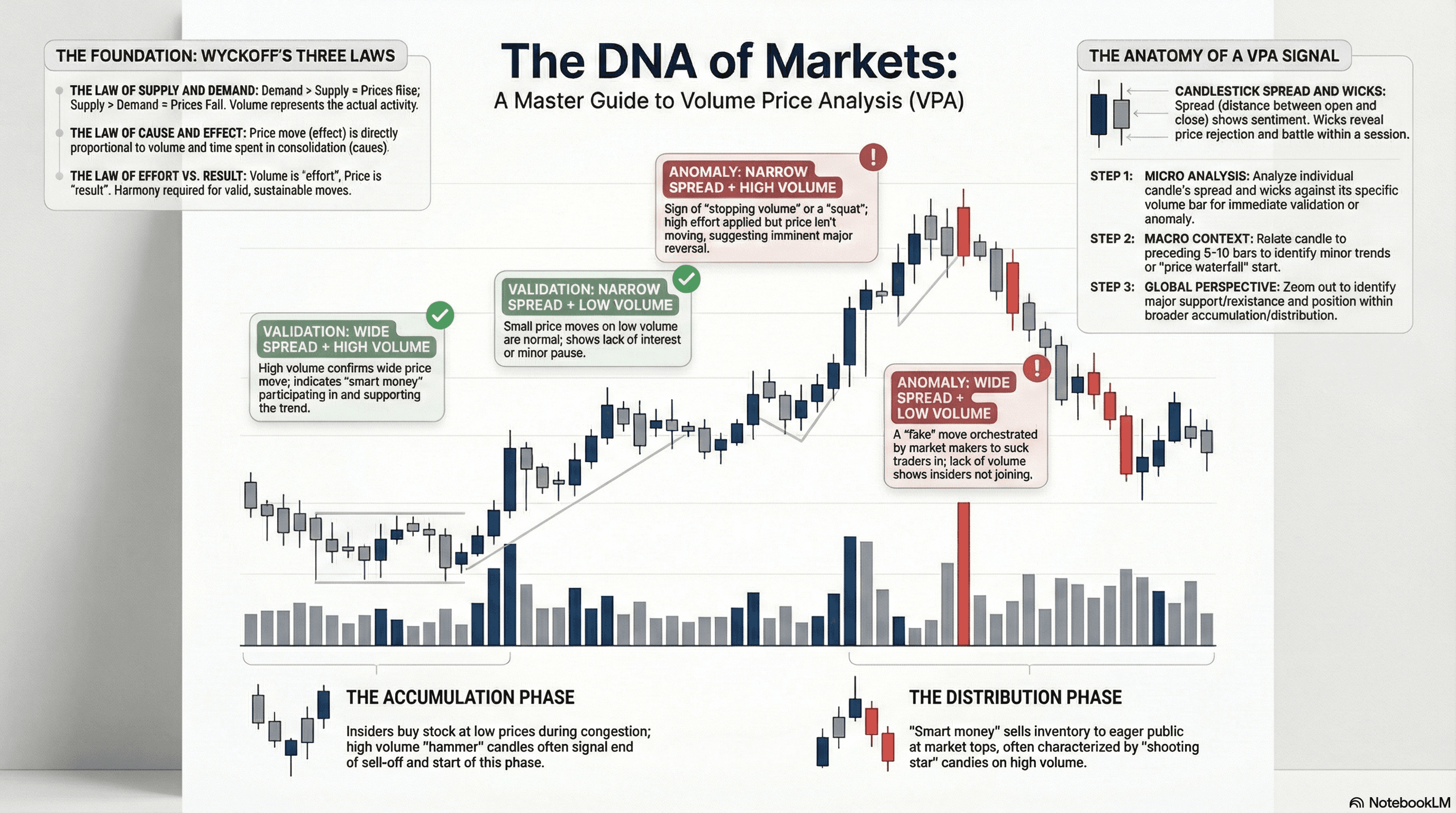
Wyckoff’s Law of Effort vs. Result is the heartbeat of VPA:
- Effort = volume
- Result = price movement
When effort and result agree, the move is real. When they diverge, the move is suspect.
Key VPA signals:
- Confirmation: Price rises with strong volume. Trend is real.
- Anomaly: Price rises on low volume. Trend is weak and likely a trap.
Think of it like trying to drive uphill on ice: lots of effort, no progress. That’s an anomaly. It signals insiders are not participating.
4. Insiders Telegraph Intentions With “Tests”
After accumulation, insiders need to ensure sellers are exhausted before driving price higher. So they run a test.
A test is a quick push downward on low volume. If selling pressure is absent, the test passes. That’s often the strongest buy signal you’ll ever see because it shows supply has been absorbed.
Low-volume tests are the market’s final “all clear” before a real advance begins.
5. Campaigns Are Designed to Manipulate Your Emotions
Wyckoff campaigns aren’t about charts; they’re about psychology. The pattern is always the same:
- Accumulation (fear phase): Bad news, falling prices, panic selling.
- Distribution (greed phase): Good news, rising prices, FOMO buying.
Insiders profit because they push the public to do the opposite of what works. Once you see that pattern, you stop reacting emotionally and start reading intent.
Conclusion: Read the Footprints, Not the Headlines
The market is not random — it’s a story written in price and volume. By learning VPA and Wyckoff logic, you stop guessing and start reading footprints.
You don’t need more indicators. You need better observation.
Now that you can spot accumulation, tests, and distribution, where will you look first for insider footprints?
Spread the good words
Give your view.
Give your view
Comments
0Use this insight inside the product
TradInvest is built to connect market context, strategy quality, and post-trade learning. Read the market with Pulse, narrow your watchlist with rotation and momentum, then review what actually worked.
Related posts
More insight tied to the same trading workflow.